Key takeaway: In January 2026, Stanford researchers showed that an AI model reading one night of lab sleep data could rank people's risk for 130 conditions, including dementia, heart failure and death from any cause. A full night of sleep recording holds far more medical information than sleep medicine has ever used. The most useful signal was not any single measurement but the moments when the body's systems fell out of step with each other. The model is not ready for clinics, and the harder question is who will be allowed to read the forecast once it is.
The detail I can't get past is the paper.
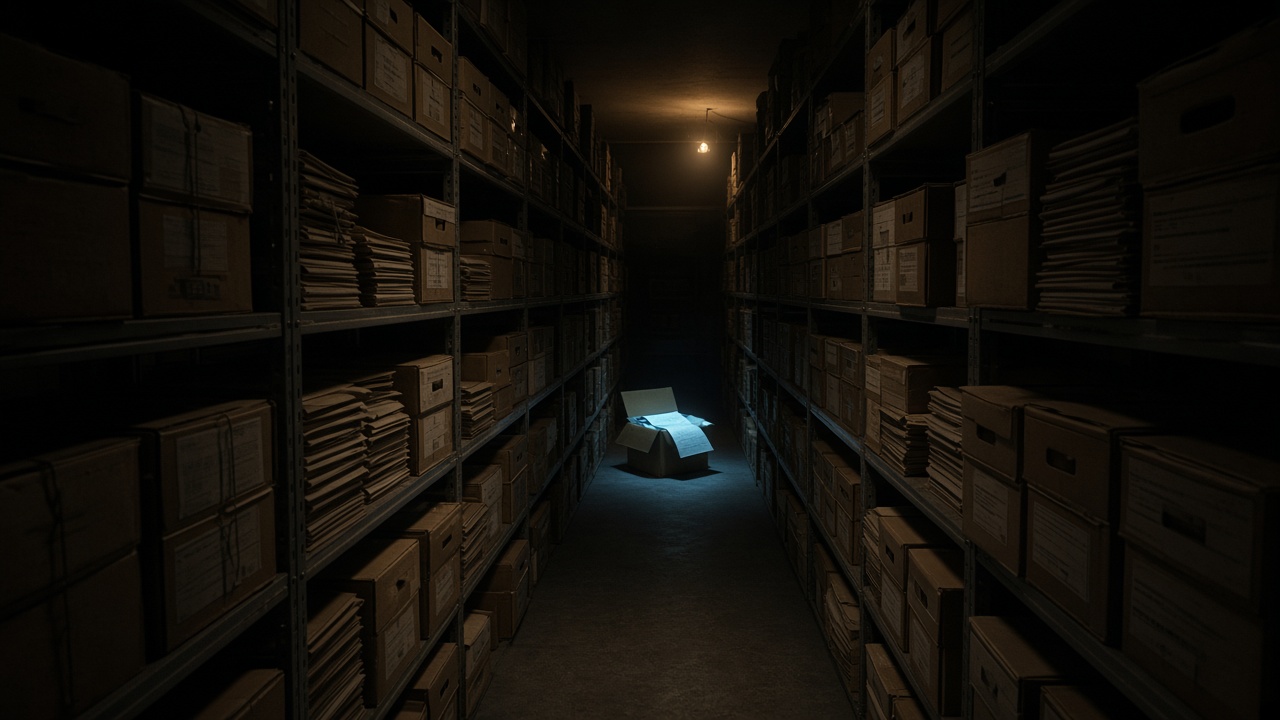
Stanford's sleep clinic was founded in 1970 by William Dement, widely considered the father of sleep medicine. The Stanford patients in a new AI study published this January were recorded between 1999 and 2024. The clinic's recordings go back further, Emmanuel Mignot told the university's news office, but only on paper. ¹ Decades of human nights, preserved as squiggles that no computer was ever going to read.
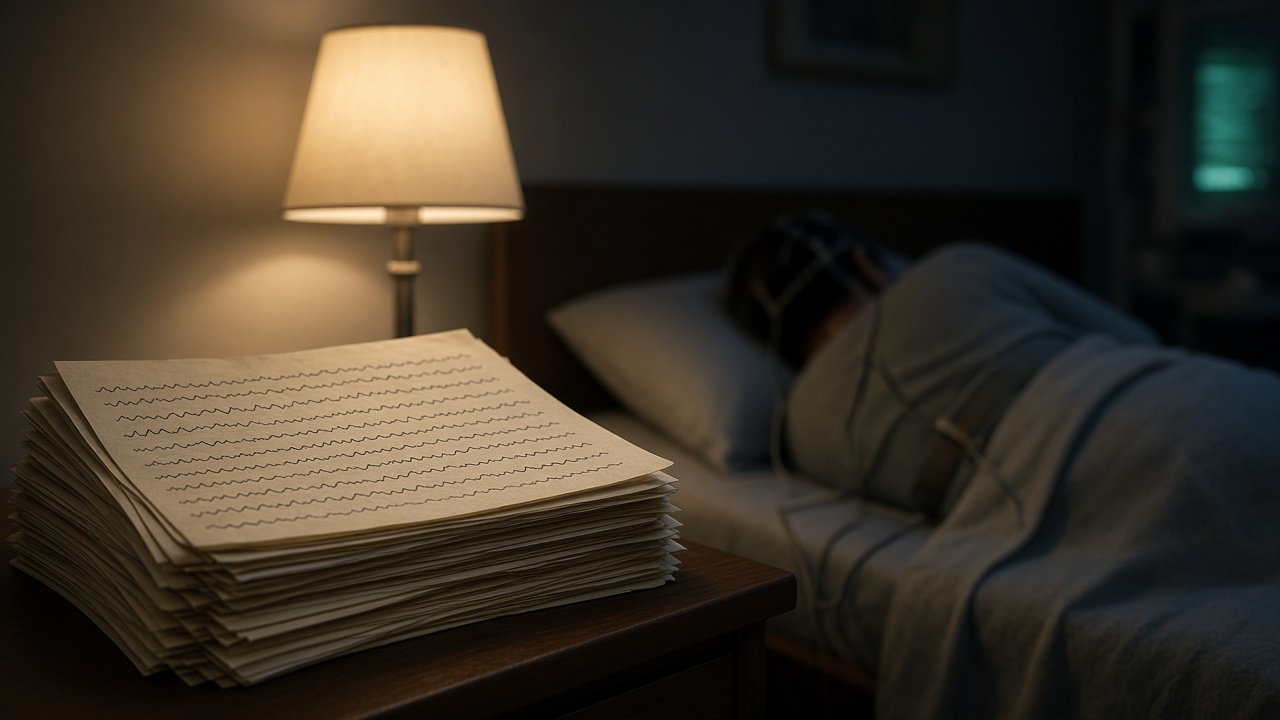
If you have had a sleep study, you know the setup. Wires glued to your scalp, a belt around your chest, a clip on your finger, a sensor under your nose, and a room that is trying very hard to look like a hotel and failing in the way only hospitals can. You lie there convinced you will never fall asleep with all this on. Then you do. In the morning, someone tells you whether you stop breathing at night.
That is mostly what the night is for. How often your breathing stalls, how badly, and maybe a breakdown of your sleep stages. Eight hours of your brain, heart, lungs, muscles and eyes reporting in, and the clinical question at the end is, roughly, apnea or no apnea.
I used to think that was efficient. Now I think it is one of the more expensive habits in medicine.
Call it the unread night
Mignot, who directed the Stanford sleep centre from 2010 to 2019, describes a sleep study as a kind of general physiology: eight hours of recording from a person who cannot go anywhere. ¹ Few other tests watch the whole body for that long, in that much detail, while it does nothing to manage the impression it is making. And only a fraction of what gets recorded is ever used.
So his team, with the biomedical data scientist James Zou and collaborators in Denmark and at Harvard, tried using all of it. They built a model called SleepFM and trained it on more than 585,000 hours of polysomnography, the full overnight lab recording, from about 65,000 people. ² The model chopped each night into five-second slices and treated them roughly the way a language model treats words. ¹ The largest group, about 35,000 Stanford patients aged 2 to 96, came with electronic health records offering up to 25 years of follow-up. ¹
Then the researchers asked the night to predict the future. Out of more than 1,000 disease categories in those records, the model could forecast 130 with a concordance index of at least 0.75.¹² The concordance index works like this: take any two patients, ask the model which one will develop the condition first, and count how often it is right. At 0.84 for death from any cause, 0.85 for dementia, 0.80 for heart failure and 0.78 for stroke, the model ranked those pairs correctly far more often than chance. ² Stanford's announcement lists Parkinson's disease at 0.89.¹ The model also held up on the Sleep Heart Health Study, a dataset it never saw during training.²
One night of sleep, read in full, carries information about conditions far outside sleep medicine, from heart failure to dementia.
That is half the problem. The other half is the nights we never record at all.
In 1997, researchers at the University of Wisconsin estimated, from a sample of 4,925 employed adults, that 82% of men and 93% of women with moderate to severe sleep apnea had never been clinically diagnosed. These were people, the authors noted, without obvious barriers to health care. ³ That estimate is nearly thirty years old, and the diagnosis has likely improved since, but the scale has not shrunk. A 2019 analysis in The Lancet Respiratory Medicine put the number of adults aged 30 to 69 with obstructive sleep apnea at 936 million worldwide, 425 million of them with moderate to severe disease. ⁴
So the waste runs both ways. We underread the nights we record, and we fail to record most of the nights that matter.
Listen for the disagreements.
Most people know a particular kind of bad night. The eyes are heavy, the body is flat on the mattress, and something inside is still running, a pulse you can hear in the pillow. Asleep, technically. Not quite at rest.
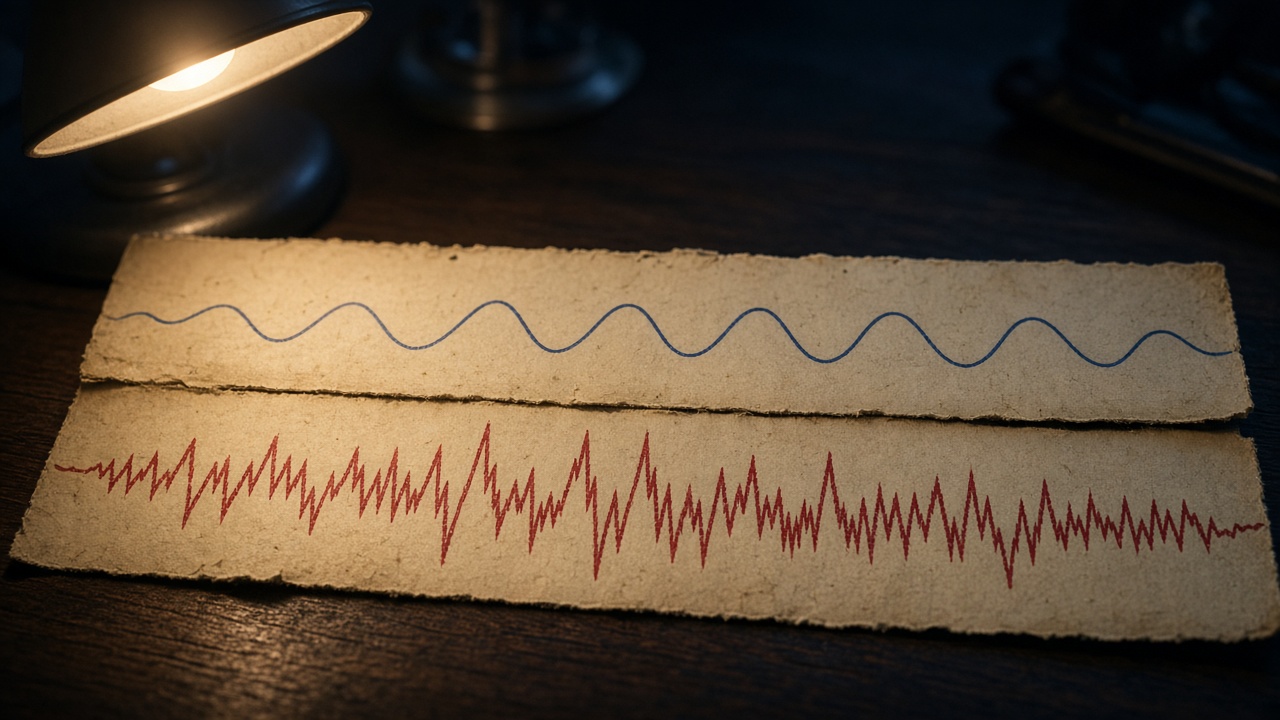
That feeling turns out to sit close to the most interesting finding in the Stanford work. Heart signals mattered more for predicting heart disease, and brain signals mattered more for mental health conditions, as you would expect. The most accurate predictions came from combining the channels, and the most informative moments, the team reported, were the ones where the body was out of sync: a brain that looks asleep paired with a heart that looks awake. ¹
I think of it as the out-of-sync body. Health shows up less in any single reading than in the places where your systems stop agreeing about what is happening.
The strongest warning signs in sleep data appear when the body's systems disagree with each other, not in any one measurement.
That reframes what a useful sleep product even is. Most popular consumer sleep trackers lead with a single tidy number. If the information lives in the disagreement between signals, a single number is exactly the format that averages it away. You end up with a score that says 82 while your heart and brain spent part of the night arguing.
And the consumer side is clearly moving toward the clinic. In September 2024, the FDA cleared Apple's sleep apnea notification feature for the Apple Watch; Samsung's sleep apnea feature is listed under the same device category. ⁵
Apple's own validation study is worth reading closely, because it is honest about the tradeoff. Across a prospective study of 1,499 adults, the feature caught 66.3% of people with moderate to severe apnea and correctly cleared 98.5% of those without it. ⁵ Broken down, it flagged 164 of 184 people with severe apnea, about 89%, but only 89 of 205 with moderate apnea, about 43%. ⁵
Apple deliberately tuned it to avoid false alarms. That is a defensible choice for a feature meant to run passively on ordinary wrists. It also means a watch hears a few channels of what a lab hears and misses most of the quieter cases.
The Stanford team names wearable data as one possible way to improve the model. ¹ That is the moment the unread night stops being a lab curiosity and starts being something that happens in your bedroom every night, whether or not anyone asked for a forecast.
Where I have to argue with myself
I want to be careful, because the case for reading every night in full is weaker than the headline numbers make it look.
In September 2026, a group of ten researchers led by Annina Helmy published a commentary in SLEEP reviewing the current crop of sleep foundation models. Their verdict: the training cohorts were consistently skewed toward older patients, mostly from a single ethnic group, who already had other illnesses. Evaluation methods varied from paper to paper, and disease prediction claims were hard to interpret without checking how much of the result came from age and demographics alone.
When they ran an existing sleep foundation model, untuned, on 51 patients with narcolepsy type 1 and 28 healthy controls, its sleep representations added minimal improvement over demographic baselines. Their conclusion was that these models are not yet suitable for clinical use. ⁶
That critique lands. Think about who ends up in a sleep clinic in the first place: people sent there because someone already suspected something was wrong. A model trained on referred patients learns the nights of people someone was already worried about. Whether it reads a healthy 35-year-old's night as well is an open question.
There is also the problem of explanation. "It doesn't explain that to us in English," Zou said of the model's predictions. ¹ His team has built techniques to see which signals the model weighs, which helps. Still, a ranking without a reason is a strange thing to hand a patient. A dementia forecast with a concordance of 0.85 is a remarkable result in a paper. On a Tuesday afternoon in a doctor's office, with few ways to act on it, it is mostly a new thing to lie awake about.
So the honest version of my argument is narrower than my headline. The night is underread. The reading is not ready. Both are true, and the second one will not stay true for long.
Who gets to read the forecast?
Here is the part I don't think enough people are asking about.
If one night of data can rank who is more likely to die first, the most motivated readers of that ranking will not be patients. In the United States, the law written specifically to stop predictive health information from being used against people is the Genetic Information Nondiscrimination Act of 2008. It covers genetic information in health insurance and employment. Its health coverage protections do not extend to life insurance, disability insurance or long term care insurance, though some states add protections of their own. ⁷
A sleep recording is not genetic information. As far as I can tell, an algorithm that ranks your mortality risk from your breathing and heart rhythm falls outside that law entirely. Life insurers have always wanted to know how you will die. Until now they have had to make do with a blood panel and a questionnaire you filled out optimistically.
The unread night was, in a strange way, a privacy protection. Nobody could misuse what nobody could read. That protection is ending, and nothing has been built to replace it.
My bet
Within five years, a full night recording read by a model like SleepFM will be sold as a general health screen, marketed for heart and brain risk rather than for snoring. The first organization to read your night in full won't be your sleep doctor. It will be whoever pays for the screen, and often that will be an insurer.
Regulators won't get there first. They will arrive after the first pricing scandal, holding a law written for DNA.
What is SleepFM? SleepFM is an AI foundation model built by Stanford Medicine researchers and collaborators, published in Nature Medicine in January 2026. It was trained on more than 585,000 hours of overnight sleep lab recordings from about 65,000 people and can forecast risk for 130 conditions from a single night of data.
Can one night of sleep really predict future disease? In research settings, yes, to a useful degree. SleepFM ranked patients' risk of dementia, heart failure, stroke and death from any cause with concordance scores between 0.78 and 0.85. Independent researchers caution that sleep foundation models are trained on older, sicker patients and are not yet ready for clinical use.
What is polysomnography? Polysomnography is the full overnight sleep study done in a lab. It records brain activity, heart rhythm, breathing, muscle activity, eye movements and blood oxygen at the same time, and it is the gold standard for diagnosing sleep disorders such as sleep apnea.
What does a concordance index of 0.8 mean? It means that if you take any two people, the model correctly predicts which one will develop the condition first about 80% of the time. A score of 0.5 is a coin flip.
Can an Apple Watch detect sleep apnea? It can flag likely moderate to severe sleep apnea, but it misses many cases. In Apple's validation study, the feature caught 66.3% of people with moderate to severe apnea, including about 89% of severe cases but only about 43% of moderate ones. No notification does not mean you don't have apnea.
Can insurers use sleep data against me? In the United States, the main federal law against predictive health discrimination, GINA, covers genetic information only, and even then not for life, disability or long term care insurance. Sleep data is not genetic information. What a given insurer can do depends on the type of insurance and on state law.
¹ Nina Bai, "New AI model predicts disease risk while you sleep," Stanford Medicine News Center, 6 January 2026. Source for the paper records detail, the 35,000 patient Stanford cohort, the concordance index explanation, the Parkinson's figure, the out of sync finding and the Zou quote.
² Thapa, Kjaer et al., "A multimodal sleep foundation model for disease prediction," Nature Medicine 32, 752 to 762 (2026). 130 conditions with concordance index and AUROC of at least 0.75 (Bonferroni corrected P < 0.01) on held out participants, six year horizon for AUROC.
³ Young, Evans, Finn and Palta, "Estimation of the clinically diagnosed proportion of sleep apnea syndrome in middle-aged men and women," SLEEP 20(9), 705 to 706 (1997). In laboratory polysomnography on a subset of 1,090 participants.
⁴ Benjafield et al., "Estimation of the global prevalence and burden of obstructive sleep apnoea: a literature-based analysis," The Lancet Respiratory Medicine (2019). Based on AASM 2012 criteria; a sensitivity analysis gave a lower estimate of 730 million.
⁵ US FDA 510(k) K240929, Apple Sleep Apnea Notification Feature, decision date 13 September 2024; Apple, "Estimating Breathing Disturbances and Sleep Apnea Risk from Apple Watch," September 2024. Reference was a home sleep apnea test (Nox T3s). 1,278 of the 1,499 enrolled participants contributed to the notification analysis. Samsung Sleep Apnea Feature listed under the same FDA product code (QZW) in the FDA device database.
⁶ Helmy, Morand, Calzoni, Dei Rossi, Fiorillo, Bassetti, Faraci, Mougiakakou, Tzovara and Schmidt, "Foundation Models in Sleep Research: Opportunities and Limitations," SLEEP, published 15 September 2026.
⁷ National Human Genome Research Institute, "Genetic Discrimination," genome.gov.
- Stanford Medicine News Center: https://med.stanford.edu/news/all-news/2026/01/ai-sleep-disease.html
- Nature Medicine (Thapa, Kjaer et al. 2026): https://www.nature.com/articles/s41591-025-04133-4
- SLEEP (Young et al. 1997): https://pubmed.ncbi.nlm.nih.gov/9406321/
- The Lancet Respiratory Medicine (Benjafield et al. 2019): https://pmc.ncbi.nlm.nih.gov/articles/PMC7007763/
- FDA 510(k) K240929: https://www.accessdata.fda.gov/cdrh_docs/pdf24/K240929.pdf and Apple validation paper: https://www.apple.com/health/pdf/sleep-apnea/Sleep_Apnea_Notifications_on_Apple_Watch_September_2024.pdf
- SLEEP (Helmy et al. 2026): https://academic.oup.com/sleep/advance-article/doi/10.1093/sleep/zsag225/8796016
- genome.gov: https://www.genome.gov/about-genomics/policy-issues/Genetic-Discrimination