

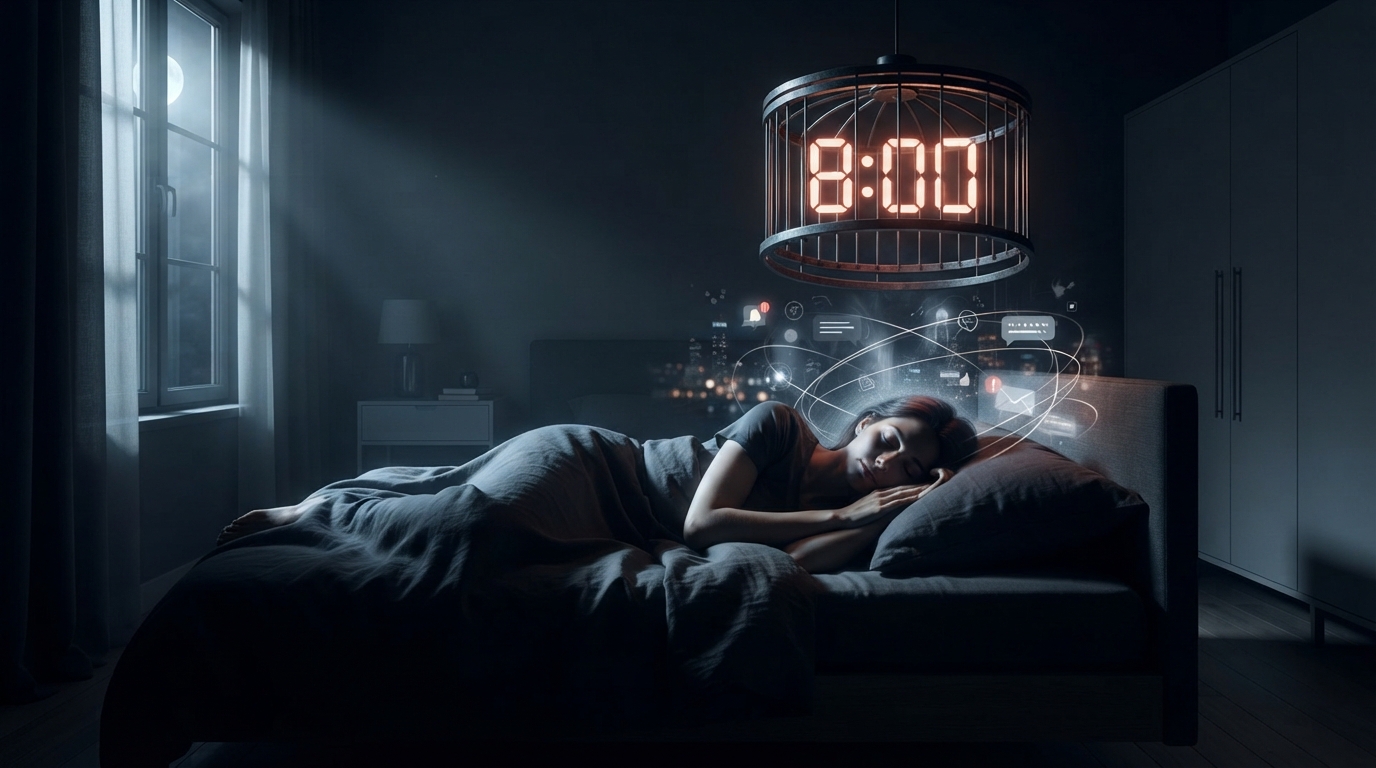
Key takeaway: Hitting eight hours in bed does not guarantee restorative sleep. Fragmented sleep, an inconsistent schedule, evening stimulation, and unmanaged stress can all produce a full night that still leaves you exhausted. The fix usually isn't more sleep. It's better sleep continuity.
I did the math last winter, out of pure spite. Eight hours a night, seven nights a week, and I still woke up like someone had unplugged me overnight and forgotten to plug me back in. I had followed every instruction I'd ever been given about sleep. Lights off by eleven. No party. No doomscrolling until dawn. And the alarm still landed like a personal insult.
If that sounds familiar, you are not broken, and you are not imagining it. You can sleep for eight hours and still not get eight hours of rest, because duration and restoration are measured differently by your body than they are by your clock. That gap between the two is where most of this tiredness lives.
Hours were never the whole story.
Eight hours became the answer to sleep, and the way "eat less, move more" became the answer to weight loss. Technically true. Almost useless in practice.
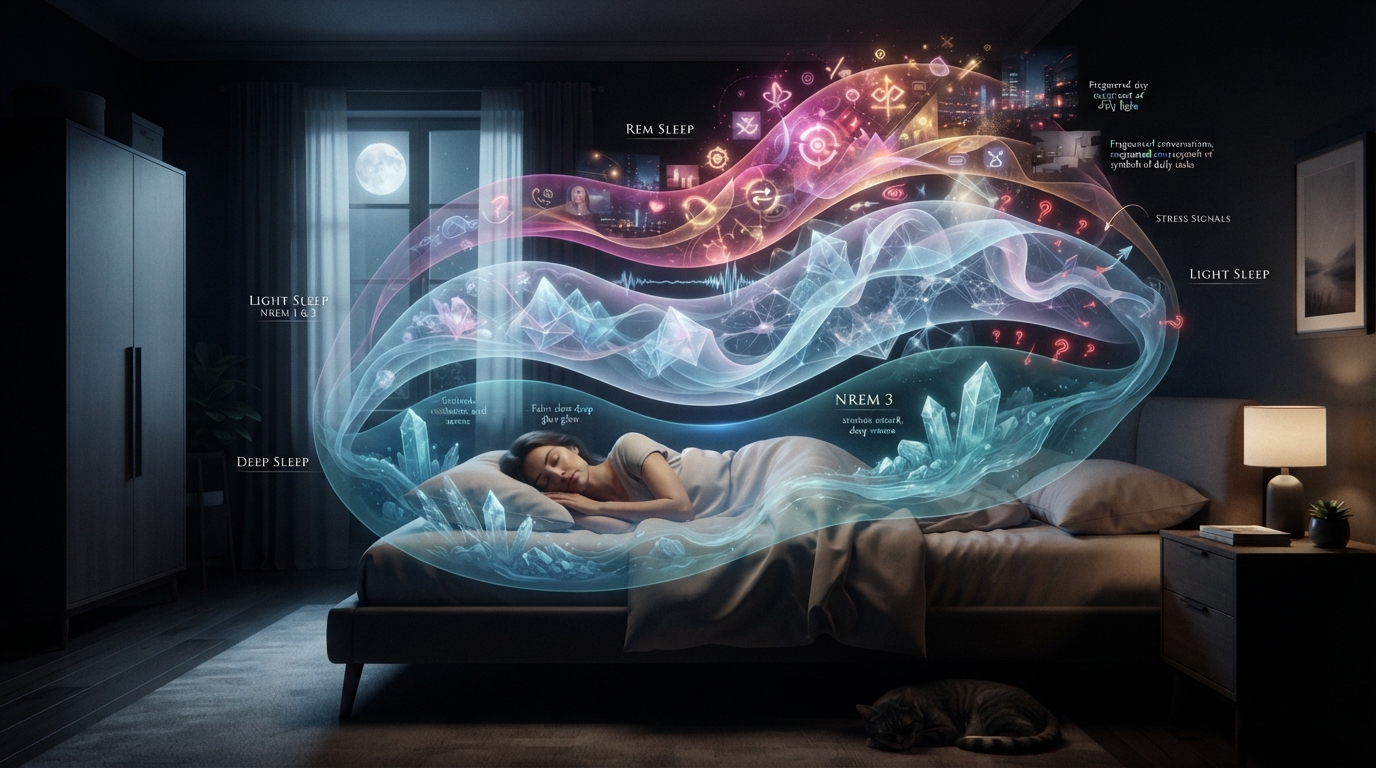
Your body doesn't experience the night as one flat block of unconsciousness. It cycles through stages, lighter sleep, deep sleep, and REM, each doing different work. Deep sleep handles physical repair. REM handles memory consolidation and emotional processing. If those cycles get interrupted, cut short, or badly timed, you can rack up eight hours in bed without moving through them the way you're supposed to.
Here's the part that took me a while to accept: two people can lie down at the same time, sleep the same number of hours, and wake up in completely different conditions. One gets up ready to answer emails before coffee. The other feels like they fought something in their sleep and lost. The national data backs this up more bluntly than I expected. In 2024, only 54.8% of American adults said they woke up feeling well rested most days, even though a majority of adults are technically sleeping something close to the recommended range. ¹ Almost half the country is doing the time and still not getting the reward.
Think of sleep like a phone left charging overnight. Eight hours plugged in should mean a full battery in the morning. But if the cable keeps loosening, or the outlet cuts out, or something is quietly draining power the whole time, you wake up to 61% and no idea why. Your body can do the same thing to you, minus the helpful percentage readout.
Where the eight hours actually go wrong
Fragmented sleep is one of the most common and least visible culprits, since brief awakenings can happen throughout the night without leaving any memory of them. Noise, temperature shifts, a restless partner, a notification buzzing somewhere in the room. None of it has to fully wake you to disrupt the architecture of the night. You remember eight hours. Your nervous system remembers something choppier.
Then there's the schedule itself. Ten at night to six in the morning during the week, then a slide into two or three in the morning once Friday hits, is a version of jet lag you gave yourself voluntarily. The weekly average might look fine on paper. Your circadian rhythm does not grade on a curve. It expects consistency, and when it doesn't get it, you can sleep a completely reasonable number of hours and still wake up feeling like you crossed four time zones without leaving your bed.
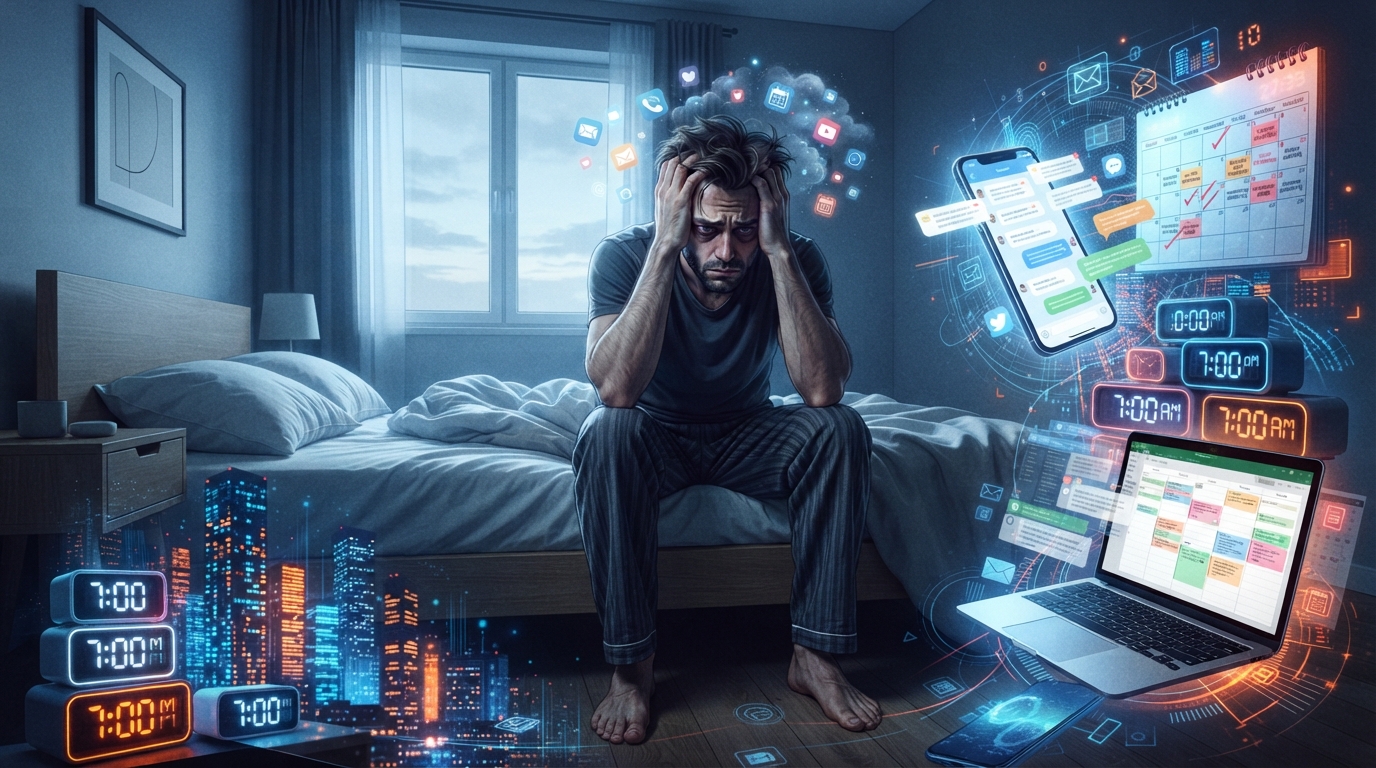
Mental load is the harder one to diagnose because it doesn't show up on a sleep tracker. You can put your body down at eleven and leave your mind running the tab on everything you didn't finish today. Work. Money. The message you still haven't answered.
Chronic stress is associated with lower sleep quality even when total sleep time stays the same, which is exactly why a full night can still feel unrefreshing. The cycle is almost too clean: stress disrupts sleep, disrupted sleep produces more stress the next day, and the next night arrives already compromised.
Evening technology deserves its own paragraph, mostly because it earns it. A century ago, darkness gave your environment a clean, obvious signal that the day was ending. Now you can lie in bed lit by a screen, half watching something, half replying to a message, half remembering a task you forgot, and expect your brain to flip a switch the second you put the phone down. It generally does not work like a light switch. It works more like a dimmer that someone else is controlling.
And then there's caffeine, which is where people are most confidently wrong. Caffeine's half life runs roughly four to six hours in most adults, and clinical studies find sleep disruption is consistently reported when it's consumed within about three hours of bedtime. ² That 3 p.m. coffee you swear "doesn't affect you anymore" is often still partially in your bloodstream at midnight, quietly keeping the lights on in a room you thought you'd turned off.
It's not a sleep debt. It's a continuity problem.
I think of this as a continuity budget rather than a sleep debt. A debt implies the fix is simple: sleep more, pay it down, and balance is restored. Continuity doesn't work that way. You can add two extra hours to a night that's already fragmented nine times and just end up with a longer version of the same broken pattern. More time in the same disrupted loop isn't rest. It's overtime.
This is where the piece has to complicate itself a little, because I don't want to hand you a tidy story that isn't true. Chasing "sleep quality" too hard has its own failure mode. There's a documented pattern, sometimes called orthosomnia, where people become so fixated on optimizing their sleep scores that the anxiety of monitoring it starts interfering with the sleep itself. So no, the answer isn't to buy a $400 ring and stare at your REM percentage every morning like it's a stock ticker. The goal is awareness, not surveillance.
Mornings complicate the picture too. Sleep inertia, the grogginess right after waking, especially out of deep sleep, can be dramatic enough that your first five minutes awake tell you almost nothing reliable about how you actually slept. Judging the whole night by how your brain feels ninety seconds after the alarm is a bit like judging a movie by the opening logo.
When it's not a habit problem at all
Sometimes the explanation isn't lifestyle at all, and this is the part worth taking seriously rather than skimming past. Obstructive sleep apnea is far more common than most people assume and far more underdiagnosed. Newer prevalence estimates put the number at roughly 83.7 million US adults, about 32% of the adult population, living with OSA as of 2024, with the disease remaining largely unrecognized and untreated. ³ That's not a rare condition hiding in the corner. That's nearly one in three adults, many of whom have never been told, because the interruptions in breathing happen while they're unconscious and leave no memory behind.
If you snore heavily, gasp during sleep, wake with headaches, or feel persistently exhausted no matter what you adjust, that's a conversation for a doctor, not another article. Fatigue is a symptom. It is not, on its own, a diagnosis, and treating it like one by endlessly tweaking your bedtime routine can mean missing something that actually needs medical attention.
What's actually worth trying
Fixing tiredness usually starts with sleep consistency, not sleep quantity, since a stable schedule improves circadian alignment even before total hours change. A few things are worth doing before anything more elaborate:
Keep roughly the same sleep and wake time, weekends included. Give yourself a genuine wind-down period before bed, without your inbox in the room. Notice when your last caffeine actually is, not when you think it stopped mattering. Keep the bedroom dark, cool, and quiet, which sounds almost insultingly basic and works anyway. Get outside during the day, since daylight is one of the strongest signals your circadian rhythm actually listens to. And stop treating constant exhaustion as a personality trait. It isn't one.
None of this is a novel philosophy. It's closer to maintenance than transformation, which is probably why people skip it in favor of buying a new mattress instead.
The number was never the point.
Somewhere along the way, sleep got flattened into a single digit because a single digit is easy to put on an app, a wellness poster, or a listicle. Eight hours. Clean, memorable, and wrong often enough to matter.
Your body was never going to respect a spreadsheet. It responds to continuity, timing, stress load, and environment, not a countdown clock. The next time you wake up after a technically complete night and still feel like you lost a fight, the more useful question isn't "Did I get enough hours?" It's "What happened during them?"
The eight-hour number isn't going anywhere because it's simple, and simple sells. But the conversation around sleep will keep shifting toward quality and continuity over raw duration, if only because too many well-rested-looking people keep showing up exhausted for the old model to hold. The number will stay on the wellness posters. It just won't be the thing that actually explains your Tuesday morning.
FAQ
Why do I still feel tired after 8 hours of sleep? Usually because the sleep was fragmented, poorly timed relative to your circadian rhythm, or shortened in restorative stages like deep sleep and REM, even though the total hours in bed added up to eight.
Can stress cause tiredness even with enough sleep? Yes. Chronic stress is linked to reduced sleep quality and more fragmented sleep, which can leave you feeling exhausted even when your total sleep duration looks adequate on paper.
Does sleeping more fix constant tiredness? Not always. If your existing sleep is already fragmented or poorly timed, adding hours can extend a disrupted pattern rather than fix it. Consistency and continuity usually matter more than extra volume.
How long before bed should I stop drinking caffeine? Most research points to avoiding caffeine within about 3 hours of bedtime, since caffeine's half life of roughly 4 to 6 hours means a meaningful dose can still be active in your system at that point.
Could my tiredness be sleep apnea? It's worth checking with a doctor, especially if you snore loudly, gasp during sleep, wake with headaches, or feel persistently exhausted. Sleep apnea is common, frequently undiagnosed, and disrupts restorative sleep without leaving any memory of the interruptions.
Is 8 hours the right amount of sleep for everyone? Seven to nine hours is the commonly recommended range for adults, but the right number varies by individual, and hitting a duration target doesn't guarantee restorative sleep if continuity, timing, or underlying health issues are working against you.
Persistent fatigue that affects work, driving, or daily functioning is worth discussing with a healthcare professional. This article is informational and isn't a substitute for medical advice.
Sources
- National Center for Health Statistics, National Health Interview Survey. "Short Sleep Duration and Sleep Difficulties Among Adults: United States, 2024. "NCHS Data Brief No. 559, 2026. Supports the claim that 30.5% of US adults sleep less than 7 hours, and only 54.8% report waking up well rested.
- SLEEP journal, Oxford Academic, randomized clinical crossover trial on caffeine dose and timing, 2025; Houston Methodist / FDA guidance on caffeine half-life. Supports the claim that caffeine's half life runs roughly 4 to 6 hours and that consumption within about 3 hours of bedtime consistently disrupts sleep.
- Sönmez, I., Vo Dupuy, A., Yu, K., et al. "Unmasking Obstructive Sleep Apnea: Estimated Prevalence and Impact in the United States." SLEEP, Volume 48, Supplement 1, May 2025. Supports the claim that an estimated 83.7 million US adults (about 32%) have obstructive sleep apnea, which remains largely undiagnosed.