
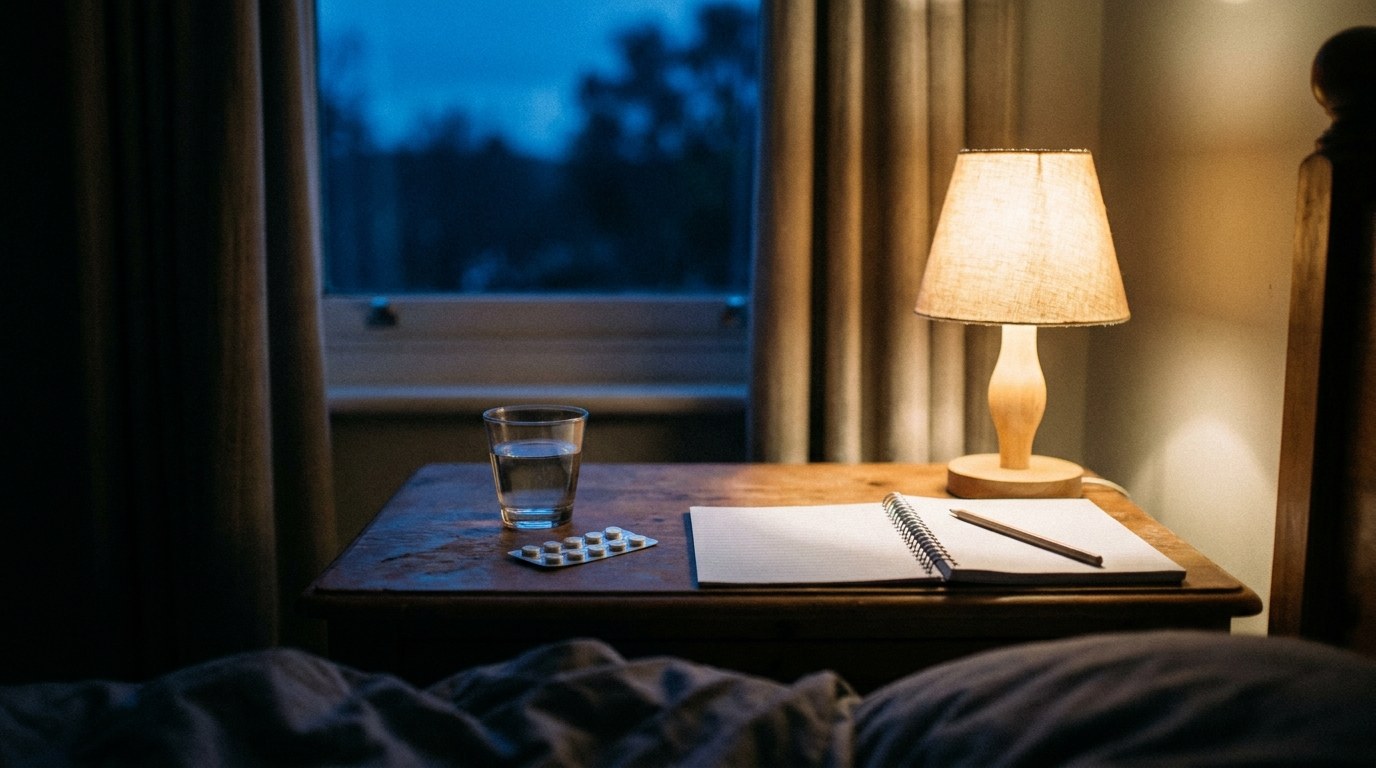
Key takeaway: Cognitive behavioral therapy for insomnia, or CBTI, is the guideline first treatment for chronic insomnia, yet in a 2026 US survey only 6.2% of adults with clinically elevated insomnia had used it in the past year, against 21.4% who had taken a prescription sleep medication. The pill wins on convenience, not on evidence, and an app or chatbot only closes the gap if it delivers the hard parts of the therapy.
I keep thinking about the person at 3 a.m. who finally books the appointment.
Weeks of bad nights, a phone full of sleep scores, and one honest sentence to a doctor: I cannot sleep. What comes back is usually something that fits in a hand. A prescription is quick to write. The alternative takes weeks, a notebook and a bedtime you will hate.
The numbers say the hand wins. In 2024, 5.2% of American adults took a prescription medication to help them fall or stay asleep most days or every day. Among adults 65 and older it was 8.8%.¹
The major guidelines say that is the wrong first move.
In 2016 the American College of Physicians issued a strong recommendation, backed by moderate quality evidence, that all adults with chronic insomnia receive cognitive behavioral therapy for insomnia as the initial treatment. Pills come second, and only when therapy alone has failed.² European and British guidelines point the same way.³
So why is the pill still winning?
The appointment has a pill shaped hole
I think of it as the pill shaped hole. The health system has a slot for something you swallow: a prescription, a pharmacy, a refill. It has almost no slot for something you have to do for weeks with a sleep diary and a strict wake time. Treatments flow into whichever slot exists.
A 2026 study in Behavioral Sleep Medicine put numbers on the hole. Researchers surveyed 3,080 American adults online. Only 15.1% said they were familiar with CBTI. For its two core techniques, sleep restriction and stimulus control, the figures were 4.4% and 5%. Melatonin hit 80.5%.³
Among the 547 people with clinically elevated insomnia, 21.4% had taken a prescription sleep medication in the past year. Only 6.2% had used CBTI. Over the counter sleep aids were at 59.4%.³
Treat those figures with a sensible dose of suspicion. It was an opt in online panel, the prescription question named trazodone as well as Ambien and Lunesta, and the authors themselves say the 15% may be an upper bound, because people who answer surveys tend to be better educated.³
Doctors are not much better placed. The same paper cites a survey of Veterans Affairs primary care providers: 82% had some familiarity with CBTI, and only 10% understood it well enough to use it in practice.³
Supply is thin as well. The Board of Behavioral Sleep Medicine publishes a directory of certified diplomates, updated in August 2026. I counted roughly 300 entries, a few already past their expiry date. The survey authors put chronic insomnia at 10% to 15% of adults.³ ⁴
Not every CBTI therapist needs that credential, and the field is openly arguing about who should deliver the treatment.³ The arithmetic still works against anyone waiting for an appointment.
A pill, by contrast, has a very short waiting list.
Rented sleep and owned sleep
Call it rented sleep and owned sleep. A sleeping pill rents you a night. You pay each evening, it works while you hold the lease, and when you stop, the flat goes back to the landlord. Therapy is closer to a purchase. It costs more up front and it is yours afterward.
The cleanest head to head I could find is old and small, but it is a proper trial. In 2004, Gregg Jacobs and colleagues in Boston randomized 63 adults aged 25 to 64, all with chronic trouble falling asleep, to behavioral therapy, zolpidem, both, or a placebo.⁵
Midway through the eight week treatment, the time it took to fall asleep had dropped 44% with therapy, 29% with zolpidem and 10% with placebo. Adding the pill to therapy did nothing extra.⁵
After treatment, the drug group had stopped taking it and waited two weeks. Therapy had cut the time to fall asleep by 52%. Zolpidem was at 14%. Placebo, awkwardly, was at 17%.⁵
In the best trial I could find, the therapy kept working after treatment ended and the pill did not. The authors wrote that zolpidem returned measures toward baseline once stopped, and that therapy kept its gains at follow up.⁵
One more detail stays with me. At the one month follow up, 38% of the pill group reported unsuccessful treatment and opted to cross over to therapy. In the placebo group it was 43%.⁵
Rented sleep also comes with a hazard of its own. On 30 April 2019 the FDA required its strongest warning, a boxed warning, on zolpidem, eszopiclone and zaleplon. The agency had reviewed 66 cases of people who sleepwalked, drove or did other things while not fully awake after taking them: 46 nonfatal serious injuries and 20 deaths.⁶
The FDA called these events rare, and said they can happen after the first dose and at the lowest recommended doses.⁶
Where the therapy sends you the bill
Now I have to argue with my own headline, because therapy is not painless and the evidence is tidier in a headline than in a paper.
First, "therapy beats the pill" is my compression. The College of Physicians said it had insufficient evidence to compare CBTI and drugs directly, and it left room for short term medication when therapy alone does not work.²
The Jacobs trial was small, recruited through newspaper ads, covered only trouble falling asleep, and excluded people on sleep medication or in treatment for depression. The authors warned that the long term follow up should be read with caution because of attrition.⁵
Second, the treatment can feel awful. In a 2014 lab study, 16 adults with insomnia followed sleep restriction therapy, a core part of CBTI, for four weeks. Measured by polysomnography, their total sleep fell by an average of 91 minutes on night 1, 78 minutes on night 8 and 69 minutes on night 22. Attention lapses and daytime sleepiness rose. Both were back to baseline by three months.⁷
Their own ratings of sleep and insomnia severity improved. But the study had no control group, and the point stands: you are asked to sleep less so you can sleep better, and for a few weeks you feel only the first half.
A pill never asks that of you. That is part of its charm.
Third, the digital version is not magic. In the largest trial I found, 1,711 adults with insomnia symptoms were randomized to digital CBTI or to sleep hygiene education. The digital group did better on health, well being and sleep related quality of life at 4, 8 and 24 weeks. The effect on global health was small, at 0.31 standard deviations at week 24. Only 58% completed at least four sessions.⁸
The trial was also funded by Big Health, the company behind Sleepio, and its lead author is a cofounder and shareholder.⁸ It compared the app with sleep hygiene, not with a pill.
None of that rescues the pill. It only stops me selling therapy as a free upgrade. Owned sleep has a down payment.
The insomnia app that went through bankruptcy court
If therapy works and software can deliver it, somebody should be getting rich. I went looking for who.
In England, NICE recommended Sleepio in May 2022 as a cost saving option in primary care for people who would otherwise be offered sleep hygiene advice or sleeping pills. At £45 per person, NICE's model saved £4.52 per person after one year. It also noted limited evidence on how the app compares with face to face therapy.⁹
The American story is rougher. Pear Therapeutics sold Somryst, a prescription app for chronic insomnia, among other products. It went public through a SPAC deal valued at $1.6 billion in December 2021. In 2022 it reported $12.7 million in revenue against a $123.4 million operating loss, and on 7 April 2023 it filed for Chapter 11.¹⁰
Its founder, Corey McCann, wrote that Pear had shown clinicians would prescribe, patients would engage and the products could save payors money, but that payors can still deny payment.¹⁰
Pear's troubles were not only about insomnia, and a company can fail for ordinary reasons. Still, Nox Health won the Somryst assets at auction with a $3.9 million bid.¹⁰
Big Health has since cleared the regulatory hurdle. The FDA's database shows a clearance decision for Sleepio on 5 August 2024, with Somryst named as the predicate device, which is the regulatory way of saying the earlier app paved the road and then left town.¹¹
Medicare also created three digital mental health treatment billing codes effective 1 January 2025. Big Health's own page says those codes are "not a guarantee of reimbursement."¹¹
What a chatbot can sell you at 3 a.m.
This is where the AI part comes in, and where I get nervous.
An October 2025 trial in Health Informatics Journal randomized 80 psychiatric outpatients in Taiwan to a CBTI chatbot for four weeks or to a website of basic sleep education. Sixty six finished, 35 in the chatbot group and 31 in the control group. The chatbot group improved on the Pittsburgh Sleep Quality Index and on depression and anxiety scales. The control group showed no statistically detectable change.¹²
That is promising, and it is also small, short and from a single clinic. The control was a website, not a pill, and the abstract does not say how much of the therapy the bot actually delivered.
So here is the test I would apply to any app or chatbot that claims to treat insomnia. The test is whether it rents you a night or gives you something you keep.
A bot that offers breathing exercises and a kind word at 3 a.m. is renting. It may be pleasant, and it may even help for a night. A bot that sets a sleep window, reads your diary, tightens it, and keeps you out of bed when you want to be in it is trying to sell you ownership, and by the evidence above you will dislike it for a couple of weeks.
I suspect a product tuned to be pleasant at 3 a.m. will drift toward renting, because renting feels better and retains better. That is my suspicion, not a finding.
Who ends up paying for the therapy
The next round of guidance will say the same thing. The hole is the problem, not the guidance.
I expect the pattern to hold. A survey like the 2026 one, repeated in 2027, will still find far more adults with a prescription history than a CBTI history. Most people with insomnia won't hear the word CBTI from a doctor this year. They will hear something closer to "let's try something to help you sleep."
The money will not come from insomniacs at 3 a.m. It will come from employers, health systems and national services that count the savings, the way NICE did. Chatbots sold as sleep coaches won't deliver sleep restriction unless someone is paid to make them do it, and the ones that do will lose users in week two.
The pill will keep winning, and not because it works better. It is the only treatment with a slot waiting for it.
FAQ
What is CBTI and how long does it take? CBTI is cognitive behavioral therapy for insomnia. It combines techniques such as sleep restriction, stimulus control and changing unhelpful thoughts about sleep, and the guideline version runs for several weeks. The Jacobs trial used an eight week treatment phase, and the prescription app SleepioRx is described as a 90 day treatment.
Is CBTI better than sleeping pills? For chronic insomnia it is the recommended first treatment, and in the 2004 Jacobs trial it outperformed zolpidem on time to fall asleep after treatment. The American College of Physicians says the evidence is insufficient for a direct comparison, so the honest answer is better as a first step, with room for short term medication if therapy alone fails.
Does digital CBTI work? A 2019 trial of 1,711 adults found digital CBTI improved insomnia, health and well being compared with sleep hygiene education, though only 58% completed at least four sessions. NICE recommended Sleepio in England in 2022 as a cost saving option, and it noted limited evidence against face to face therapy.
Can an AI chatbot treat insomnia? One small 2025 trial in Taiwan found a CBTI chatbot improved sleep quality and mood scores over four weeks compared with a sleep education website. That is early evidence from 80 people, not proof that a general purpose chatbot can replace a clinician or a full program.
Are insurers paying for insomnia apps? Patchily. Medicare created digital mental health treatment codes in 2025, but Big Health says they do not guarantee reimbursement. Pear Therapeutics, which sold the Somryst app, went into Chapter 11 in April 2023, and its founder blamed slow payer coverage.
Are prescription sleeping pills dangerous? For most people they are used safely, but the FDA put a boxed warning on zolpidem, eszopiclone and zaleplon in April 2019 after 66 cases of serious injury or death linked to complex sleep behaviors. The FDA says anyone who has had such an episode should stop the drug and contact a clinician.
This essay is general information, not medical advice. If you have had trouble sleeping for more than a few weeks, talk to a doctor before starting or stopping any sleep medication or a sleep restriction program.
Footnotes
¹ Mykyta, Elgaddal and Warren, "Use of Sleep Aids Among Adults Age 18 and Older: United States, 2024," NCHS Health E Stat 116, April 2026. National Health Interview Survey, 2024, n = 31,509. 5.2% of adults used prescription medication most days or every day in the past 30 days (12.9% any sleep aid); 8.8% among adults 65 and older.
² Qaseem et al. for the American College of Physicians, "Management of Chronic Insomnia Disorder in Adults: A Clinical Practice Guideline," Annals of Internal Medicine 165(2), 125 to 133, 2016, and ACP press release, 3 May 2016. Strong recommendation, moderate quality evidence for CBTI as initial treatment; weak recommendation, low quality evidence for shared decision making on adding drugs if CBTI alone fails; ACP stated there was insufficient evidence to directly compare CBTI and drugs.
³ Assar, Walker, Egeler, Floyd, Dickens and Vargas, "Estimating Public Knowledge About Cognitive Behavioral Therapy for Insomnia (CBTI) and Alternative Treatments," Behavioral Sleep Medicine 24(3), 330 to 345, 2026. Quota sampled online panel of 3,080 US adults. Familiar with CBTI 15.1%, sleep restriction 4.4%, stimulus control 5%, melatonin 80.5%. Among 547 adults with clinically elevated insomnia: past year prescription medication 21.4% (examples named: Ambien, Lunesta, trazodone), over the counter aids 59.4%, CBTI 6.2%. The authors call 15% an upper bound. The paper also supplies the VA provider figures (from Ulmer et al. 2017), the 10% to 15% prevalence, and the guideline and delivery debate citations.
⁴ Board of Behavioral Sleep Medicine, "Behavioral Sleep Medicine Diplomates" directory, updated August 2026 (accessed 11 October 2026). The author's own count of entries with certification and expiry dates was 301; some expiry dates are already past, and the count is an approximation, not an official total.
⁵ Jacobs, Pace Schott, Stickgold and Otto, "Cognitive Behavior Therapy and Pharmacotherapy for Insomnia: A Randomized Controlled Trial and Direct Comparison," Archives of Internal Medicine 164, 1888 to 1896, 27 September 2004. 63 adults aged 25 to 64 with chronic sleep onset insomnia; eight week treatment phase. Sleep onset latency change at midtreatment: 44% (CBT and combination), 29% (zolpidem), 10% (placebo). After treatment and a two week washout: 52%, 14%, 17%. At one month, 5 of 13 pill completers (38%) and 6 of 14 placebo completers (43%) chose to cross over to therapy.
⁶ US Food and Drug Administration, "FDA requires stronger warnings about rare but serious incidents related to certain prescription insomnia medicines," 30 April 2019, and Drug Safety Communication of the same date. 66 cases reviewed: 46 nonfatal serious injuries and 20 deaths linked to eszopiclone, zaleplon and zolpidem; the agency said the events can occur after the first dose and at the lowest recommended doses.
⁷ Kyle, Miller, Rogers, Siriwardena, MacMahon and Espie, "Sleep Restriction Therapy for Insomnia Is Associated with Reduced Objective Total Sleep Time, Increased Daytime Somnolence, and Objectively Impaired Vigilance," SLEEP 37(2), 229 to 237, 2014. 16 patients, within subject, noncontrolled, four week sleep restriction; polysomnographic total sleep time down 91, 78 and 69 minutes on nights 1, 8 and 22; vigilance lapses and sleepiness returned to baseline by three months.
⁸ Espie et al., "Effect of Digital Cognitive Behavioral Therapy for Insomnia on Health, Psychological Well Being, and Sleep Related Quality of Life: A Randomized Clinical Trial," JAMA Psychiatry, 2019 (DIALS trial). 1,711 participants, digital CBTI versus sleep hygiene education, assessed at 4, 8 and 24 weeks; Cohen d 0.31 for global health at week 24; 58% completed at least four sessions. Funded by Big Health Ltd; the lead author reports being a cofounder, chief medical officer and shareholder of Big Health and a developer of Sleepio.
⁹ National Institute for Health and Care Excellence, "Sleepio to treat insomnia and insomnia symptoms," HealthTech guidance HTG624 (formerly MTG70), published 20 May 2022. Recommendation 1.1, price of £45 per person, saving of £4.52 per person after one year in the base case, and limited evidence against face to face CBTI.
¹⁰ Pear Therapeutics press release filed with the US SEC, 7 April 2023 (Chapter 11); Katie Jennings, Forbes, 7 April 2023 (2022 revenue of $12.7 million, operating loss of $123.4 million, SPAC valued at $1.6 billion in December 2021); Conor Hale, Fierce Biotech, 10 April 2023 (McCann statement); MobiHealthNews, 19 May 2023 and 2 June 2023, and Nox Health press release, 20 June 2023 (Nox bid $3.9 million for the Somryst assets; acquisition closed 20 June 2023).
¹¹ US FDA 510(k) database, K233577, Sleepio, decision date 5 August 2024, predicate Somryst (K191716), regulation 21 CFR 882.5801; Big Health, "US FDA Grants Clearance for SleepioRx" (8 August 2024) and SleepioRx product page (Medicare digital mental health treatment codes in the CY 2025 Physician Fee Schedule, "not a guarantee of reimbursement").
¹² Chiu, Lee, Lin and Cheng, "Using cognitive behavioral therapy based chatbots to alleviate symptoms of insomnia, depression, and anxiety: A randomized controlled trial," Health Informatics Journal, 1 October 2025. 80 psychiatric outpatients randomized 1:1; 35 and 31 completed all procedures; four weeks; PSQI improvement in the chatbot group (t(34) = 3.80, p < .001); no reliable change in controls. Based on the published abstract; the full text was not read.
Sources
- NCHS Health E Stat 116 (2024 sleep aid use): https://www.cdc.gov/nchs/data/hestat/hestat116.pdf
- Annals of Internal Medicine (ACP guideline 2016): https://www.acpjournals.org/doi/10.7326/M15-2175 and ACP press release: https://www.acponline.org/acp-newsroom/acp-recommends-cognitive-behavioral-therapy-as-initial-treatment-for-chronic-insomnia
- Behavioral Sleep Medicine (Assar et al. 2026): https://doi.org/10.1080/15402002.2025.2610674
- Board of Behavioral Sleep Medicine directory: https://www.bsmcredential.org/index.php/bsm-diplomates
- Archives of Internal Medicine (Jacobs et al. 2004): https://www.med.upenn.edu/cbti/assets/user-content/documents/Jacobs_Pace-Schott_Stickgold_Otto_2004.pdf
- FDA via PR Newswire (30 April 2019): https://www.prnewswire.com/news-releases/fda-requires-stronger-warnings-about-rare-but-serious-incidents-related-to-certain-prescription-insomnia-medicines-300840960.html and FDA Drug Safety Communication: https://www.fda.gov/safety/medical-product-safety-information/certain-prescription-insomnia-medicines-new-boxed-warning-due-risk-serious-injuries-caused
- SLEEP (Kyle et al. 2014): https://pmc.ncbi.nlm.nih.gov/articles/PMC3900612/
- JAMA Psychiatry (Espie et al. 2019): https://pmc.ncbi.nlm.nih.gov/articles/PMC6583463/
- NICE HTG624: https://www.nice.org.uk/guidance/htg624/chapter/1-Recommendations and https://www.nice.org.uk/guidance/htg624/chapter/3-Evidence
- SEC filing, Pear press release: https://www.sec.gov/Archives/edgar/data/1835567/000183556723000020/peartherapeuticsfilesforch.htm ; Forbes: https://www.forbes.com/sites/katiejennings/2023/04/07/pear-therapeutics-files-for-bankruptcy-as-ceo-blames-shortfalls-on-insurers/ ; Fierce Biotech: https://www.fiercebiotech.com/medtech/cut-core-prescription-app-developer-pear-therapeutics-files-bankruptcy-lays-staff ; MobiHealthNews: https://www.mobihealthnews.com/news/pear-therapeutics-assets-sold-6m-auction-after-bankruptcy ; Nox Health: https://www.globenewswire.com/news-release/2023/06/20/2691426/0/en/Nox-Health-Closes-Acquisition-of-Somryst-the-Only-FDA-Cleared-Digital-Insomnia-Treatment-From-Pear-Therapeutics.html
- FDA 510(k) K233577: https://www.accessdata.fda.gov/scripts/cdrh/cfdocs/cfpmn/pmn.cfm?ID=K233577 ; Big Health: https://www.bighealth.com/news/us-fda-grants-clearance-for-sleepiorx and https://www.bighealth.com/sleepio-rx
- Health Informatics Journal (Chiu et al. 2025), abstract: https://exa.ai/library/publication/7kqhjd7vvzc