
Key takeaway: Why can't you sleep on Sunday night? Usually for two reasons that stack: sleeping in on Saturday and Sunday shifts your body clock later and leaves you less tired at bedtime, and worry about the coming work week keeps your brain switched on. The fix starts with your weekend wake time, not with Sunday night itself.
Why can't I sleep on Sunday night? Because your body is still on weekend time and your mind is already at work. Both problems were set up hours before you turned the light off.
That is the short answer. The longer one is more interesting, because it suggests the night we blame is the one that did the least wrong.
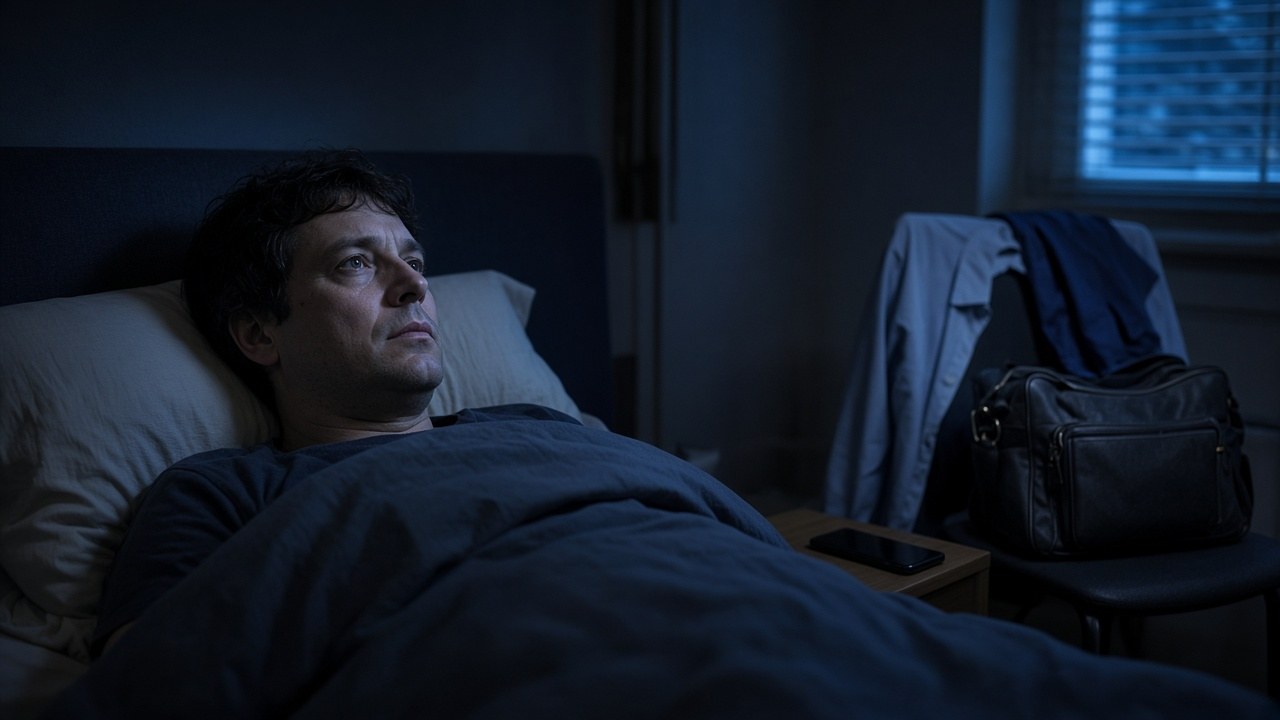
You probably know the scene. It is 11:30 on Sunday. You went to bed early on purpose, like a responsible adult preparing for a big week. The room is dark, the alarm is set, and you are lying there wide awake, mentally rewriting an email you have not even received yet.
By 1 a.m. you have done the arithmetic twice. If you fall asleep right now, you get five and a half hours. Now, five hours and twenty minutes.
Most people file this under stress, and stress is part of it. The bigger part, I think, happened on Saturday morning while you were enjoying it.
You flew west on Friday and nobody told you
The main physical reason for Sunday night insomnia is social jetlag: the weekly shift between your weekday sleep schedule and your later weekend schedule, which moves your body clock as if you had crossed time zones.
The term comes from chronobiologists in Munich, who defined it in 2006 as the gap between when you sleep on workdays and when you sleep on free days.¹ In a database of more than 65,000 mostly central European people, Till Roenneberg's group found that 69% had at least one hour of social jetlag and about a third had two hours or more.²
Their own description is the best one. Shifting your sleep later on the weekend is like flying a few time zones west on Friday evening and flying back on Monday morning. Except nobody gives you a window seat, and you do it every week for forty years.
We have written about this gap before, in the context of the October clock change, at https://thinknarratives.com/articles/the-extra-hour-of-sleep-is-not-free-we-just-keep-calling-it-a-gift. The weekend version is smaller and much more frequent. Daylight saving moves the clock twice a year. Your weekend moves it fifty two times.
The mechanism is light. Your internal clock sets itself mostly by when light hits your eyes. Sleep until 10:30 on Saturday and Sunday, and your clock gets its morning signal hours late, twice. By Sunday night, the body is honestly not ready for sleep at the time your Monday alarm demands.
Two lie ins are enough to do it
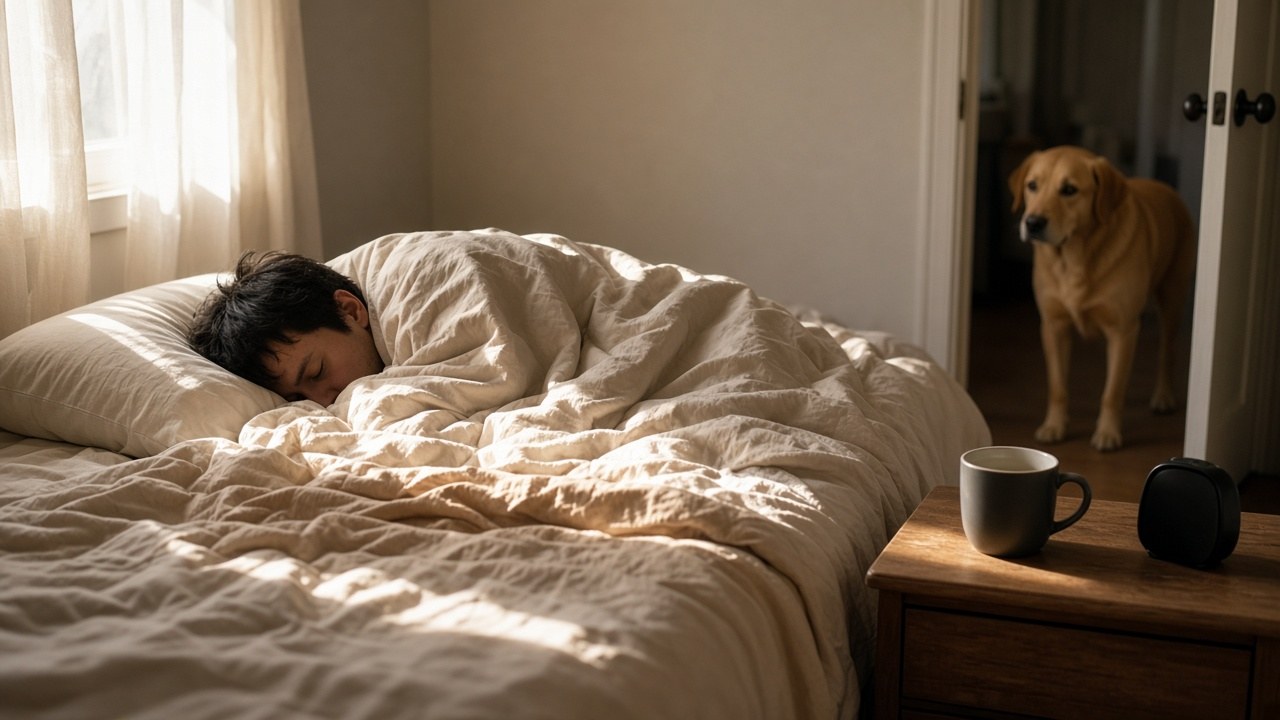
Research shows that sleeping in for just two weekend mornings delays your body clock by about 40 minutes and makes it harder to fall asleep on Sunday night.
The cleanest test of this comes from Flinders University in Australia. In a 2008 study, 16 people spent one weekend getting up at their normal weekday time and another weekend sleeping in. On the lie in weekend they woke about three hours later than usual, and they only moved their wake time, not their bedtime.³
That was enough. Their melatonin onset, the evening signal that tells the body night has started, shifted 42 minutes later between Friday and Sunday nights. They took longer to fall asleep on Sunday night, and they reported more fatigue and sleepiness on Monday and Tuesday. The researchers named it plainly: the cost of sleeping in is the Monday morning blues.³
In fairness, eight extra minutes to fall asleep on Sunday is not dramatic. The point is the direction. Two lazy mornings, no late nights, no alcohol required, and the clock already moved.
There is a second, quieter effect. Sleep pressure, the chemical urge to sleep that builds the longer you are awake, starts accumulating when you get up. Get up at 10:30 and by 11 p.m. you have been awake for twelve and a half hours instead of the usual sixteen. You are trying to sleep with a tank that is not full yet.
I think of it as a weekend tax paid in Sunday hours. The lie in feels free when you take it. The bill arrives at bedtime.
The dread is not imaginary either
I should push back on my own headline here, because Saturday morning does not explain everything.
Plenty of people keep a steady wake time all weekend and still lie awake on Sunday night. If it were only about light and sleep pressure, they would sleep fine. Many of them do not.
Anticipating a hard work day measurably changes how you sleep the night before, even if you do fall asleep.
Swedish researchers at the Karolinska Institute looked at this directly. In 37 adults recorded in the sleep lab, people who felt apprehensive about the next working day got less slow wave sleep, the deepest and most restorative stage, along with more anxiety at bedtime and worse sleep by their own account.⁴ Not a crisis. Just ordinary dread about tomorrow, showing up in the brain waves.
The body keeps a similar diary in the morning. In a study of 227 London civil servants from the Whitehall II cohort, the cortisol surge that follows waking was larger on work days than on weekend days.⁵ A separate study of 219 people found that the weekday surge was strongest in those reporting chronic work overload and worry.⁶ Your stress system starts the work week before you do.
So the dread is real. What I would argue is that it lands on a body that has been set up to receive it badly. A tired brain on a normal clock can fall asleep through a fair amount of worry. A rested brain whose clock thinks it is 9:30 p.m. has nothing better to do than worry.
Sunday is also a night you rehearse
There is one more ingredient, and it is the one that turns a bad Sunday into a pattern.
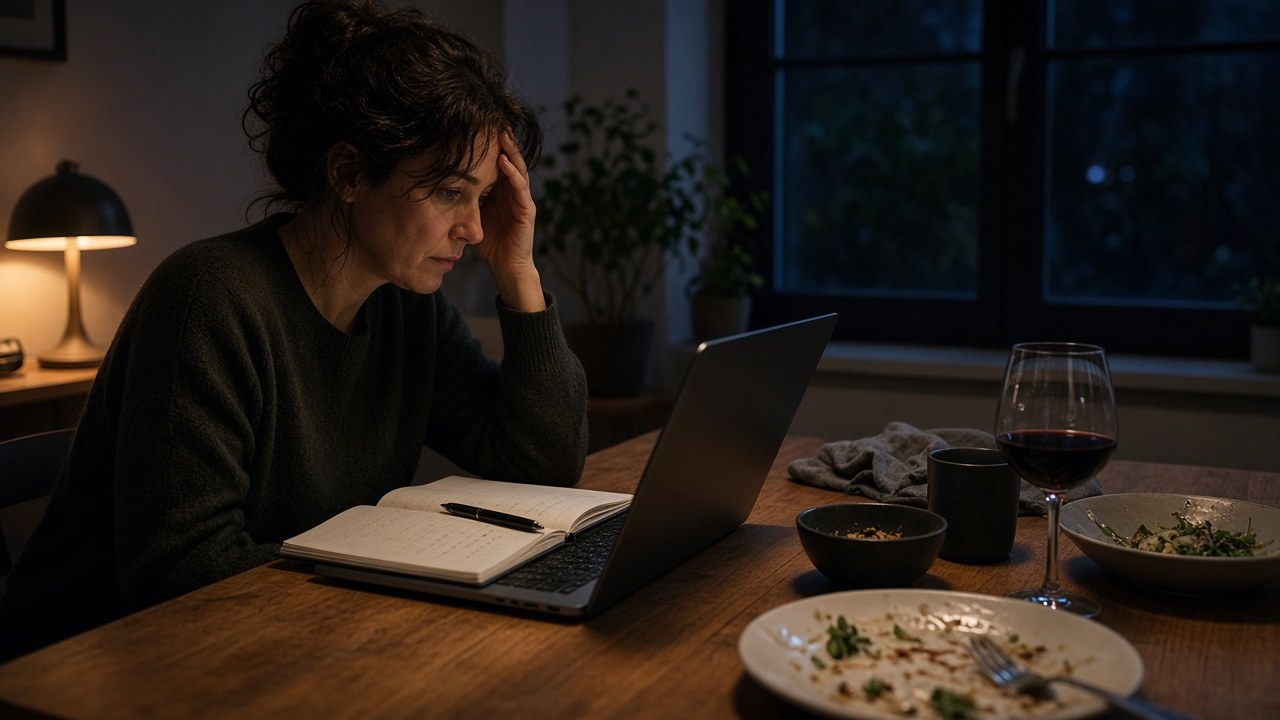
After a few rough Sunday nights, Sunday itself becomes the cue. You start bracing around dinner. You go to bed early to compensate, which, with a delayed clock, only gives you more time to lie there awake. You check the time. You do the arithmetic again.
Sleep researchers call this conditioned arousal, and it is one of the main targets of cognitive behavioral therapy for insomnia, the treatment that sleep medicine recommends before pills. We went through that treatment, and why it keeps losing to the prescription pad despite better evidence, at https://thinknarratives.com/articles/the-best-insomnia-treatment-is-not-a-pill-the-pill-is-still-winning.
The bed becomes the place where you think about Monday. The brain learns that quickly, and it does not unlearn it on its own.
If you also tend to wake at 3 a.m. later in the week, a similar mental loop is usually involved, and the clock watching makes it worse. We wrote about that at https://thinknarratives.com/articles/waking-up-at-3-am-is-not-the-problem-the-clock-on-your-nightstand-is.
What actually helps on a Sunday
The most effective fix for Sunday night insomnia is keeping your weekend wake time within about an hour of your weekday wake time, and getting outdoor light early on both weekend mornings.
That sounds like a punishment, so let me make the case. You are not giving up rest. You are moving it. If you are short on sleep after the week, go to bed earlier on Friday and Saturday rather than sleeping until noon. Your clock cares much more about when you get up than about when you lie down.
Get daylight in the morning, especially on Sunday. In a 2017 study, people who spent a summer weekend camping in natural light had their melatonin onset shift about 1.4 hours earlier than on weekdays, while a comparison group who stayed home in electric light saw no such shift.⁷ You do not have to sleep in a tent. A walk outside before noon, without sunglasses, does a version of the same job.
Do your Monday thinking on Sunday afternoon, not at midnight. In a small study of college students with insomnia, a simple exercise called constructive worry, writing down each worry and a next step for it in the early evening, reduced mental arousal at bedtime compared with just listing worries.⁸ It did not change their measured sleep in that study, so treat it as a way to quiet the noise rather than a sleeping pill on paper.
Go to bed when you are sleepy, not when the calendar says it is responsible. And if you are lying awake and frustrated, get up and do something dull in dim light until you feel sleepy again. That is the core of stimulus control, which the American Academy of Sleep Medicine recommends for chronic insomnia.⁹
Skip the Sunday afternoon nap, or keep it short and early. A two hour nap at 4 p.m. on Sunday is the sleep pressure version of eating dessert before dinner.
Monday will keep its reputation, and the weekend will get the blame it deserves
None of this will make Monday popular. Work will still start, the inbox will still be full, and some Sundays will still be bad because something real is waiting for you.
What will change, for anyone who tries it, is the share of Sunday nights that go wrong. People who hold their wake time steady through the weekend will find that most of their Sunday insomnia was never about Monday at all. The worry will still visit. It will just meet a body that is ready to sleep.
And I don't think the habit will spread on its own. The lie in is too pleasant and the cost arrives too late, at the exact moment we are too tired to connect it with Saturday. Sunday night will keep taking the blame for a decision we made on Saturday morning, with the curtains closed and the alarm off.
FAQ
Why can't I sleep on Sunday night? Most often because of social jetlag and worry combined. Sleeping in on the weekend delays your body clock and reduces the sleep pressure you have built by bedtime, so you are not tired when your Monday schedule needs you to be. Anticipating the work week adds mental and physical arousal on top of that.
What is Sunday night insomnia? It is a common name for trouble falling or staying asleep specifically on Sunday nights. It is not a formal diagnosis. It usually reflects a shift in sleep timing over the weekend plus anticipatory stress about the week ahead, and it often improves when weekend wake times are kept steady.
Does sleeping in on the weekend make it harder to sleep on Sunday? Yes. In a 2008 study, sleeping in about three hours later on two weekend mornings delayed the body clock by 42 minutes, made it take longer to fall asleep on Sunday night, and increased sleepiness on Monday and Tuesday.
How do I stop the Sunday scaries from ruining my sleep? Deal with the week ahead earlier in the day. Write down what is worrying you and one next step for each item on Sunday afternoon or early evening, keep the evening calm, and avoid using your bed as the place where you plan Monday. If you cannot sleep, get up and do something quiet until you feel sleepy.
Should I go to bed earlier on Sunday night? Not much earlier than usual. If your body clock has drifted later over the weekend, going to bed very early often means lying awake longer. Keeping your weekend wake time close to your weekday one and going to bed when you feel sleepy works better.
Is it bad to catch up on sleep on the weekend? A little extra sleep is fine if you are short on it, but how you take it matters. Going to bed earlier on Friday and Saturday is easier on your body clock than sleeping very late in the morning, which shifts your rhythm and makes Sunday night harder.
This article is for general information and is not medical advice. If you have trouble sleeping on most nights for three months or more, or if poor sleep is affecting your days, talk to a qualified clinician.
Sources
¹ Marc Wittmann, Jenny Dinich, Martha Merrow and Till Roenneberg, "Social Jetlag: Misalignment of Biological and Social Time," Chronobiology International 23(1 and 2), 497 to 509, 2006. Defines social jetlag as the difference in sleep timing between work days and free days. https://doi.org/10.1080/07420520500545979
² Till Roenneberg, Karla V. Allebrandt, Martha Merrow and Céline Vetter, "Social Jetlag and Obesity," Current Biology 22(10), 939 to 943, 2012. More than 65,000 mostly central European participants; 69% report at least 1 hour of social jetlag and one third 2 hours or more; describes the weekly shift as flying west on Friday and back on Monday. https://doi.org/10.1016/j.cub.2012.03.038
³ Amanda Taylor, Helen R. Wright and Leon C. Lack, "Sleeping-in on the weekend delays circadian phase and increases sleepiness the following week," Sleep and Biological Rhythms 6(3), 172 to 179, 2008. 16 participants; weekend wake time delayed by about 3 hours; melatonin onset 42 minutes later; 8 minutes longer to fall asleep on Sunday night; more fatigue and sleepiness on Monday and Tuesday. https://doi.org/10.1111/j.1479-8425.2008.00356.x
⁴ Göran Kecklund and Torbjörn Åkerstedt, "Apprehension of the subsequent working day is associated with a low amount of slow wave sleep," Biological Psychology 66(2), 169 to 176, 2004. 37 adults; apprehension of a difficult next day linked to less slow wave sleep, more bedtime anxiety and poorer subjective sleep. https://doi.org/10.1016/j.biopsycho.2003.10.004
⁵ Sabine R. Kunz-Ebrecht, Clemens Kirschbaum, Michael Marmot and Andrew Steptoe, "Differences in cortisol awakening response on work days and weekends in women and men from the Whitehall II cohort," Psychoneuroendocrinology 29(4), 516 to 528, 2004. 227 adults; larger cortisol awakening response on work days than weekends. https://doi.org/10.1016/S0306-4530(03)00072-6
⁶ Wolff Schlotz, Juliane Hellhammer, Peter Schulz and Arthur A. Stone, "Perceived Work Overload and Chronic Worrying Predict Weekend-Weekday Differences in the Cortisol Awakening Response," Psychosomatic Medicine 66(2), 207 to 214, 2004. 219 participants; stronger weekday cortisol rise in people reporting chronic work overload and worrying. https://doi.org/10.1097/01.psy.0000116715.78238.56
⁷ Ellen R. Stothard and colleagues, "Circadian Entrainment to the Natural Light-Dark Cycle across Seasons and the Weekend," Current Biology 27(4), 508 to 513, 2017. A summer weekend camping in natural light shifted melatonin onset about 1.4 hours earlier; a weekend in electric light did not. https://doi.org/10.1016/j.cub.2016.12.041
⁸ Colleen E. Carney and William F. Waters, "Effects of a Structured Problem-Solving Procedure on Pre-Sleep Cognitive Arousal in College Students With Insomnia," Behavioral Sleep Medicine 4(1), 13 to 28, 2006. Constructive worry done in the early evening reduced pre-sleep cognitive arousal versus a control exercise; sleep diary and actigraphy measures did not change. https://doi.org/10.1207/s15402010bsm0401_2
⁹ Jack D. Edinger and colleagues, "Behavioral and psychological treatments for chronic insomnia disorder in adults: an American Academy of Sleep Medicine clinical practice guideline," Journal of Clinical Sleep Medicine 17(2), 255 to 262, 2021. Strong recommendation for CBT-I; conditional recommendation for stimulus control as a single component therapy. https://doi.org/10.5664/jcsm.8986