
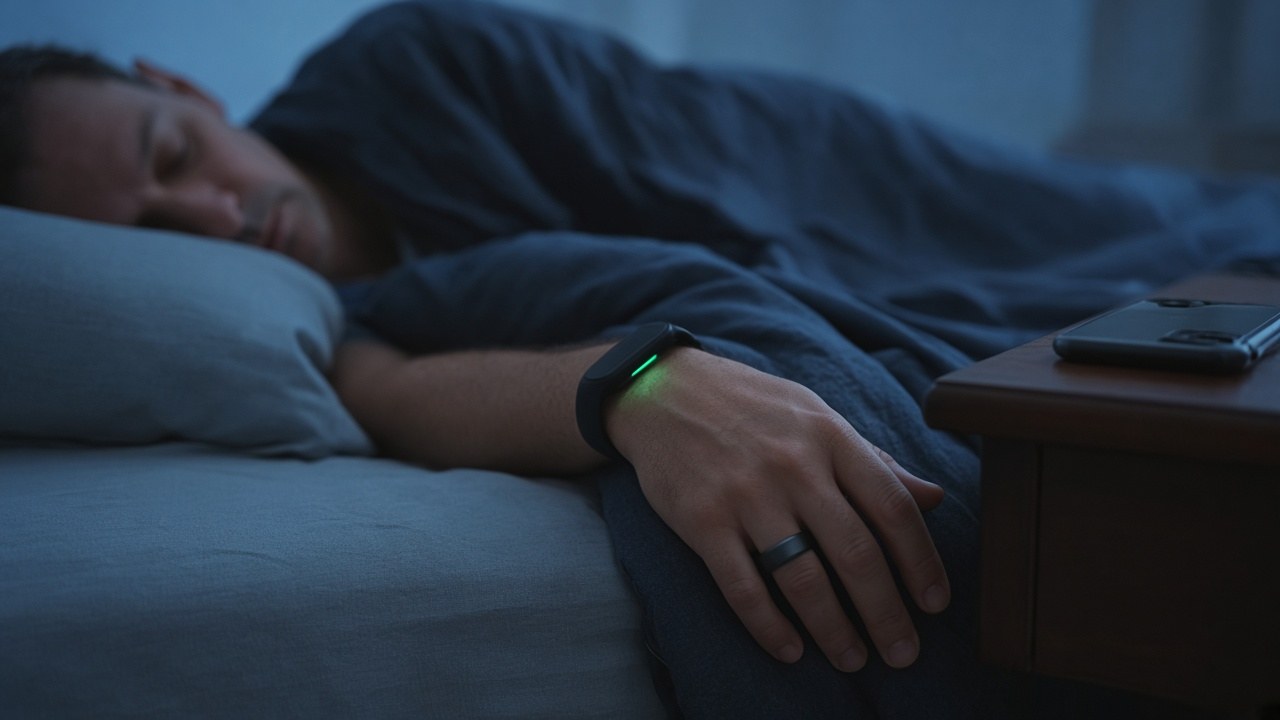
Key takeaway: Are AI sleep trackers accurate? For healthy sleepers, modern rings and watches are reasonably accurate at telling when you slept and roughly how long, because they are very good at recognizing sleep. They are weak at spotting quiet wakefulness, fair at best at sorting your night into deep, light and REM sleep, and the nightly sleep score is a company's recipe, not a reading.
Are AI sleep trackers accurate? At timing your night, mostly yes. At narrating it, much less than the app suggests.
That gap is the whole story, and it matters more than which brand wins the next review.
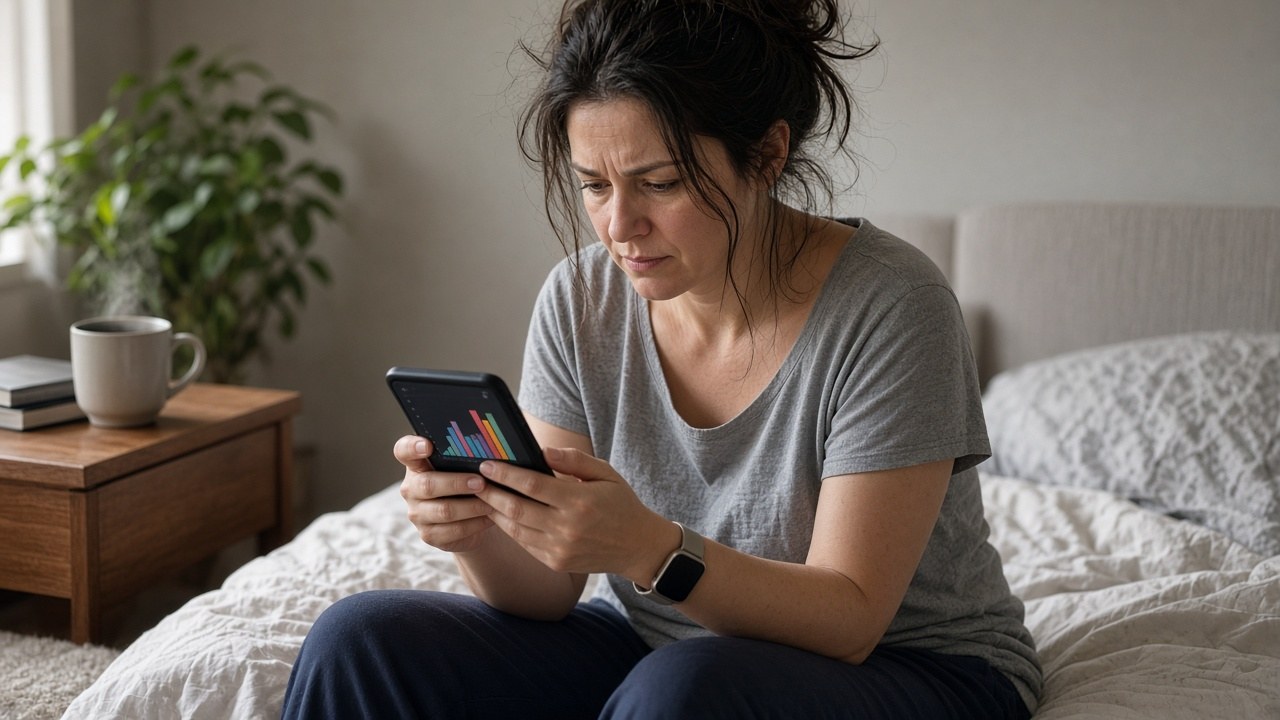
Every morning a lot of us open an app and see a tidy chart: a block of deep sleep here, a run of REM there, a score of 78 with a little upward arrow. It looks like a lab report. It reads like a lab report.
It is not a lab report. It is a forecast about your brain, made by a device that never touched it.
The good news is that the forecast is better than it used to be, and some parts of it are genuinely trustworthy. The trick is knowing which parts.
What a ring can actually feel through your skin
A consumer sleep tracker does not measure sleep directly. It measures movement, heart rhythm and temperature, then uses a trained model to infer which stage of sleep you were probably in.
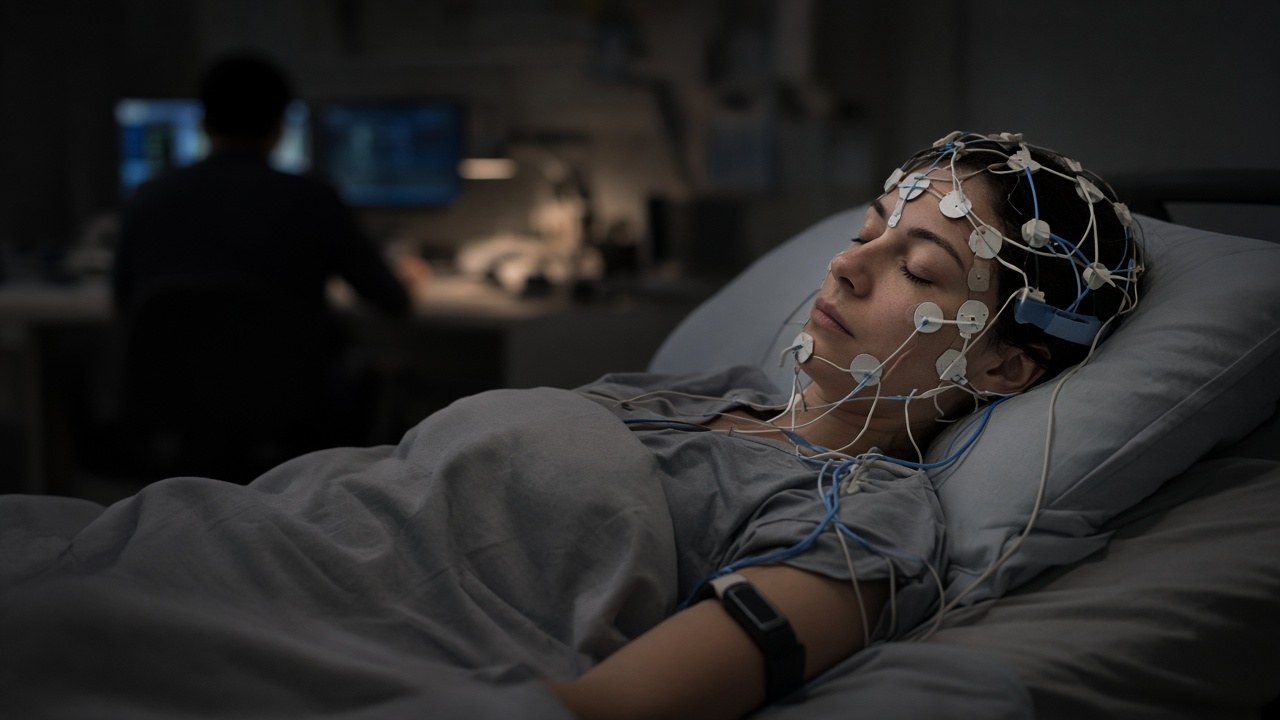
In a sleep lab, sleep is defined by the brain. Polysomnography glues electrodes to your scalp, face and chin and records brain waves, eye movements and muscle tone. A trained technologist then scores the night in 30 second chunks, and those patterns are what deep sleep and REM sleep actually are.
A ring or a watch gets none of that. It has an accelerometer that notices when you move, an optical sensor that shines light into your skin to track pulse and heart rate variability, and often a temperature sensor. From those signals, a machine learning model trained on nights of real lab data estimates what your brain was doing.
That is the AI in an AI sleep tracker. Not a chatbot. A pattern matcher that has seen enough lab nights to make an educated guess about yours.
The best public look at how much each signal helps comes from Oura's own researchers. In a 2021 study of 106 people across 440 nights, their four stage model (wake, light, deep and REM) reached 57% accuracy using movement alone, 60% with temperature added, 76% once heart rate variability came in, and 79% after adding features based on time of night and body clock. The same model separated sleep from wake with 96% accuracy.¹
Two things are true at once. The heart signals do a remarkable amount of work. And a company testing its own algorithm is a company grading its own homework, which is why the independent studies below matter more.
Where the trackers earn their keep
For healthy adults, current trackers are good at detecting sleep and reasonably good at estimating when you slept and for how long.
Independent lab studies keep landing on the same picture. A 2021 study in the journal Sleep tested seven consumer devices against polysomnography in 34 healthy young adults over three nights. Most performed as well as or better than research grade actigraphy, the wrist sensors scientists have used for decades. Every device caught at least 93% of the 30 second chunks that the lab scored as sleep.²
A 2022 Australian study put six wearables on 53 healthy adults at once, including the Apple Watch, Oura, WHOOP and Garmin. For the simple question of asleep or awake, agreement with the lab ran from 86% to 89%, and the authors concluded that all six were valid for measuring the timing and duration of sleep.³
So if your tracker says you slept from 11:40 p.m. to 6:50 a.m., that is probably close. If it says you averaged six hours a night this month instead of the seven you believed, I would take that seriously. Duration is where these devices have earned the most trust.
That is the stopwatch part. It is the useful part. It is also the boring part, which is why the app puts it in small print under a colorful chart.
The stillness problem
There is a catch hiding in that 93%. Catching sleep is easy for a wrist sensor, because most of a normal night is sleep. Catching wakefulness is the hard part.
In the same 2021 study, the devices correctly identified only 18% to 54% of the chunks the lab scored as awake, depending on the device.² If you are lying still in the dark with your eyes closed, your body looks a lot like a sleeping body. Your tracker gives you the benefit of the doubt.
For good sleepers this barely matters, because there is not much wake to miss. For people with insomnia, it is the whole problem.
A 2017 study tested a Fitbit against polysomnography in 33 people with insomnia disorder and 17 good sleepers. In good sleepers, the Fitbit overestimated total sleep by 6.5 minutes. In the insomnia group, it overestimated by 32.9 minutes, and the share of nights with clinically acceptable agreement fell from 82.4% to 39.4%.⁴
Here is the twist. People with insomnia often make the opposite error. A long line of research shows that many of them underestimate how much they actually slept and overestimate how long it took to drift off, partly because light sleep can feel like being awake.⁵
So the person lying there at 3 a.m. thinks they barely slept, and the ring on their finger thinks they slept more than they did. Both are wrong, in opposite directions, about the same night. If that 3 a.m. scene is familiar, we wrote about why it happens at https://thinknarratives.com/articles/waking-up-at-3-am-is-not-the-problem-the-clock-on-your-nightstand-is, and the tracker is not the tool that will fix it.
I think of it as the stillness tax. The people who most want an honest account of their night are the ones whose nights the devices read worst.
Deep sleep and REM are the part you screenshot
Sleep stage breakdowns are the least reliable thing your tracker shows you, and they are usually the thing people care about most.
When studies move from asleep or awake to the full four stage breakdown, the numbers drop. In the 2022 Australian study, agreement with the lab on stages ranged from 50% for Garmin and 53% for the Apple Watch to 61% for Oura and 60% for WHOOP. The authors' verdict was blunt: all six devices needed improvement for specific sleep stages.³
A 2025 Belgian study of six wrist trackers in 62 adults, some of them with suspected sleep apnea, found agreement scores (Cohen's kappa) between 0.21 and 0.53, which statisticians describe as fair to moderate. The Apple Watch Series 8 did best. The researchers said the better devices could follow prolonged, meaningful changes in sleep architecture, which is a polite way of saying weeks, not nights.⁶
The biggest comparison so far tested 11 trackers, including watches, rings, bedside devices and phone apps, in 75 adults with sleep complaints in Korea. Stage accuracy varied enormously, with the best device more than twice as good as the worst on the main score. The top performer was an app called SleepRoutine. The study was run largely by employees of Asleep, the company that makes SleepRoutine, and the paper discloses that they hold stock in it.⁷
I am not saying the result is wrong. I am saying that in this field, it is always worth reading the affiliations before the rankings.
We looked at one more lab study in https://thinknarratives.com/articles/stop-asking-a-chatbot-how-you-slept, where three popular devices tracked sleep and wake well but agreed poorly with the lab on nightly deep sleep and REM totals. Different labs, different devices, same shape every time. Strong on when. Shaky on what kind.
Even the sleep lab argues with itself
I should complicate my own headline here, because the sleep lab is not quite the oracle I have been implying.
Polysomnography is scored by humans. The American Academy of Sleep Medicine runs a reliability program where thousands of scorers grade the same recordings. In one analysis of more than 2,500 scorers and over 3.2 million scoring decisions, they agreed with the majority view 82.6% of the time. For deep sleep, agreement was only 67.4%. For the lightest stage, it was 63.0%. The hardest call of all was telling light sleep from deep sleep.⁸
Think about that for a second. The gold standard is a committee, and the committee disagrees about one in six chunks of the night, and about one in three when it comes to deep sleep.
That cuts both ways. It means a tracker scoring 60% on stages is not as hopeless as it sounds, because the ceiling is not 100%. It also means no wrist device will ever be validated as better than the humans who define the answer, because those humans are the answer key.
One of the 2022 authors wrote that "the whole world is becoming a sleep laboratory."³ I like the line. I would only add that it is a laboratory where the instruments are friendly, cheap and confident, and nobody shows you the error bars.
The sleep score is a recipe, not a reading
A sleep score is not measured. It is calculated from a weighted mix of estimates, and every company uses its own recipe.
Apple is unusually transparent about its recipe. The Apple Watch sleep score is out of 100: up to 50 points for estimated sleep duration, 30 for bedtime consistency compared with your previous 13 nights, and 20 for interruptions, meaning how often you woke and how long you stayed awake.⁹
Oura's score blends seven contributors: total sleep, efficiency, restfulness, REM sleep, deep sleep, how quickly you fell asleep, and timing. A score of 85 or above is labelled optimal.¹⁰
Look at what goes into each. Apple's recipe leans mostly on duration and regularity, the things trackers measure well, although the interruption points depend on spotting wake, which is the weak spot. Oura's includes REM and deep sleep, the two things every independent study says are least reliable. Neither recipe is wrong. They are simply different products wearing the same word.
That is why the American Academy of Sleep Medicine said in its 2018 position statement that consumer sleep data is not standardized, that the raw data and algorithms are usually unavailable to clinicians, and that these devices cannot be used to diagnose or treat sleep disorders unless they are FDA cleared and tested against the gold standard. The academy also said they can help start a useful conversation with a clinician.¹¹
There is a human cost to treating the recipe as a reading. In 2017, sleep researchers described patients whose pursuit of a perfect tracker number made their sleep worse, and gave it a name: orthosomnia.¹² If you are already asking why you still feel tired after eight hours, as plenty of people do at https://thinknarratives.com/articles/why-you-still-feel-tired-after-8-hours-of-sleep, chasing a higher score is unlikely to be the answer.
A score of 74 does not mean your sleep was 74% good. It means you scored 74 on one company's formula.
How I would actually use one
None of this makes trackers useless. It makes them specific tools, and they are excellent at a few jobs.
Use a sleep tracker for duration and regularity over weeks, not for stage breakdowns or a verdict on one night.
Watch your bedtime and wake time. Consistency is one of the things these devices measure best, and it is one of the habits most worth fixing.
Read the weekly average, not the nightly number. A single night is noisy. Four weeks of drifting later and sleeping less is a real signal.
Treat deep sleep and REM as a weather forecast. Interesting, occasionally right, not something to plan your day around.
If you have insomnia, discount the good news as well as the bad. Your device probably credits you with sleep you did not get, and your own memory probably shortchanges you.
If something worries you, take the trend to a clinician, not the screenshot. That is exactly the use the AASM endorses.¹¹
And if you wake up feeling fine and the app says you slept badly, believe your body. The stopwatch may be right about the hours. It was never in a position to judge how they felt.
The error bars are coming, and the score will not go away
Stage estimates will keep improving, because heart signals and bigger training sets are doing real work. They still won't beat the human scorers, and the gap between a ring and a lab will keep showing up wherever wake hides inside stillness.
What will change is pressure on disclosure. Within the next few years, at least one major wearable maker will start showing a confidence level or a range next to its sleep stage estimates, the way weather apps show a chance of rain. It will be a sensible move, and it will be sold as a new feature rather than as an admission.
The sleep score won't disappear. It is too good at bringing people back to the app. But the people who sleep best with a tracker will be the ones who use it as a stopwatch and let their own mornings do the judging.
FAQ
Are AI sleep trackers accurate? Partly. For healthy adults, modern rings and watches are reasonably accurate at detecting sleep and estimating when and how long you slept, with lab agreement of roughly 86% to 89% for sleep versus wake in one six device study. They are much less accurate at sorting sleep into deep, light and REM stages, and they tend to miss quiet periods of wakefulness.
Which sleep tracker is most accurate? There is no consistent winner. Rankings change from study to study, device generation to device generation, and with who is tested. In a 2025 Belgian study the Apple Watch Series 8 agreed best with the lab, while in a 2022 Australian study Oura and WHOOP did better than the Apple Watch on sleep stages. Check who funded a study before trusting its ranking.
Are sleep trackers accurate for deep sleep and REM? Not very, on a nightly basis. In one independent six device study, stage agreement ranged from 50% to 65%, compared with about 83% agreement between trained human scorers. Deep sleep is hard even for experts to score. Use stage data only for long term trends.
Is Oura more accurate than Apple Watch? It depends on the study and the model. In a 2022 study of older models, Oura agreed with the lab on sleep stages 61% of the time and the Apple Watch 53%. In a 2023 Korean study of newer models, both showed only fair agreement on stages. For total sleep time, both perform reasonably well in healthy sleepers.
Can a sleep tracker tell if I have insomnia or sleep apnea? Not on its own. The American Academy of Sleep Medicine says consumer trackers cannot diagnose sleep disorders unless they are FDA cleared and validated against polysomnography. In people with insomnia, trackers also tend to overestimate sleep. They are useful for spotting patterns to discuss with a clinician.
Should I trust my sleep score? Trust it as a summary, not a measurement. Each company calculates its score differently: Apple's is based on duration, bedtime consistency and interruptions, while Oura's also includes estimated deep and REM sleep. If the score and how you feel disagree, how you feel is the better guide.
This article is for general information and is not medical advice. Persistent poor sleep, loud snoring, gasping at night or heavy daytime sleepiness deserves a conversation with a qualified clinician.
Sources
¹ Marco Altini and Hannu Kinnunen, "The Promise of Sleep: A Multi-Sensor Approach for Accurate Sleep Stage Detection Using the Oura Ring," Sensors 21(13), 4302, June 2021. Authors affiliated with Oura. 106 participants, 440 nights against polysomnography; four stage accuracy 57% with accelerometer only, 60% with temperature, 76% with heart rate variability, 79% with circadian features; 96% for sleep versus wake. https://doi.org/10.3390/s21134302
² Evan D. Chinoy and colleagues, "Performance of seven consumer sleep-tracking devices compared with polysomnography," Sleep 44(5), zsaa291, 2021. 34 healthy young adults over three lab nights; most devices matched or beat actigraphy; epoch sensitivity for sleep at least 0.93, specificity for wake 0.18 to 0.54; stage results mixed; worse on disrupted nights. https://doi.org/10.1093/sleep/zsaa291
³ Dean J. Miller and colleagues, "A Validation of Six Wearable Devices for Estimating Sleep, Heart Rate and Heart Rate Variability in Healthy Adults," Sensors 22(16), 6317, 2022. Funded by the Australian Institute of Sport; some authors belong to a lab that receives research support from WHOOP. 53 healthy adults; sleep versus wake agreement 86% to 89%; stage agreement 53% Apple Watch S6, 50% Garmin, 51% Polar, 61% Oura Gen 2, 60% WHOOP 3.0, 65% Somfit; quote "the whole world is becoming a sleep laboratory." https://doi.org/10.3390/s22166317
⁴ Seung-Gul Kang and colleagues, "Validity of a commercial wearable sleep tracker in adult insomnia disorder patients and good sleepers," Journal of Psychosomatic Research, 2017. Fitbit Flex versus polysomnography in 33 insomnia patients and 17 good sleepers; total sleep overestimated by 6.5 minutes in good sleepers and 32.9 minutes in insomnia; acceptable agreement 82.4% versus 39.4%. https://doi.org/10.1016/j.jpsychores.2017.03.009
⁵ Allison G. Harvey and Nicole K. Y. Tang, "(Mis)perception of sleep in insomnia: a puzzle and a resolution," Psychological Bulletin 138(1), 2012. Review of evidence that many people with insomnia underestimate total sleep and overestimate time to fall asleep. https://doi.org/10.1037/a0025730
⁶ An-Marie Schyvens and colleagues, "A performance validation of six commercial wrist-worn wearable sleep-tracking devices for sleep stage scoring compared to polysomnography," Sleep Advances 6(2), zpaf021, 2025. 62 adults, healthy and with suspected sleep apnea; sleep sensitivity above 90%, wake specificity 29.39% to 52.15%; kappa 0.21 to 0.53, Apple Watch Series 8 highest at 0.53; suitable for tracking prolonged changes. https://doi.org/10.1093/sleepadvances/zpaf021
⁷ Taeyoung Lee and colleagues, "Accuracy of 11 Wearable, Nearable, and Airable Consumer Sleep Trackers: Prospective Multicenter Validation Study," JMIR mHealth and uHealth 11, e50983, 2023. 75 adults with sleep complaints in Korea; macro F1 from 0.26 to 0.69; SleepRoutine highest; Apple Watch 8 and Oura Ring 3 fair agreement on stages; authors affiliated with Asleep, maker of SleepRoutine, disclose stock holdings. https://doi.org/10.2196/50983
⁸ Richard S. Rosenberg and Steven Van Hout, "The American Academy of Sleep Medicine Inter-scorer Reliability Program: Sleep Stage Scoring," Journal of Clinical Sleep Medicine 9(1), 81 to 87, 2013. More than 2,500 scorers, over 3.2 million decisions; overall agreement 82.6%; stage N3 (deep) 67.4%; stage N1 63.0%; N2 versus N3 hardest. https://doi.org/10.5664/jcsm.2350
⁹ Apple Support, "View your sleep score on Apple Watch," watchOS User Guide, accessed 22 October 2026. Score out of 100: sleep duration 50 points, bedtime consistency 30 points (last 13 nights), interruptions 20 points. https://support.apple.com/guide/watch/view-your-sleep-score-apded441a669/watchos
¹⁰ Oura, "Your Oura Sleep Score and How To Interpret It," Oura blog, accessed 22 October 2026. Seven contributors: total sleep, efficiency, restfulness, REM sleep, deep sleep, latency and timing; 85 or higher labelled optimal. https://ouraring.com/blog/sleep-score/
¹¹ Seema Khosla and colleagues for the AASM Board of Directors, "Consumer Sleep Technology: An American Academy of Sleep Medicine Position Statement," Journal of Clinical Sleep Medicine 14(5), 877 to 880, 2018. Data not standardized, algorithms proprietary; cannot be used for diagnosis or treatment unless FDA cleared and validated; may enhance the patient and clinician conversation. https://doi.org/10.5664/jcsm.7128
¹² Kelly G. Baron and colleagues, "Orthosomnia: Are Some Patients Taking the Quantified Self Too Far?," Journal of Clinical Sleep Medicine 13(2), 351 to 354, 2017. Describes patients whose preoccupation with tracker data worsened their sleep. https://jcsm.aasm.org/doi/10.5664/jcsm.6472