
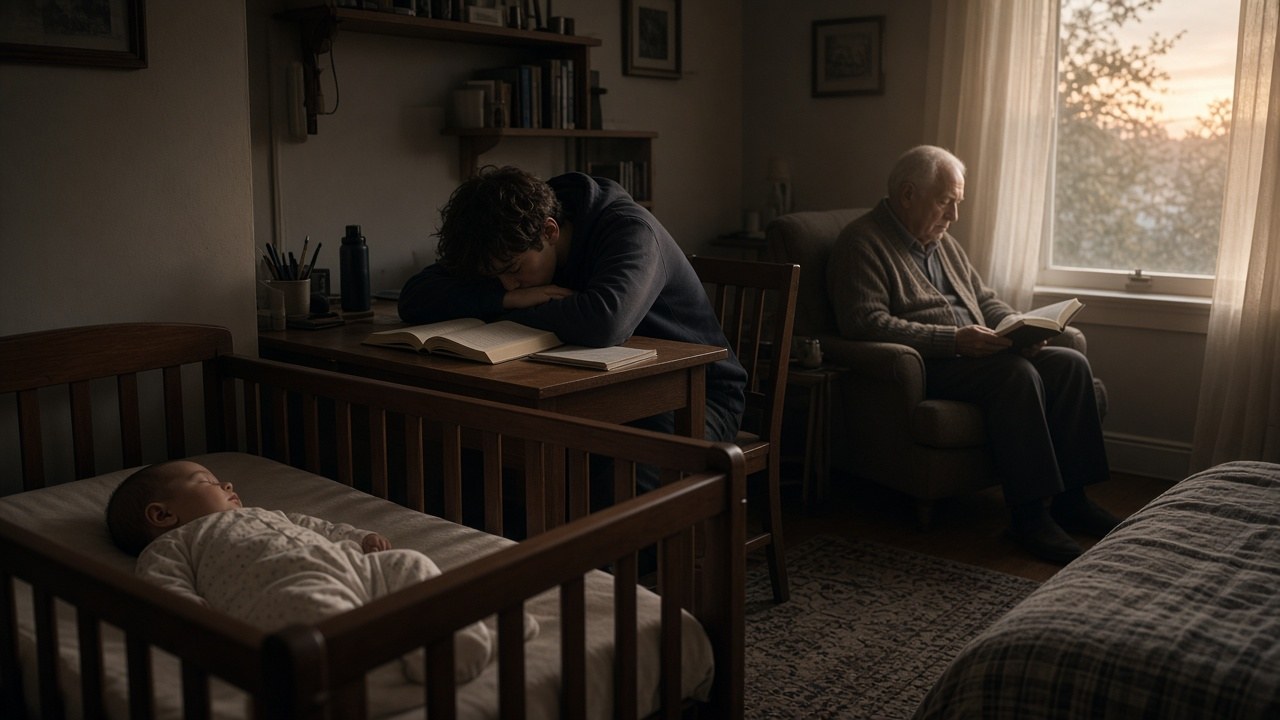
Key takeaway: Expert panels recommend 14 to 17 hours a day for newborns, 12 to 16 for infants, 11 to 14 for toddlers, 10 to 13 for preschoolers, 9 to 12 for school age children, 8 to 10 for teenagers and at least 7 for adults. After 18, the recommended number barely moves for the rest of your life. What changes is how hard it gets to collect it.
How much sleep do you need by age? Newborns need about 14 to 17 hours a day, teenagers 8 to 10, and adults at least 7 hours a night, with 7 to 9 the recommended range from 18 to 64 and 7 to 8 after 65.
That is the chart. It hangs in pediatric waiting rooms and gets screenshotted into parenting group chats, and it looks like a staircase. Every step down is a birthday. Then, around the 18th, the steps stop and the line runs flat across the page until it falls off the right edge.
I find that flat line more interesting than all the steps before it. Children grow out of their sleep needs on schedule. Adults do not grow out of theirs at all, and most of us spend decades behaving as if we had.
Call it the adult discount: the quiet belief that once you stop growing, you have earned a smaller dose. Nobody says it out loud. You can see it in the bedtimes.
The staircase, read properly
The numbers most people quote come from two expert panels. In 2015 the National Sleep Foundation brought together 18 specialists from 12 organizations and set ranges for nine age groups: 14 to 17 hours for newborns, 12 to 15 for infants, 11 to 14 for toddlers, 10 to 13 for preschoolers, 9 to 11 for school age children and 8 to 10 for teenagers.¹
The American Academy of Sleep Medicine published its own pediatric ranges in 2016, after a 13 member panel reviewed 864 studies. They mostly agree, with slightly wider bands: 12 to 16 hours for babies from 4 to 12 months and 9 to 12 hours for children from 6 to 12 years.²
For children up to age five, those totals include naps. The academy also declined to set any number for babies under four months, citing the wide range of normal variation. Anyone who has lived with a newborn will recognize that phrase as the polite version.
One detail parents tend to skip: the academy warned that regularly sleeping more than the recommended hours may also be linked to problems, including high blood pressure, obesity and poorer mental health.² The chart is a range for a reason. It is not a high score table.
So far, so tidy. The staircase falls from 17 hours at the top to about 9 at age 12, and every step is real biology. The trouble starts at the step where biology and the bell schedule stop agreeing.
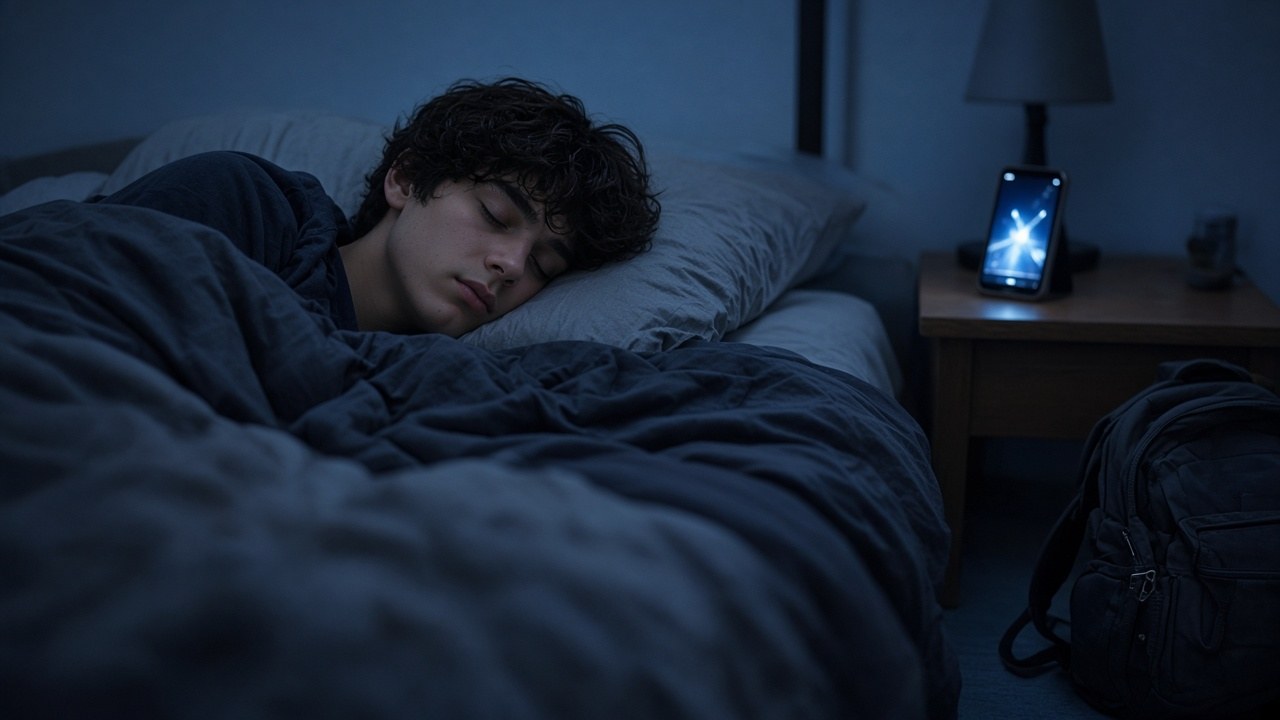
A teenager's clock moves two hours and the bus does not
At puberty, most adolescents go through what the American Academy of Pediatrics calls a sleep phase delay: a shift of up to two hours later in when they fall asleep and wake up, driven by later melatonin release and sleep pressure that builds more slowly.³
Their need does not shrink to match. The academy puts optimal sleep for most teenagers at 8.5 to 9.5 hours, and says the average teen has trouble falling asleep before 11 p.m. and is best suited to waking at 8 a.m. or later.³ Then we put them on a bus at 6:45.
The results are measurable. In the CDC's 2023 Youth Risk Behavior Survey, 23 percent of US high school students said they got at least 8 hours of sleep on an average school night. In 2013 it was 32 percent.⁴
I used to read the teen line on the chart as a statement about teenagers. It is partly a statement about timetables. A large meta-analysis of sleep across the lifespan found that the decline in total sleep through childhood and adolescence showed up in recordings made on school days, not on days off.⁵
The drop in teenage sleep is partly a school schedule wearing a lab coat. Change the schedule and part of the drop goes away, which is roughly what happened when one American city tried it.
When Seattle moved high school start times from 7:50 to 8:45 a.m., researchers tracking students with wrist monitors found median school night sleep rose 34 minutes, from 6 hours 50 minutes to 7 hours 24 minutes, and median grades rose 4.5 percent.⁶ The academy recommends middle and high schools start no earlier than 8:30.³ California made that the legal floor for most high schools in 2022.⁷
Adults hear "7 or more" as "about 7"
For adults, the American Academy of Sleep Medicine and the Sleep Research Society wrote one sentence in 2015: adults should sleep 7 or more hours per night on a regular basis to promote optimal health.⁸ Fifteen experts reviewed 5,314 papers to arrive at it.
The way they got there matters more than the sentence. The panel agreed that 6 hours or less was inappropriate for optimal health and that 7 to 9 was appropriate. It could not reach consensus on the stretch between 6 and 7, though the median vote landed on inappropriate. So it chose a floor, not a range.⁹
Seven hours is the minimum, not the target. Most adults treat it as a ceiling with some give, the way drivers treat a speed limit, and with roughly the same results.
The CDC's numbers show how much give. In 2022, 37 percent of US adults reported sleeping less than 7 hours in a 24 hour period, a share that did not move between 2013 and 2022. Adults aged 45 to 64 were the worst group at 39 percent.¹⁰ Those are the people most likely to be reading sleep charts for their children while ignoring the line with their own age on it.
There is a lab result that makes the discount look worse. Elizabeth Klerman and Derk-Jan Dijk gave healthy young adults 16 hours of sleep opportunity a day for up to a week. At home they spent about 8.5 hours in bed. In the lab their sleep first rose, then settled at about 8.9 hours, which took around five days to reach.¹¹ The researchers concluded that young people carry a sleep debt they do not notice.
If you hit your hours and still feel flat, the number may not be the only problem, and we went through the usual suspects at https://thinknarratives.com/articles/why-you-still-feel-tired-after-8-hours-of-sleep. The longer argument that quantity and rest are not the same thing is at https://thinknarratives.com/articles/the-eight-hour-lie-why-sleeping-enough-isnt-the-same-as-being-rested.
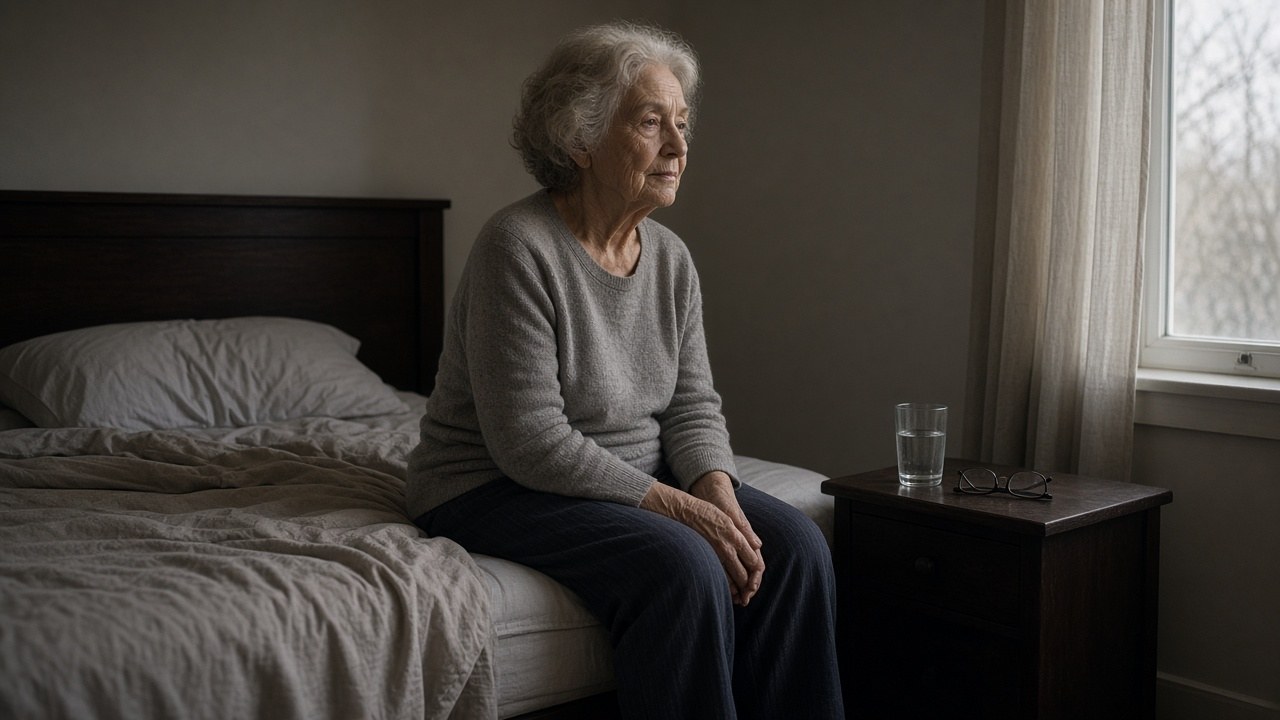
The one age where the chart might be too generous
Here my headline needs an asterisk, because the flat line is not perfectly flat. Near the right edge of the chart the evidence starts to argue with me, and it deserves a fair hearing.
The National Institute on Aging says older adults need about the same amount of sleep as all adults, 7 to 9 hours a night.¹² The National Sleep Foundation narrows that to 7 to 8 hours after 65, and lists 5 to 6 hours as possibly appropriate for some older people.¹ Two respected bodies, one age group, two different answers. That alone tells you the evidence is thinner here than the confident chart suggests.
The same Klerman and Dijk study included people aged 60 to 76. Given 16 hours of opportunity, they settled at 7.4 hours, a full 1.5 hours less than the young group, and they were less sleepy during the day than the young volunteers, not more.¹¹ Older bodies seemed to want less sleep, or to be less able to produce it.
The authors could not fully separate those two explanations. They did point out a practical consequence: an older person who spends more time in bed than they can actually sleep may be setting up the very insomnia complaints that bring people to doctors.¹¹ We made a version of that point about long nights at https://thinknarratives.com/articles/ten-hours-in-bed-will-not-fix-you-the-night-was-already-broken.
The large population data lean the same way. A study of nearly 500,000 UK adults aged 38 to 73 found that about 7 hours a night was linked to the best cognitive performance and mental health, with both shorter and longer sleep tied to worse results, and steady sleep duration mattered too.¹³
So the honest version of my headline is this: your need stops shrinking at 18, then may ease down slightly decades later. It does not ease down at 35 because you have a mortgage.
Nine hours is not the safe side either
If seven is a floor, it is tempting to assume more is always safer. The mortality data do not cooperate. A 2010 meta-analysis of 16 studies and nearly 1.4 million people found that short sleepers had a 12 percent higher risk of death over the follow up period, and long sleepers a 30 percent higher risk, compared with people sleeping around 7 to 8 hours.¹⁴
That long sleep number is almost certainly not about sleep being poisonous. Long sleep often travels with illness, depression or undiagnosed sleep apnea, and the adult consensus panel could not agree on any biological pathway by which long sleep itself causes harm.⁹ It said more than 9 hours may be appropriate for young adults, people recovering from sleep debt and people who are ill.⁸
And yes, some people genuinely need less. In 2009 researchers described a mutation in a gene called DEC2 in a mother and daughter who naturally slept about 6.25 hours a day, against just over 8 hours for relatives without it.¹⁵ It is rare enough to be a headline when another family turns up.
If you need an alarm and three coffees to function on six hours, you have not found the gene. You have found the coffee.
Finding your number inside the range
The ranges are written for healthy people without sleep disorders, which makes them a starting point rather than a prescription. Within the adult band of 7 to 9 hours, there is room for real individual difference. There is not room for five.
The simplest test I know borrows from the lab. Pick a fixed wake time, give yourself enough time in bed for about 8 hours of sleep, and keep it for two weeks. The first few days do not count, because if Klerman and Dijk are right, you are paying off old debt.¹¹ What you settle into after that, and how you feel at 3 p.m., is closer to your number than any chart.
For children, the chart is more literal. For teenagers, the useful lever is the morning, not the lecture. After 65, if 7 hours leaves you alert, lying in bed for nine to chase a chart is more likely to buy you wakeful hours than restful ones. If you sleep 9 or 10 hours and still wake exhausted, that is a reason to see a doctor, not to buy a better pillow.
The flat line will outlast every sleep trend
The adult line on these charts will not drop below 7 hours when the panels next revise them. The evidence for 7 as a floor keeps getting stronger, and no amount of productivity culture will turn that into 6.
School start times will keep moving later, one state and one district at a time, because the before and after numbers are hard to argue with. The teen line on the chart will not move while that happens. Only the bell will.
Adults will keep looking for the discount. Wearables will hand them a nightly score, apps will offer to optimize the hours they do get, and the recommendation will sit there unchanged, as flat and as boring as it was in 2015. Boring is the point. Your sleep need stopped shrinking when you stopped growing. The negotiation was always with yourself.
FAQ
How much sleep do you need by age? The National Sleep Foundation recommends 14 to 17 hours a day for newborns, 12 to 15 for infants, 11 to 14 for toddlers, 10 to 13 for preschoolers, 9 to 11 for school age children, 8 to 10 for teenagers, 7 to 9 for adults aged 18 to 64 and 7 to 8 for adults over 65. The American Academy of Sleep Medicine's ranges are nearly identical and count naps up to age five.
How many hours of sleep does a teenager need? Teenagers need 8 to 10 hours a night, and the American Academy of Pediatrics puts the optimal amount for most at 8.5 to 9.5 hours. Only 23 percent of US high school students reported getting at least 8 hours on school nights in 2023, partly because puberty shifts their body clock up to two hours later while school still starts early.
Do older adults need less sleep? Mostly not. The National Institute on Aging says older adults need about the same 7 to 9 hours as other adults, while the National Sleep Foundation recommends 7 to 8 after 65. Lab research suggests older people's maximum capacity for sleep does fall, so sleep often becomes lighter and shorter even when the need stays similar.
Is 6 hours of sleep enough? For most adults, no. The expert panel behind the adult guideline agreed that 6 hours or less is inappropriate for optimal health and set 7 hours as the minimum. A very small number of people carry rare gene variants that let them function on about 6 hours, but most people who sleep 6 hours are simply short on sleep.
Is it bad to sleep 9 or 10 hours? Not necessarily. Sleeping more than 9 hours may be appropriate for young adults, people recovering from sleep debt and people who are ill. Long sleep is linked to higher mortality in population studies, but it is often a sign of an underlying problem such as illness, depression or sleep apnea, so persistent long sleep with daytime exhaustion is worth checking with a doctor.
This article is for general information and is not medical advice. If you or your child regularly sleep far outside these ranges or feel exhausted despite enough sleep, talk to a qualified clinician.
Sources
¹ Max Hirshkowitz, Kaitlyn Whiton, Steven M. Albert and colleagues, "National Sleep Foundation's sleep time duration recommendations: methodology and results summary," Sleep Health 1(1), 40 to 43, 2015. Panel of 18 experts from 12 organizations; recommended and "may be appropriate" ranges for nine age groups. https://doi.org/10.1016/j.sleh.2014.12.010
² Shalini Paruthi, Lee J. Brooks, Carolyn D'Ambrosio and colleagues, "Recommended Amount of Sleep for Pediatric Populations: A Consensus Statement of the American Academy of Sleep Medicine," Journal of Clinical Sleep Medicine 12(6), 785 to 786, 2016. Ranges for ages 4 months to 18 years, naps included up to age five, no recommendation under 4 months, 13 member panel and 864 articles. https://doi.org/10.5664/jcsm.5866
³ American Academy of Pediatrics, Adolescent Sleep Working Group, Committee on Adolescence and Council on School Health, "School Start Times for Adolescents," Pediatrics 134(3), 642 to 649, 2014. Pubertal phase delay of up to 2 hours, optimal teen sleep of 8.5 to 9.5 hours, and the recommendation that middle and high schools start no earlier than 8:30 a.m. https://doi.org/10.1542/peds.2014-1697
⁴ Centers for Disease Control and Prevention, "Youth Risk Behavior Survey Data Summary and Trends Report for Dietary, Physical Activity, and Sleep Behaviors: 2013 to 2023." Share of high school students getting at least 8 hours of sleep on an average school night, 32 percent in 2013 and 23 percent in 2023. https://www.cdc.gov/yrbs/dstr/pdf/DSTR-Dietary-PhysicalActivity-SleepBehavior2013-2023-508.pdf
⁵ Maurice M. Ohayon, Mary A. Carskadon, Christian Guilleminault and Michael V. Vitiello, "Meta-Analysis of Quantitative Sleep Parameters From Childhood to Old Age in Healthy Individuals: Developing Normative Sleep Values Across the Human Lifespan," Sleep 27(7), 1255 to 1273, 2004. Decline in total sleep time in children and adolescents seen only in school day recordings. https://doi.org/10.1093/sleep/27.7.1255
⁶ Gideon P. Dunster, Luciano de la Iglesia, Miriam Ben-Hamo and colleagues, "Sleepmore in Seattle: Later school start times are associated with more sleep and better performance in high school students," Science Advances 4(12), eaau6200, 2018. Start time moved from 7:50 to 8:45 a.m.; median sleep up 34 minutes; median grades up 4.5 percent. https://doi.org/10.1126/sciadv.aau6200
⁷ California Education Code, Section 46148 (added by Senate Bill 328, 2019). High schools to begin no earlier than 8:30 a.m. and middle schools no earlier than 8:00 a.m. by July 1, 2022, with rural districts exempt. https://leginfo.legislature.ca.gov/faces/codes_displaySection.xhtml?lawCode=EDC§ionNum=46148.
⁸ Nathaniel F. Watson, M. Safwan Badr, Gregory Belenky and colleagues, "Recommended Amount of Sleep for a Healthy Adult: A Joint Consensus Statement of the American Academy of Sleep Medicine and Sleep Research Society," Journal of Clinical Sleep Medicine 11(6), 591 to 592, 2015. Seven or more hours for adults aged 18 to 60; more than 9 hours may be appropriate for some groups; 15 experts and 5,314 articles. https://doi.org/10.5664/jcsm.4758
⁹ Nathaniel F. Watson, M. Safwan Badr, Gregory Belenky and colleagues, "Joint Consensus Statement of the American Academy of Sleep Medicine and Sleep Research Society on the Recommended Amount of Sleep for a Healthy Adult: Methodology and Discussion," Journal of Clinical Sleep Medicine 11(8), 931 to 952, 2015. Voting results on 6 hours or less, 6 to 7 hours and more than 9 hours, and the decision to set a minimum threshold rather than a range. https://doi.org/10.5664/jcsm.4950
¹⁰ Centers for Disease Control and Prevention, "FastStats: Sleep in Adults." 37 percent of US adults reporting less than 7 hours in 2022, no change from 2013 to 2022, and 39 percent among adults aged 45 to 64. https://www.cdc.gov/sleep/data-research/facts-stats/adults-sleep-facts-and-stats.html
¹¹ Elizabeth B. Klerman and Derk-Jan Dijk, "Age-Related Reduction in the Maximal Capacity for Sleep: Implications for Insomnia," Current Biology 18(15), 1118 to 1123, 2008. Sixteen hours of daily sleep opportunity; sleep settled at 8.9 hours in adults aged 18 to 32 and 7.4 hours in adults aged 60 to 76. https://doi.org/10.1016/j.cub.2008.06.047
¹² National Institute on Aging, "Sleep and Older Adults." Older adults need about the same amount of sleep as all adults, seven to nine hours each night. https://www.nia.nih.gov/health/sleep/sleep-and-older-adults
¹³ Yuzhu Li, Barbara J. Sahakian, Jujiao Kang and colleagues, "The brain structure and genetic mechanisms underlying the nonlinear association between sleep duration, cognition and mental health," Nature Aging 2, 425 to 437, 2022. Nearly 500,000 UK Biobank adults aged 38 to 73; about 7 hours linked to the best cognition and mental health. https://doi.org/10.1038/s43587-022-00210-2
¹⁴ Francesco P. Cappuccio, Lanfranco D'Elia, Pasquale Strazzullo and Michelle A. Miller, "Sleep Duration and All-Cause Mortality: A Systematic Review and Meta-Analysis of Prospective Studies," Sleep 33(5), 585 to 592, 2010. 16 studies and 1,382,999 participants; relative risk 1.12 for short sleep and 1.30 for long sleep. https://doi.org/10.1093/sleep/33.5.585
¹⁵ Ying He, Christopher R. Jones, Nobuhiro Fujiki and colleagues, "The Transcriptional Repressor DEC2 Regulates Sleep Length in Mammals," Science 325(5942), 866 to 870, 2009. DEC2 mutation carriers averaged 6.25 hours of daily sleep versus 8.06 hours in noncarriers. https://doi.org/10.1126/science.1174443