

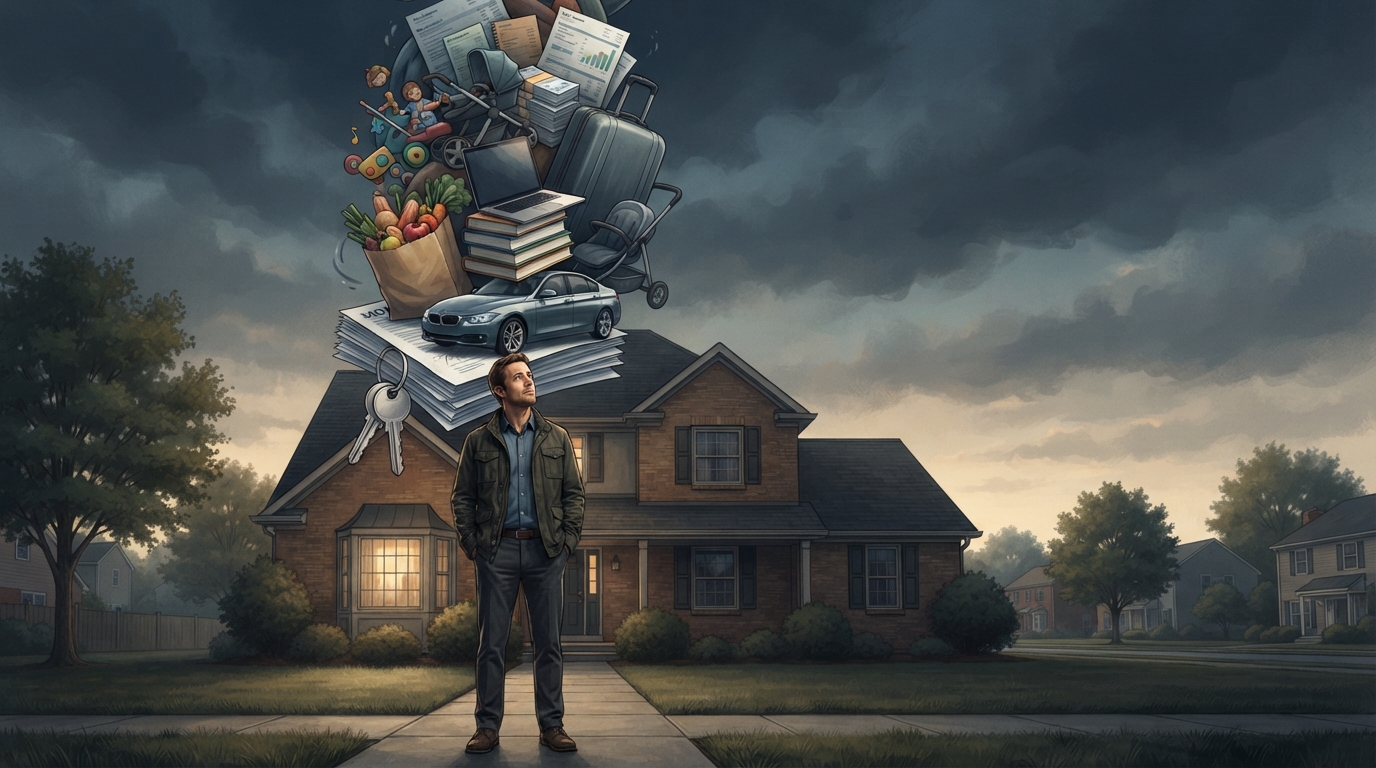
The life people were told to want was never supposed to feel luxurious. So why does a decent home, financial security, family, and free time now feel increasingly difficult to afford?
Key takeaway: The good life hasn't changed. The definition of what counts as "normal" has expanded into a checklist of requirements. The real fix isn't earning more. It's getting honest about what "enough" actually looks like.
I keep coming back to the same question, usually around 2 a.m. When the mortgage payment is processing: when did "normal" turn into a stretch goal?
Because the list itself hasn't changed much. A decent home. A reliable car. A stable job. A family, maybe one proper holiday a year, and enough savings that a broken transmission doesn't wreck your whole month. A few evenings a week where nobody needs anything from you.
Nobody's asking for a yacht. And yet ask around. Talk to reasonably paid, reasonably responsible people, the kind who do everything right on paper, and you'll find a lot of them feeling like they're falling short of a bar their parents cleared without much visible drama.
I don't think they want more than their parents wanted. I think they want the same thing, and the cost of it quietly tripled while nobody was watching.
But it's not really that the good life got more expensive in the way people usually mean. It's that the definition of a good life accumulated too many mandatory requirements. Things that used to be optional became required. Things that used to be separate became a bundle. And that bundle, the whole package, now costs something very few people can actually afford.
That's the real inflation nobody talks about. I think of it as requirement inflation: the inflation of the normal.
The inflation of normal
The obvious explanation is prices. Housing is up. Groceries are up. Childcare is absurd. Energy bills land harder than they used to. All true, all worth being angry about.
But there's a second thing happening that's easier to miss because it doesn't show up on a receipt.
The bar for "decent" quietly turned into a checklist.
A home used to mean shelter. Now it's supposed to be safe; reasonably spacious; near decent schools; close enough to work that you're not losing two hours a day to a commute; and ideally it shouldn't eat half your paycheck doing all of that.
A job used to mean a paycheck. Now it's supposed to pay well, offer flexibility, come with room to grow, protect your mental health, and leave you enough energy at the end of the day to actually enjoy the money it's paying you.
Saving used to mean saving. Now you're expected to fund an emergency cushion, a retirement account, a house down payment, your kid's education, and some vague hedge against whatever the economy does next, all at once, on one income.
None of these expectations is crazy by itself.
Stack them and you get something nobody could reasonably afford on a single salary.
Nobody sells you "a life." They sell you the pieces.
Here's the part that took me a while to see clearly: a comfortable adult life was never one purchase. It's more like a supply chain, and every link costs money on its own.
Housing needs income. Income needs a job that pays enough. A job like that often requires you to live somewhere with decent transit and opportunity, which pushes housing costs back up. You need healthcare, savings, enough time off that you don't burn out, a social life, and some kind of recreation so the whole thing feels worth doing.
Have kids and multiply most of that. Want a good school district, and the housing math gets worse again.
None of the individual line items looks crazy on a spreadsheet. Add them up and you get a number that doesn't match most paychecks.
This is why people can stare at their bank statement, find no single embarrassing expense, no daily latte, and no impulse purchase and still feel like they're drowning. There's no smoking gun. The whole life is the expense.
I've watched a friend do this math in real time. She got a promotion that came with a €300 monthly raise. She was genuinely excited, a win, finally, after years of grinding. Three hundred euros is real money. It's also the exact amount her rent went up three months later, plus the difference in her commute costs after her office moved further out. The raise disappeared before it ever arrived. She didn't do anything wrong. The math just didn't work in her favor.
Security used to be assumed. Now you have to build it yourself.
Maybe the biggest shift is this one: a stable paycheck used to feel like enough. Now it's the starting point for a whole separate project.
You're expected to build an emergency fund because your job could vanish with two weeks' notice. Invest, because a pension isn't coming and retirement is on you. Carry insurance, because one bad diagnosis or accident can undo a decade of progress. Keep your skills current, because your industry might not look the same in five years. Have a backup plan, because your main plan is standing on ground that could shift at any moment.
Financial security stopped being something your job or your government handed you. It became a DIY project everyone's expected to run in their spare time.
Which puts a lot of people in a strange spot. They're doing everything right: working, saving, paying every bill on time, and cutting the obvious waste, and they still lie awake knowing one bad month could knock the whole thing over.
Which is, you know, a normal amount of existential dread to be casually carrying around on a Tuesday.
Housing stopped being just housing
If you want the clearest example of one thing carrying too much weight, look at housing.
A home should just be a place to live. Instead, it's doing five or six jobs at once: shelter, investment vehicle, status marker, proxy for school quality, determinant of your commute, and often the biggest asset in someone's eventual retirement.
That's a lot to ask of one monthly payment.
You cannot decide where to work until you figure out where you can afford to sleep. In the US, nearly half of renters now spend more than 30% of their income on housing, the federal government's traditional threshold for being "cost-burdened."¹ In the UK, the ratio of median house prices to median earnings has more than doubled since the early 1990s, from roughly 3.5 to over 8 in 2025. ² In Australia, the national median house price is now more than eight times the median annual income, up from around 4.5 in the early 1990s. ³
These numbers are tracking the same story in different accents.
It's gotten serious enough that housing costs now directly shape which jobs people can even consider. I was in a room recently where someone mentioned a job opening in another city, and the first question wasn't "What's the salary?" It was, "Could anyone actually afford to live there?"
Think about what that means. Housing isn't just one line item anymore. It's become the thing that decides whether the rest of the bundle is reachable at all.

"Just earn more" doesn't actually fix this
The obvious answer, the one everyone reaches for first, is to make more money. If life costs more, out-earn it.
Fair enough on paper. But it quietly assumes the wrong problem: that the issue is your income, not the fact that "normal" keeps getting more expensive underneath you.
Here is what usually happens instead. Someone gets a raise. Within a year they've moved somewhere nicer, upgraded the car, bumped up how much they think they "should" be saving, and picked up a few new obligations that come with the new tax bracket.
The extra income doesn't sit there. It gets absorbed into the next, pricier version of normal.
Nothing got solved. The problem just got a nicer coat of paint.
The psychological part matters too. People don't chase the good life purely for comfort. A lot of it is proof, evidence that the years of school, the long hours, and the sacrifices actually amounted to something. A nicer place. A better neighborhood. Trips worth posting about. Some visible sign that it was all worth it.
This sets a trap most people don't notice they're standing in: once your lifestyle becomes the receipt for your effort, downsizing starts to feel like admitting the effort failed.
So people hang onto things they've stopped enjoying. The apartment is a stretch every month. The car payment they wince at. The extra hours at a job that's draining them. The habit of saying yes to everything.
Not because they actually want any of it anymore. Because somewhere along the way, it stopped being a lifestyle choice and became part of the story they tell about who they are.
The contradiction nobody warns you about
We're told, more or less from childhood, that earning more money buys freedom.
Except the version of the good life that money usually buys tends to require more work to keep running, not less.
A bigger place needs a bigger income. A bigger income often means a more demanding job. A more demanding job eats your free time. Less free time makes convenience non-negotiable: takeout instead of cooking, a car instead of the bus, and a cleaner instead of a Saturday morning. Convenience costs money. Which means you need more income.
Round and round it goes.
At some point you're working harder to pay for the life that was supposed to be the payoff for working hard. That's not really progress. It's a treadmill with better upholstery.
The easy version of this article is just, "Everything is expensive, and that's bad. " True, but not interesting.
The harder truth is that the middle class didn't collapse because people got lazy or spent too much on avocados. Housing policy, wage stagnation, globalization, and cultural shifts all played their part. But underneath all of that, a deeper structural change took place: part of what happened is that one system was asked to deliver two different things at once.
For many workers in the postwar era, a job provided more than a paycheck. Employer pensions, unions, public services, and relatively accessible housing absorbed some of the risks that individuals are now expected to carry themselves.
That world is gone. But the expectations didn't adjust. So now we're asking a single salary to do the work of an entire social safety net and blaming individuals when it doesn't quite stretch.
Which brings us to the uncomfortable part: the people who feel like they're failing are often the ones who actually figured out the system. They just figured it out too late.
It's not "cut out your daily coffee." That advice has never solved anyone's actual problem. It's a way for people with structural advantages to tell people without them to just try harder.
The real question is closer to, "Which pieces of a good life are actually doing the work, and which ones are just there because you were told they should be?"
Maybe it's not a bigger house. Maybe it's a smaller one in a spot that hands you back an hour of your day. Maybe it's not a nicer car; it's a shorter commute, so you barely need the car. Maybe it's not more trips; it's having the slack, money, and time, both, to disappear for a week without checking your inbox once.
Financial success might have less to do with piling up an impressive-looking life and more to do with cutting the parts that require constant upkeep just to look impressive.
The Minimum Viable Good Life
There's a real difference between living cheaply and living deliberately, and it's easy to conflate the two.
Living cheaply is about spending as little as you can stand. Living deliberately is about figuring out, honestly, what you actually value paying for and letting everything else go.
The Minimum Viable Good Life is not the smallest life you can grit your teeth and tolerate. It's the smallest one that still has the stuff that matters in it.
Somewhere you actually like coming home to. Work that doesn't swallow every waking hour. People you have time left over to see. Enough cash cushion that a bad week doesn't become a bad year. Enough flexibility that you're not making decisions out of panic.
Everything past that baseline is a bonus. Not a requirement you're failing to meet.
This concept, the Minimum Viable Good Life, is worth holding onto. Because once you define it clearly, everything else becomes a choice rather than an obligation. The bigger house is an option, not a necessity. The nicer car is a treat, not a default. The career escalation is a decision, not an inevitability.
To be clear: this is not a pitch for minimalism. There's nothing morally superior about owning less. A big house can be genuinely great. A nice car is allowed to be fun. Travel is worth the money. Good food is worth the money. None of that needs defending.
The point isn't to reject nice things. It's to stop letting them set the floor for what counts as an acceptable life. Because the second every upgrade becomes mandatory, your income has to climb forever just to stay even. The moment upgrades go back to being optional, you get something back.
Room!!.

This is really about freedom, not frugality
Picture two people earning identical salaries. One needs almost every dollar of it just to keep their current life running. The other has deliberately built a life that costs noticeably less than they bring in.
From the outside, the second person might not look richer at all. Same job, similar apartment building, nothing flashy. But they're sitting on something the first person doesn't have: margin.
And margin is what actually buys options. It's what lets someone save seriously, invest, take a swing at a career change, move cities, take three months off, start the business, turn down the project that isn't worth it, or just wait for a better opportunity instead of grabbing the first one out of desperation.
That kind of wealth doesn't photograph well. But it's the kind that actually changes what your life can become.
Where this is heading
I don't think most people are failing to earn enough. I think a lot of us are trying to buy a version of success that quietly picked up too many requirements along the way, and nobody sat down to ask whether all of them were necessary.
The good life doesn't have to go away. But I suspect its footprint is going to shrink, not because people want less, but because they're going to realize the old version was a bad deal.
Here is my bet: within the next decade, the cultural definition of "making it" will shift away from visible consumption and toward invisible flexibility. The status symbol of the 2030s won't be a bigger house. It will be the ability to walk away from a job you hate without having another one lined up. The flex won't be the vacation photos. It will be the Tuesday afternoon you got back.
A good home doesn't have to be the biggest one the bank approves. A good career doesn't have to eat up every hour you have. The rest is just noise. A comfortable life was never meant to require an audience. It was supposed to be simply a life worth living.
Maybe the answer to an expensive world isn't a bigger paycheck. It's getting a lot more honest with yourself about what "enough" actually looks like and holding onto that version like it matters.
Because it does.
Frequently Asked Questions
Why does the good life feel so expensive now even though I earn a decent salary?
Because the definition of a "decent" life has expanded into a checklist of requirements, housing, savings, career flexibility, and security, which used to be separate or assumed. The complete package costs significantly more than the individual pieces suggest.
Is the solution to just earn more money?
Not really. Earning more often leads to lifestyle inflation, where the extra income gets absorbed into a pricier version of normal. The real lever is reducing what you consider mandatory, not just increasing what you bring in.
What is the Minimum Viable Good Life?
It's the smallest version of your life that still contains the things you genuinely value: a home you enjoy, work that doesn't consume you, relationships you have time for, enough savings to absorb ordinary shocks. Everything beyond that is optional.
Is this just another way of saying I should be a minimalist?
No. The point isn't to own less for its own sake. It's to stop treating every upgrade as a requirement so you can keep the things that actually matter without drowning in the cost of everything else.
What's the difference between living cheaply and living deliberately?
Living cheaply means spending as little as possible. Living deliberately means spending money only on what you actually value. They overlap sometimes, but the intention is different. One is about scarcity. The other is about priorities.
Sources:
¹ US Census Bureau, American Community Survey, 2023. Found that 49.7% of renter households spend more than 30% of their income on housing costs. The 30% threshold is the federal standard for being "cost-burdened."
² UK Office for National Statistics, UK House Price Index and Annual Survey of Hours and Earnings, 2025. The ratio of median house prices to median workplace-based earnings in England and Wales was approximately 3.5 in the early 1990s and exceeded 8 in 2025. The ONS uses "house price-to-earnings ratio" as its standard metric.
³ Australian Bureau of Statistics, Housing Occupancy and Costs, 2025. The national median house price-to-income ratio for established dwellings is 8.4, up from approximately 4.5 in the early 1990s.