


I have been watching something strange happen. People are hitting every milestone they were promised would fix things: the degree, the job, the house, and the two-week vacation, and a lot of them are discovering it does not feel the way they were supposed to feel.
Someone earning $90,000 a year does not look poor. Decent apartment, car that starts every morning, a real vacation once a year. Then a transmission dies, or a kid needs braces, and there is almost nothing underneath. Not because they were careless. Because the whole structure was built to survive a normal month, not a bad one.
Bank of America's internal spending data puts about 24% of U.S. households in that exact position in 2025, spending over 95% of their income just on necessities, and the growth in that number over the past two years has come almost entirely from middle and lower-income households, not the poorest ones. [1] It is not just the broke who feel broke anymore. It is people who, on paper, made it.
Why earning more doesn't fix it
I have watched this happen enough times that it stopped surprising me. Someone gets promoted, the offer letter looks great, and six months later they are driving a nicer car, paying a bigger mortgage, and checking their bank balance more often than before the raise. Nothing reckless happened. It was a series of entirely reasonable decisions that added up to the same financial tightness, just at a higher altitude.
Nobody wakes up one day and decides to become financially trapped. It happens the way most traps happen, one sensible choice at a time.
There is real data behind this pattern showing up at the very top of the income range too. CNBC reported in 2025 that nearly two thirds of people earning over $300,000 a year still carry credit card debt. [2] A psychologist quoted in that piece said something worth remembering: earning the money does not make you feel rich; spending it does.
Why does the middle class feel poor? Because income growth does not automatically produce wealth growth. Higher earnings usually come with higher fixed expenses, while wealth comes from owning something that keeps producing value on its own.

The adaptation problem
Humans are surprisingly bad at holding onto satisfaction. The apartment that once felt like an upgrade becomes the baseline within a year. The salary that once felt generous becomes the number you resent not being higher. This is not a character flaw so much as a design feature, the same mechanism that makes the first cup of coffee taste better than the fifth.
The comparison problem makes it worse. A person earning $120,000 rarely compares themselves to someone earning $40,000. They compare themselves to someone earning $250,000, usually the person one rung up on the exact same ladder, which means the finish line moves at roughly the speed you run toward it.
Underneath both sits the identity problem. A lot of spending was never really about utility. The car, the neighborhood, the school district – these are also quiet proof of something: I made it. I am not who I used to be. That is a harder thing to budget against than rent.
Income versus ownership
The distinction that matters most is boring compared to all of that psychology, but it has more teeth than any of it. Income is money that shows up because you did. Wealth is money that stays behind after you stop showing up.
That gap becomes visible the moment a job disappears, and for a lot of people that moment is closer than they would like to admit. The Federal Reserve's most recent household survey found only 63% of adults could cover a surprise $400 expense with cash or something close to it. [3] More than a third would need to borrow, sell something, or simply could not.
Wealthy households generally do not rest their whole lives on one income stream. They lean on ownership, a business, property, equity, or something that keeps producing whether or not they clocked in that day.
What separates wealthy people from middle-class people? The clearest difference is usually ownership. Wealthy households tend to hold assets like businesses, investments, or property that generate value beyond their own labour. Middle-class households more often trade time directly for income, with little left over to convert into ownership.
The middle class is not one thing
Here the original framing gets a little too clean. There is no single middle-class experience. A household earning $80,000 in a small town and one earning $180,000 in a major city can both technically qualify as middle class where they live and be living opposite financial lives. One might own their home outright by 45. The other might spend well over half that higher income on rent and never catch up.
Housing, healthcare, and childcare have all climbed faster than wages across most of the country for two decades. The same responsible choices that built financial security for a previous generation buy noticeably less breathing room now. Some of this is personal spending behavior. A good amount of it is just the cost of living in a country that changed underneath people while they were still following instructions written for an earlier version of it.
Two systems asked to do one job
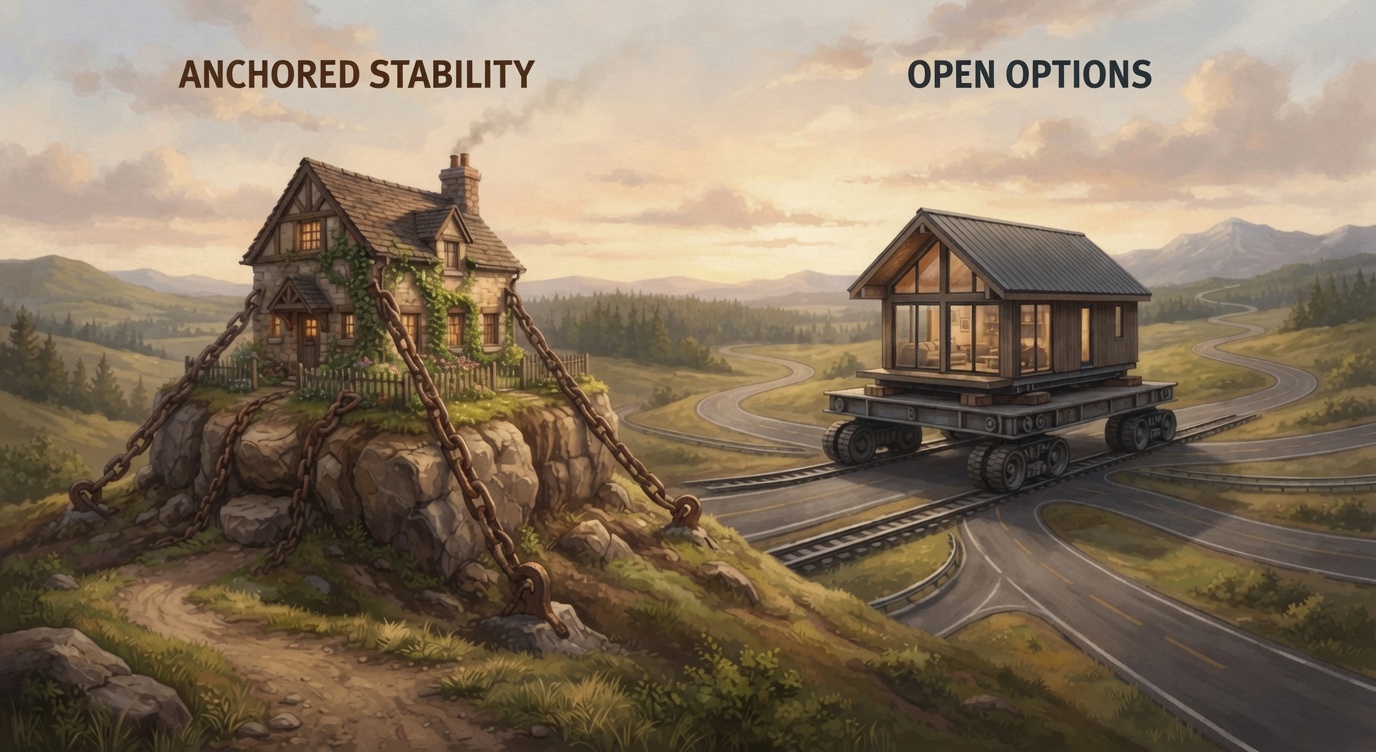
The middle class did not fail. In a lot of ways it succeeded: longer lives, safer homes, more education, and more physical comfort than any previous generation had. The problem is that one system was asked to deliver two different things at once, security and freedom, and it was only ever really built for the first one.
Security means your life does not collapse when something unexpected happens. Freedom is different. Freedom is knowing you have choices when the unexpected does happen, not just the ability to absorb it and keep going. Most middle-class households have the first. Very few have the second, and that includes households earning far more than the median. A growing number of people earning $200,000 or more a year are living pay cheque to paycheque for exactly this reason, not carelessness, but because a system built for stability was never going to hand them freedom as a side effect. [4]
Is being middle class a bad thing? No. It provides stability, comfort, and opportunity that earlier generations often did not have. The issue is that stability and financial freedom are two different goals, and reaching one does not automatically deliver the other.
What actually changes something
There is a comforting story a lot of people tell themselves: that the next raise will finally be the one that fixes it. At the bottom of the income ladder, that is usually true. Somewhere past a certain point it stops being reliably true. A study out of the University of Pennsylvania found more than a quarter of households earning between $200,000 and $300,000 a year still describe themselves as unhappy with their finances. [5]
Two people can earn the exact same amount of money and live completely different financial lives, because their money is serving two different purposes. One person's income is still paying off the past. The other is building the future. From the outside, their paychecks look identical.
Why do high earners still feel broke? Because lifestyle costs tend to rise alongside income. Without deliberately converting some of that income into assets, a bigger salary just funds a more expensive version of the same financial pressure, not less of it.
Where this leaves people
Reaching middle class is a real accomplishment, and this is not an argument that middle-class households have it worse than anyone else. It is an argument that a specific kind of trap does not check anyone's income bracket before it closes around them.
Wealth is not really a number. It is closer to a relationship with time, whether the years ahead of you are already spoken for or whether some of them are still yours to decide about. The next generation's biggest financial advantage probably will not come from simply earning more. It will come from understanding the difference between being rewarded by a system and owning a piece of it.
Key takeaway: The middle class is not failing because people earn too little. Many people feel financially trapped because their money provides stability, not ownership, and stability and freedom were never the same goal.
Frequently Asked Questions
Why do high earners still feel broke? High earners often feel broke because lifestyle expenses rise alongside income. Without building assets, a higher salary can produce a more expensive lifestyle rather than more financial security.
Is being middle class a bad thing? No. The middle class provides stability, comfort, and opportunity. The challenge is that stability and financial freedom are different goals, and one does not guarantee the other.
What separates wealthy people from middle-class people? The biggest difference is usually ownership. Wealthy households tend to own assets such as businesses, investments, or property that generate value beyond their direct labor, while middle-class income is more often traded directly for time.
Why does the middle class feel poor despite earning more? Because income growth does not automatically translate into wealth growth. Higher earnings frequently come with higher fixed expenses, while wealth comes from owning something that continues producing value independent of a paycheck.
Can a six-figure salary still mean living paycheck to paycheck? Yes. Research on so-called HENRYs, high earners not rich yet, shows a significant share of people earning $200,000 or more a year live paycheck to paycheck due to lifestyle costs rising alongside income.
Sources
- Bank of America Institute. Paycheck to Paycheck: Slowing but Growing. 2025 household spending data. Supports the claim that roughly 24% of U.S. households spent over 95% of income on necessities in 2025.
- CNBC. 'HENRYs': Why High-Earning Americans Do Not Feel Rich. July 2025. Supports the claim that a majority of $300,000-plus earners still carry credit card debt.
- Federal Reserve Board. Survey of Household Economics and Decisionmaking (SHED), 2024, published 2025. Supports the claim about emergency savings and financial resilience among U.S. households.
- South Florida Media. Why Even High Earners Are Living Paycheck to Paycheck. August 2025. Supports the claim about $200,000-plus earners living paycheck to paycheck.
- Matt Killingsworth, University of Pennsylvania. Financial satisfaction research, as reported by AOL and The Wall Street Journal. Supports the claim about financial dissatisfaction among $200,000 to $300,000 earners.