
Key takeaway: Does magnesium help you sleep? Modestly, and mainly if your diet is short on it. The best pooled evidence finds older adults fell asleep about 17 minutes faster on magnesium than on placebo, from low quality trials. Magnesium helps sleep by correcting a shortfall, not by sedating you, so the people who gain most are the ones who were running low.
Does magnesium help you sleep? Yes, a little, and mostly if you were not getting enough of it to begin with. It is a refill for a gap in your diet, not a switch that turns your brain off.
That is a smaller promise than the one on the gummy jar. It is also a more honest one, and for a lot of people it is still worth having.
You have probably seen the ritual. A glass of tart cherry juice, a scoop of magnesium powder, a splash of sparkling water, a video with soft lighting and a caption about finally sleeping like a baby. TikTok calls it the "sleepy girl mocktail," and by early 2024 it had taken the bedtime tea's place on a lot of nightstands.¹
The drink is harmless. The story around it is where things go soft. Magnesium gets sold as the calm mineral, the missing piece, the thing your anxious modern body has been begging for. Some of that is true for some people. Most of it is a marketing department rounding up.
I keep coming back to one question that the supplement aisle never asks: helps whom, compared with what, by how much?
Seventeen minutes and a lot of asterisks
The most cited trial is small and specific. In 2012, Behnood Abbasi and colleagues in Tehran randomized 46 adults aged 60 to 75 with insomnia to 500 mg of elemental magnesium a day, as magnesium oxide, or a placebo for eight weeks.²
The magnesium group did better on several measures. Their Insomnia Severity Index scores dropped more than placebo. They fell asleep faster, slept more efficiently, and showed higher serum melatonin and lower cortisol by the end. Total sleep time, the number most people care about, did not differ between groups by a margin the study could separate from chance.²
Now read the entry requirements. To join the trial, people had to be eating less than 75 percent of the recommended daily magnesium intake.²
That detail changes the whole result. This was not a test of whether magnesium makes a normal sleeper sleepier. It was a test of whether topping up older people who were short on magnesium helps their insomnia. It seems to. That is a much narrower finding than "magnesium helps you sleep."
In 2021, Jasmine Mah and Tyler Pitre pooled the trials that met a decent bar for a systematic review in BMC Complementary Medicine and Therapies. They found three randomized controlled trials, covering 151 older adults in three countries. Abbasi's was one of them.³
The pooled result: people on magnesium fell asleep 17.36 minutes faster than people on placebo. Total sleep time rose by about 16 minutes, but that difference could have been chance. All three trials were at moderate to high risk of bias, and the evidence was rated low to very low quality.³
Their conclusion is a perfect piece of academic shrugging. The literature, they wrote, is substandard for doctors to make well informed recommendations. Then, because oral magnesium is very cheap and widely available, the trial evidence may still support trying it.³
Seventeen minutes faster to fall asleep is real but modest, and it comes from older adults in a handful of small trials.
If you lie awake for an hour, seventeen minutes is a noticeable chunk. If you lie awake because your mind is running a board meeting, seventeen minutes is a rounding error on the wrong problem.
The people it helps were already running low
The newest and best designed trial makes the pattern harder to ignore.
In 2025, a team led by Julius Schuster at Leibniz University Hannover gave 155 adults aged 18 to 65 who reported poor sleep either magnesium bisglycinate, 250 mg of elemental magnesium a day, or an identical placebo for four weeks. They took two capsules 30 to 60 minutes before bed.⁴
Insomnia scores fell by 3.9 points on magnesium and 2.3 points on placebo. The difference passed the statistical bar by a whisker, p = 0.049, and the effect size was small. The authors called it "a modest benefit."⁴
Two other details matter more than the headline.
First, the placebo group got better too, by 18 percent from baseline compared with 28 percent on magnesium.⁴ A nightly ritual, a capsule, and the expectation of help did a good share of the work in both arms. Magnesium added a slice on top.
Second, in exploratory analyses the people who improved most were the ones reporting lower dietary magnesium at the start. The authors flagged them as a possible subgroup of high responders.⁴
There is the shape of it. In the Tehran trial, the participants were chosen for low intake and improved. In the German trial, the low intake participants seem to have driven more of the gain. I think of it as the refill effect. Magnesium does not push a full tank past full. It helps when the tank was low.
And plenty of tanks are low. The NIH Office of Dietary Supplements reports that 48 percent of Americans of all ages take in less magnesium from food and drink than their estimated average requirement. Men over 70, adolescents, people with type 2 diabetes, people with digestive diseases such as Crohn's or celiac disease, and people with alcohol dependence are the most likely to fall short.⁵
The drinking group deserves a pause. Chronic heavy alcohol use is a well known route to magnesium deficiency.⁵ It is also, separately, a reliable way to wreck the second half of the night. Our piece on the nightcap covers how alcohol trades a fast knockout for broken sleep later: https://thinknarratives.com/articles/a-nightcap-is-not-a-sleep-aid-it-is-a-sedative-with-a-four-hour-battery
The large observational data point the same way. In the CARDIA study, which followed 3,964 American adults, people in the top quarter of magnesium intake were less likely to sleep under seven hours than people in the bottom quarter, with an odds ratio of 0.64. The link with better sleep quality was borderline.⁶
That is an association, not proof. People who eat more beans, greens, nuts and whole grains tend to differ from people who do not in a dozen other ways. A 2023 systematic review by Arman Arab and colleagues summed up the field in one sentence: observational studies suggest a link between magnesium status and sleep, while randomized trials report contradictory findings.⁷
Magnesium looks most useful as a repair for low intake, and least useful as an add on for people who already eat enough of it.
The awkward part is that you probably do not know which group you are in. Ordinary blood tests are a poor guide, because less than 1 percent of the body's magnesium sits in serum and the body holds that level tightly.⁵ Your diet is a better clue than your lab sheet.
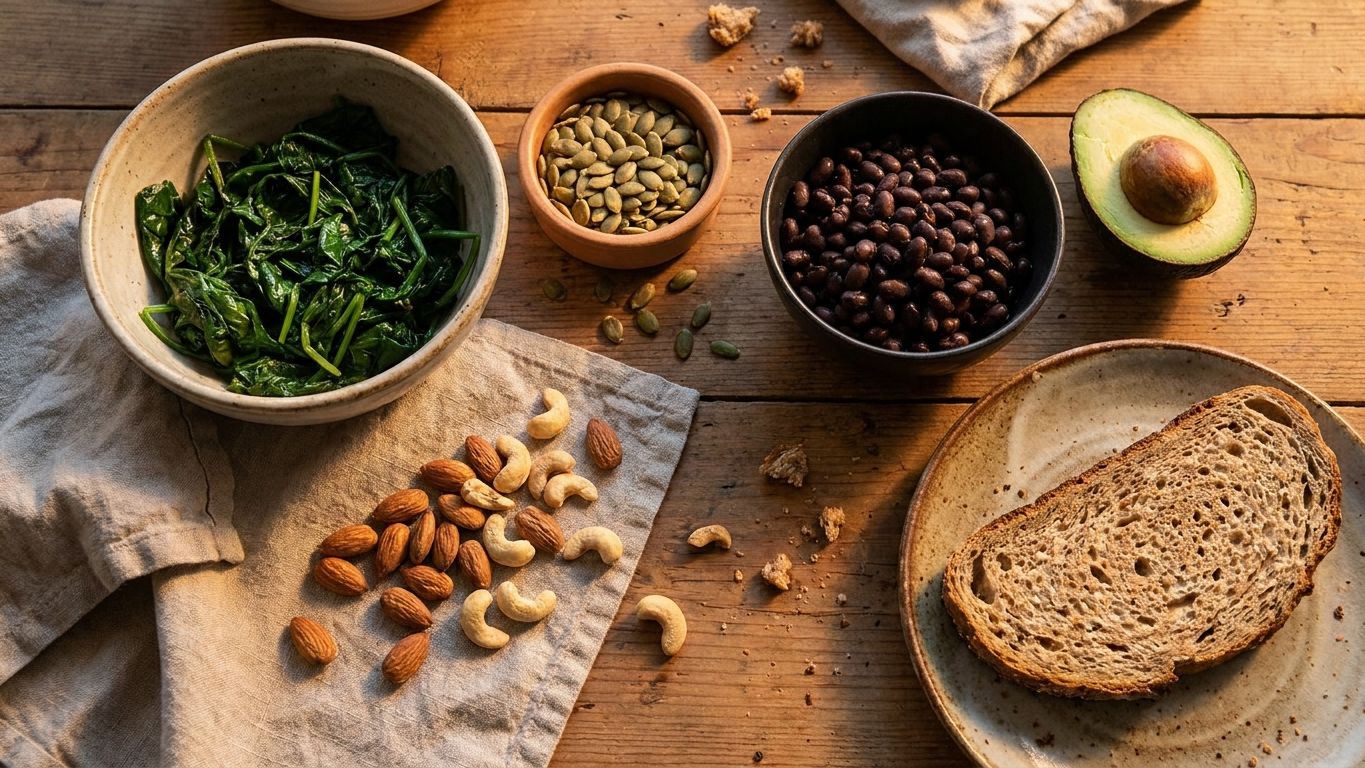
A rough check: an ounce of roasted pumpkin seeds carries about 156 mg, an ounce of almonds about 80 mg, half a cup of boiled spinach about 78 mg, and half a cup of black beans about 60 mg. Adult targets run from 310 to 420 mg a day depending on age and sex.⁵ If your week is mostly white bread, coffee and chicken breast, the refill story may well apply to you.
Glycinate, citrate, oxide: the label war
Walk into any pharmacy and the magnesium shelf looks like a chemistry exam. Glycinate for sleep. Citrate for digestion. Oxide for cheap. L-threonate for your brain, at three times the price.
Some of this is grounded. The NIH notes that forms which dissolve well in liquid are absorbed more completely, and that aspartate, citrate, lactate and chloride tend to be more bioavailable than oxide and sulfate.⁵ High doses of several forms, including oxide, chloride and carbonate, are the usual suspects for diarrhea.⁵
The comic part: the trial that launched a thousand sleep blogs used magnesium oxide, the supposedly inferior form, and still found an effect in people who were short.² Form matters less than whether you needed the magnesium in the first place.
The glycinate story has a twist of its own. In the 2025 bisglycinate trial, each daily dose delivered 250 mg of magnesium and 1,523 mg of glycine.⁴ Glycine is an amino acid that has been studied for sleep on its own. A small Japanese study published in 2007 found that 3 g of glycine before bed improved subjective sleep quality in volunteers with unsatisfactory sleep.⁸
So when a glycinate capsule seems to help, you cannot tell from that trial how much credit goes to the magnesium and how much to the glycine riding along with it. The label says magnesium. The capsule is a two ingredient product.
The fancy end of the shelf deserves the most caution. A 2024 trial of magnesium L-threonate gave 80 adults aged 35 to 55 with self reported sleep problems 1 g a day of the compound for 21 days. It reported better deep sleep and REM sleep scores from an Oura ring than placebo, plus better mood and daytime alertness on questionnaires.⁹ The product contains roughly 75 mg of elemental magnesium per gram, and the ring's sleep scores are computed by a proprietary formula.⁹ Treat that as an interesting lead, not a verdict on your brain.
None of this makes the forms identical. It makes the marketing louder than the evidence. If you want to try magnesium for sleep, the form that agrees with your stomach and your wallet is a perfectly reasonable choice.

Where magnesium deserves more credit
I have been hard on magnesium. Let me argue the other side, because it has a case.
For the person who really is short, a refill is not trivial. In the NIH summary, magnesium deficiency shows up as fatigue, weakness, muscle cramps and, in serious cases, abnormal heart rhythms.⁵ If an older adult with a thin diet sleeps better on magnesium, that is not placebo theater. That is a nutrient doing its job.
The ritual is not worthless either. Both groups improved in the bisglycinate trial.⁴ A capsule taken at the same time each night, with the lights lower and the phone further away, is a signal to the body that the day is over. If that signal helps, I am not going to sneer at it. I would just rather people knew which part was the mineral and which part was the routine.
Magnesium also compares well with the competition on one front. Our piece on melatonin made the case that melatonin is a clock signal, not a sedative, and that the gummy aisle doses it carelessly: https://thinknarratives.com/articles/melatonin-is-not-a-sleeping-pill-we-are-eating-it-like-candy
Magnesium is neither a clock signal nor a sedative. It is not a timing cue, and it does not knock you out. Its best case is quieter: removing a shortfall that might have been making sleep harder. That is less exciting and, for the right person, more durable.
Where it does not deserve more credit is chronic insomnia. If you have struggled to fall or stay asleep most nights for months, a mineral that buys seventeen minutes is not the main event. The treatment guidelines put cognitive behavioral therapy for insomnia first, and our piece on why the pill still wins anyway explains the gap between that advice and what people actually get: https://thinknarratives.com/articles/the-best-insomnia-treatment-is-not-a-pill-the-pill-is-still-winning
How to try magnesium without fooling yourself
I am not going to give you a dose. That is a conversation for a doctor or pharmacist who knows your kidneys and your medicine cabinet. I will give you the guardrails the evidence supports.
Food first. Magnesium from food does not pose a risk for healthy people, because the kidneys clear the excess.⁵ Pumpkin seeds, nuts, beans, leafy greens and whole grains do the job and bring fiber along.
Respect the supplement ceiling. The tolerable upper intake level for magnesium from supplements and medicines is 350 mg a day for adults, separate from what you eat.⁵ The trials above used amounts around that line, from 250 mg in the bisglycinate study to 500 mg in the older adult trial.² ⁴
Check the interactions. Magnesium can bind some antibiotics, such as tetracyclines and quinolones, and should be taken at least two hours before or four to six hours after them. It can also cut absorption of osteoporosis drugs called bisphosphonates. Proton pump inhibitors taken for more than about a year, and some diuretics, can drain magnesium.⁵ People with kidney disease face a real risk of magnesium building up, so this one is not a casual experiment for them.⁵
Then run an honest test. Keep a simple sleep diary for a week without it, then three or four weeks with it, at the same time each night. Note how long it takes to fall asleep and how you feel the next day. If nothing moves, you have your answer, and it cost you less than one month of a premium gummy subscription.
Magnesium will keep winning the shelf
Magnesium will keep outselling the evidence for years, because it sits in a sweet spot: cheap, mostly safe, vaguely natural, and easy to film in a nice glass. The next big trial will not crown it a sleep aid. It will find, again, that the people who gain most are the ones who were eating too little of it.
What will change is the pitch. As more trials report the low intake subgroup, the honest brands will start selling magnesium as a dietary top up rather than a sleep cure, and the dishonest ones will keep the moonlit packaging and the vague promises.
You do not need to wait for either. Look at your plate before you look at the pill bottle. If your diet is thin on magnesium, a refill may buy you a slightly easier night. If your diet is fine and your mind is loud, magnesium will not be the thing that quiets it.
FAQ
Magnesium glycinate vs citrate for sleep: which is better? No trial has compared them head to head for sleep. Citrate and similar soluble forms absorb well but citrate can loosen stools. Glycinate is usually gentler on the stomach, and its sleep trial also delivered about 1.5 g of glycine, which may contribute. Choose the form you tolerate.
How much magnesium should I take for sleep? Sleep trials have used 250 to 500 mg of elemental magnesium a day. The upper limit for supplements and medicines in adults is 350 mg a day, on top of food, so ask a doctor or pharmacist before going higher, especially if you have kidney disease or take regular medication.
Can you take magnesium every night? Most healthy adults can take a modest magnesium supplement daily within the 350 mg supplemental limit. Diarrhea, nausea and cramping are the common signs of too much. People with kidney problems, or those on certain antibiotics, bisphosphonates, diuretics or long term acid reducers, should check with a clinician first.
Magnesium vs melatonin: which is better for sleep? They do different jobs. Melatonin is a timing signal that is most useful for shifting your body clock, as with jet lag. Magnesium is a nutrient that seems to help modestly when your intake is low. Neither is a first line treatment for chronic insomnia; CBT-I is.
How long does it take for magnesium to help sleep? Trials have measured effects after three to eight weeks, not after one dose. If you try it, give it about a month at a consistent time each night and track your sleep before and during, so you can tell a real change from a good week.
This article is for general information and is not medical advice. If you have persistent insomnia, kidney disease, heart rhythm problems, or take regular medication, speak to a doctor or pharmacist before starting magnesium supplements.
Sources
¹ Jocelyn Solis-Moreira, "Could Magnesium and TikTok's 'Sleepy Girl Mocktail' Actually Help You Sleep?," Scientific American, 16 February 2024. https://www.scientificamerican.com/article/could-magnesium-and-tiktoks-sleepy-girl-mocktail-actually-help-you-sleep/
² Behnood Abbasi, Masud Kimiagar, Khosro Sadeghniiat, Minoo M. Shirazi, Mehdi Hedayati and Bahram Rashidkhani, "The effect of magnesium supplementation on primary insomnia in elderly: A double-blind placebo-controlled clinical trial," Journal of Research in Medical Sciences 17(12), 1161 to 1169, December 2012. https://pmc.ncbi.nlm.nih.gov/articles/PMC3703169/
³ Jasmine Mah and Tyler Pitre, "Oral magnesium supplementation for insomnia in older adults: a Systematic Review & Meta-Analysis," BMC Complementary Medicine and Therapies 21, 125, April 2021. https://doi.org/10.1186/s12906-021-03297-z
⁴ Julius Schuster, Igor Cycelskij, Adrian Lopresti and Andreas Hahn, "Magnesium Bisglycinate Supplementation in Healthy Adults Reporting Poor Sleep: A Randomized, Placebo-Controlled Trial," Nature and Science of Sleep 17, 2027 to 2040, August 2025. https://doi.org/10.2147/NSS.S524348
⁵ National Institutes of Health, Office of Dietary Supplements, "Magnesium: Fact Sheet for Health Professionals," updated 6 January 2026. https://ods.od.nih.gov/factsheets/Magnesium-HealthProfessional/
⁶ Yijia Zhang, Cheng Chen, Liping Lu, Kristen L. Knutson, Mercedes R. Carnethon, Alyce D. Fly, Juhua Luo, David M. Haas, James M. Shikany and Ka Kahe, "Association of magnesium intake with sleep duration and sleep quality: findings from the CARDIA study," Sleep 45(4), zsab276, 2022. https://doi.org/10.1093/sleep/zsab276
⁷ Arman Arab, Nahid Rafie, Reza Amani and Fatemeh Shirani, "The Role of Magnesium in Sleep Health: a Systematic Review of Available Literature," Biological Trace Element Research 201(1), 121 to 128, 2023. https://doi.org/10.1007/s12011-022-03162-1
⁸ Wataru Yamadera, Kentaro Inagawa, Shintaro Chiba, Makoto Bannai, Michio Takahashi and Kazuhiko Nakayama, "Glycine ingestion improves subjective sleep quality in human volunteers, correlating with polysomnographic changes," Sleep and Biological Rhythms 5(2), 126 to 131, 2007. https://doi.org/10.1111/j.1479-8425.2007.00262.x
⁹ Heather A. Hausenblas, Tarah Lynch, Stephanie Hooper, Aahana Shrestha, Doug Rosendale and Jennifer Gu, "Magnesium-L-threonate improves sleep quality and daytime functioning in adults with self-reported sleep problems: A randomized controlled trial," Sleep Medicine: X 8, 100121, 2024. https://doi.org/10.1016/j.sleepx.2024.100121