
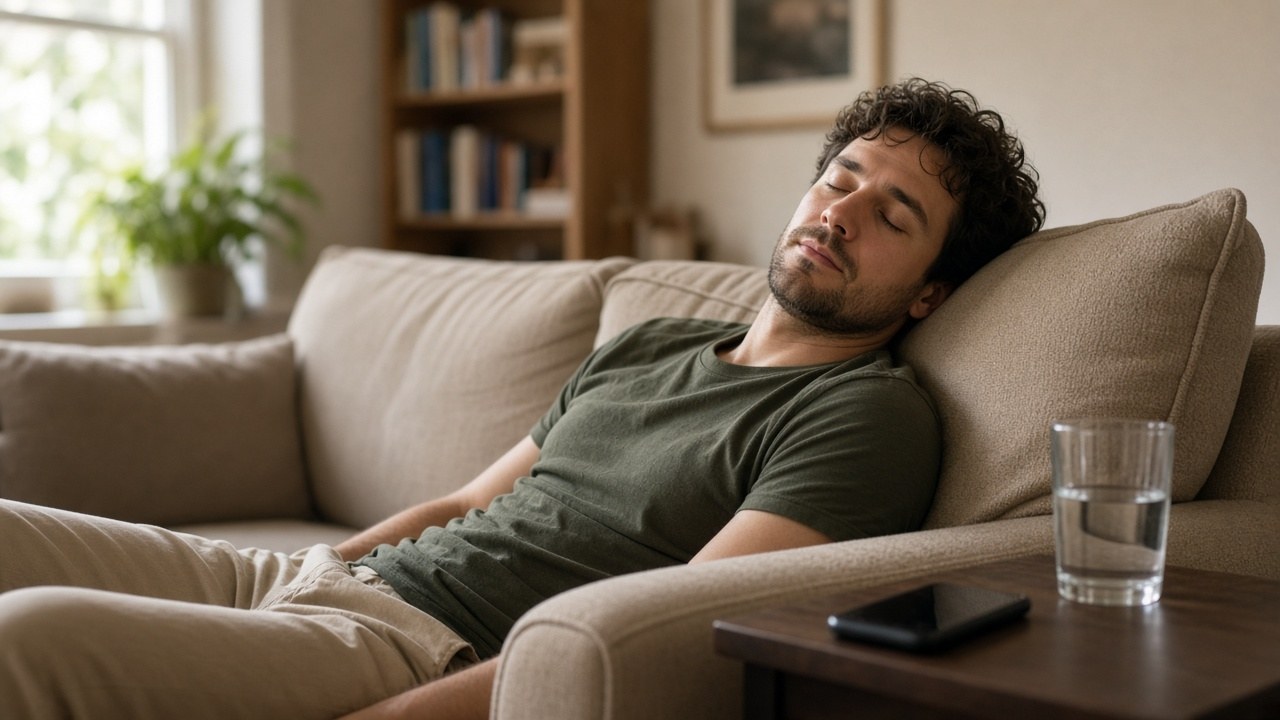
Key takeaway: Is napping good or bad for you? For most healthy adults, a short nap of about 10 to 20 minutes is good: it restores alertness with little grogginess. Long, frequent or irregular daytime sleep is linked to higher blood pressure, stroke and mortality risk, and it is usually a symptom of poor night sleep or illness rather than the cause.
Is napping good or bad for you? A short nap is good. Needing a long one every day is a warning light.
That is the whole answer, and the rest of this piece is about why the internet keeps getting it wrong in both directions.
I keep seeing the same two camps. One treats the afternoon nap as a productivity hack with a cult following: lie down, set a timer, wake up a better employee. The other shares headlines that say naps raise your risk of stroke and early death, and the hack crowd quietly closes the tab.
Both camps are arguing about the nap. The nap is mostly not the point.
What matters is why you are lying down at 2 p.m., for how long, and how often. A 15 minute nap you chose and a two hour collapse you could not avoid share a word. They do not share much else.
The short nap works, and the evidence is old and boring
A brief afternoon nap reliably improves alertness and performance, and the best length in controlled tests is shorter than most people think.
The cleanest experiment is from 2006. Researchers in Australia restricted 24 healthy young adults to about five hours of sleep, then gave them an afternoon nap at 3 p.m. of exactly 5, 10, 20 or 30 minutes, or no nap at all, and tested them for three hours afterward.¹
The 5 minute nap did almost nothing. The 10 minute nap improved every measure immediately, from sleepiness and fatigue to cognitive performance, with some benefits lasting as long as 155 minutes. The 20 minute nap helped too, but the gains only showed up about 35 minutes after waking. The 30 minute nap first made people worse, a stretch of impaired alertness the researchers attributed to sleep inertia, and only then paid off.¹
So the champion was 10 minutes. Not a dramatic number. Very hard to sell as a wellness program.
NASA ran the more famous version in real cockpits. In a study of long haul pilots published in 1994, crew members in the rest group got a planned 40 minute rest opportunity during the quiet cruise phase while colleagues flew. They fell asleep on 93% of opportunities, in an average of 5.6 minutes, and slept about 25.8 minutes. The nap was associated with better physiological alertness and performance than in a no rest group, and the benefit carried through descent and landing.²
You have probably seen this study quoted with a 34% performance gain and a 54% alertness gain. Those numbers are everywhere. They are not in the NASA report's abstract, which is a useful reminder that the nap literature has its own game of telephone.²
Mainstream clinical advice lands in the same place. Mayo Clinic recommends 20 to 30 minutes, in the early afternoon, before about 3 p.m., and warns that the grogginess after a longer nap often takes about 35 minutes to clear.³
If you have ever woken from a 90 minute nap feeling like your skull was full of wet sand, that is sleep inertia, and it is not a character flaw. You just went deep enough that waking up became a procedure.
The scary headlines are mostly measuring sick people
Large studies do link frequent napping to higher blood pressure, stroke and death, but much of that link comes from who naps, not from what napping does.
The study behind the 2022 stroke headlines followed about 358,000 UK Biobank participants who had no high blood pressure or stroke at the start. People who said they usually napped had a 12% higher risk of developing high blood pressure and a 24% higher risk of stroke than people who never napped.⁴
Read one level down and the picture changes. The usual nappers were more likely to be men, to smoke, to drink daily, to report insomnia and snoring, and to be evening types. The study recorded how often people napped, not for how long, and nap frequency was self reported.⁴
That is a list of people who are sleeping badly at night. Snoring is the classic outward sign of sleep apnea. Insomnia is in the name. Daily drinking fragments sleep. The nap in this data looks less like a cause and more like the bill arriving.
The 2025 data point that went viral is the same story with better instruments. Researchers at Massachusetts General Hospital put wrist actigraphy on 86,565 UK Biobank adults, average age 63, for a week. Longer daytime sleep, more irregular daytime sleep from one day to the next, and more sleep between 11 a.m. and 3 p.m. were each associated with higher mortality over the follow up, even after adjusting for night sleep, smoking, alcohol and illness.⁵
The authors were open about the limits. A wrist sensor detects stillness, not brain waves, so a person sitting quietly can be counted as napping. Their 9 a.m. to 7 p.m. window may also have swallowed parts of some people's main sleep. And their own conclusion was not "stop napping." It was that napping patterns could help doctors spot who is at risk.⁵
I think of it as the messenger nap. It shows up because something else is wrong, and then gets blamed for the news.
Where my own headline gets too comfortable
I would like to say the nap is innocent and the illness behind it is guilty. The evidence does not let me off that easily.
The same 2022 Hypertension study ran a Mendelian randomization analysis, a method that uses genetic variants linked to napping as a natural experiment, to get around the who naps problem. It found that each step up in napping frequency, from never to sometimes or from sometimes to usually, came with about 40% higher odds of high blood pressure in UK Biobank data, and the direction held in a separate Finnish dataset.⁴
Genetic methods have their own blind spots, and the genes that make you nap may also shape night sleep. Still, it means "napping is purely a symptom" is a stronger claim than the data supports.
And the same method points the other way for the brain. A 2023 UCL led study used 92 genetic variants tied to habitual napping and found that a genetic tendency to nap was associated with a total brain volume about 15.8 cubic centimeters larger, with no effect on hippocampal volume, reaction time or visual memory. The authors called it a modest causal association.⁶
So napping might nudge blood pressure in the wrong direction and brain volume in the right one. That is less satisfying than a verdict. It is also what the data looks like.
Frequency is the number nobody asks about
How often you nap may matter more than whether you nap at all.
A Swiss study followed 3,462 Lausanne residents with no history of cardiovascular disease for about five years. People who napped once or twice a week had a 48% lower risk of a heart attack, stroke or heart failure than people who did not nap at all, and that held after adjusting for age, night sleep and the usual cardiovascular risks.⁷
People who napped six or seven times a week first looked 67% worse. After adjustment, that excess risk disappeared. Nap length, from 5 minutes to over an hour, showed no link to events. The frequent nappers were older, heavier, more likely to smoke and more likely to have severe sleep apnea.⁷
The numbers are small, with only 155 events in total, and the authors and an accompanying editorial both urged caution. But the shape fits everything above. The occasional nap someone takes by choice looks fine or better than fine. The daily nap looks like a marker of a body already in trouble.
The dementia research makes the marker idea concrete. A Rush University team followed more than 1,400 older adults for up to 14 years with wrist sensors. Daytime napping grew by about 11 minutes a year in people who stayed cognitively healthy. It doubled after a diagnosis of mild cognitive impairment and nearly tripled after an Alzheimer's diagnosis. Those who napped more than an hour a day had a 40% higher risk of developing Alzheimer's.⁸
The researchers stressed that this is an association running in both directions, not proof that napping causes dementia. The point for the rest of us is quieter: a sudden, growing need for daytime sleep is information. Mayo Clinic says the same in plainer words. If you need naps more than usual, talk to a clinician.³

The planned nap and the debt nap
Call the first kind the planned nap. You choose it. It is short, usually under half an hour. It happens a few times a week, often before you need it, before a long drive or a late shift. You wake up and get on with the day.
Call the second kind the debt nap. It chooses you. It runs long, it happens most days, its timing wanders, and you often wake up worse. It is your body collecting on a night that did not deliver.
The debt nap is the one in the scary studies. It sits next to the person we wrote about in https://thinknarratives.com/articles/ten-hours-in-bed-will-not-fix-you-the-night-was-already-broken, who spends ten hours in bed and still wakes up wrecked, and next to everyone asking why they are still tired after eight hours at https://thinknarratives.com/articles/why-you-still-feel-tired-after-8-hours-of-sleep. More daytime sleep does not repair a broken night. It hides it.
There is one group for whom even the planned nap is a bad trade: people with insomnia. A long afternoon nap drains the sleep pressure that should carry you through the night, which is why the behavioral treatment we covered in https://thinknarratives.com/articles/the-best-insomnia-treatment-is-not-a-pill-the-pill-is-still-winning usually restricts daytime sleep. Mayo Clinic makes the same point: if you struggle to fall or stay asleep at night, naps can make it worse.³
So the useful question is not "should I nap?" It is "which nap is this?"
Your watch will start reading your naps for you
Here is where I think this goes.
Wearables already score your night. Within a few years they will treat daytime sleep as a health signal in its own right: how long, how often, how irregular, and whether it is creeping upward. The 2025 mortality study practically wrote the product spec when it suggested actigraphy based nap assessment for spotting risk.⁵
That will be useful for one group. Older adults whose napping quietly doubles over a year will get a nudge to see someone, and some of them will find apnea, heart trouble or early cognitive decline sooner than they would have.
It will not settle the culture war. Hustle culture will keep selling the 20 minute nap as a hack, and headline culture will keep reporting long naps as a death sentence. Both will keep skipping the part that matters, which is that the nap is mostly a messenger.
And the people who need a two hour nap every afternoon will not be fixed by a better nap. They will be fixed by finding out what is wrong with their nights.
FAQ
Is napping good or bad for you? For most healthy adults, short naps are good. A 10 to 20 minute nap improves alertness and performance with little grogginess. Long, daily or irregular naps are linked to higher health risks, but they usually reflect poor night sleep or an underlying condition rather than causing it outright.
How long should a power nap be? Aim for about 10 to 20 minutes. In a controlled study, a 10 minute nap gave the fastest benefits, while a 30 minute nap caused grogginess first. Mayo Clinic suggests keeping naps to 20 to 30 minutes at most and taking them before about 3 p.m.
Is it bad to nap every day? Not automatically, but a daily need for a long nap deserves attention. Large studies link usual napping to higher blood pressure and stroke risk, and daily nappers are more likely to have insomnia, snoring or sleep apnea. If your need for naps has grown, talk to a doctor.
Why do I feel worse after a nap? That is sleep inertia. If you nap long enough to enter deeper sleep, waking up leaves you groggy and slower for a while, often up to about 35 minutes. Shorter naps of 10 to 20 minutes mostly avoid it.
Does napping affect sleep at night? Short, early afternoon naps usually do not hurt night sleep in healthy adults. Long or late naps can, and people with insomnia are usually advised to avoid daytime naps because they reduce the sleep pressure needed at night.
Can too much napping be a sign of a health problem? Yes. Excessive daytime sleepiness can point to sleep apnea, insomnia, depression, medication effects or other conditions. In older adults, a steady increase in daytime napping has been linked to cognitive decline, so a growing need to nap is worth raising with a clinician.
This article is for general information and is not medical advice. Persistent daytime sleepiness, loud snoring, gasping at night or a sudden increase in napping deserves a conversation with a qualified clinician.
Sources
¹ A. Brooks and L. Lack, "A brief afternoon nap following nocturnal sleep restriction: which nap duration is most recuperative?," Sleep 29(6), June 2006. 24 healthy young adults restricted to about 5 hours of night sleep; naps of 5, 10, 20 or 30 minutes at 3 p.m. versus no nap; the 10 minute nap gave immediate improvements lasting up to 155 minutes; 20 minute benefits emerged after 35 minutes; 30 minutes produced sleep inertia first. https://doi.org/10.1093/sleep/29.6.831
² Mark R. Rosekind and colleagues, "Crew factors in flight operations IX: Effects of planned cockpit rest on crew performance and alertness in long-haul operations," NASA Technical Memorandum, 1994. 21 pilots; planned 40 minute rest opportunity; pilots slept on 93% of opportunities, fell asleep in 5.6 minutes and slept 25.8 minutes; improved alertness and performance through descent and landing. https://ntrs.nasa.gov/citations/19950006379
³ Mayo Clinic Staff, "Napping: Do's and don'ts for healthy adults," Mayo Clinic, 6 November 2024. Recommends 20 to 30 minute naps in the early afternoon, before about 3 p.m.; sleep inertia often clears within about 35 minutes; naps can worsen night sleep problems; see a clinician if you need to nap more than usual. https://www.mayoclinic.org/healthy-lifestyle/adult-health/in-depth/napping/art-20048319
⁴ M. J. Yang and colleagues, "Association of Nap Frequency With Hypertension or Ischemic Stroke Supported by Prospective Cohort Data and Mendelian Randomization in Predominantly Middle-Aged European Subjects," Hypertension, published 25 July 2022, with the American Heart Association news release "Study shows link between frequent naps and high blood pressure." 358,451 UK Biobank participants; usual napping versus never: 12% higher risk of hypertension, 24% higher risk of stroke; usual nappers more often men, smokers, daily drinkers, with insomnia or snoring; Mendelian randomization odds ratio about 1.40 per napping category for hypertension. https://www.ahajournals.org/doi/10.1161/HYPERTENSIONAHA.122.19120 and https://newsroom.heart.org/news/study-shows-link-between-frequent-naps-and-high-blood-pressure
⁵ Chenlu Gao and colleagues, "Objectively-Assessed Napping Behaviors Predict Mortality in Middle-to-Older Aged Adults," SLEEP 2025 abstract 0350, Sleep 48 (Supplement 1), May 2025, with the SLEEP meeting news release, 27 May 2025. 86,565 UK Biobank adults, mean age 63, 7 day actigraphy; longer naps (hazard ratio 1.20 per standard deviation), more variable naps (1.14) and more naps from 11 a.m. to 3 p.m. (1.07) linked to higher mortality; limitations include actigraphy misreading quiet rest as sleep. https://doi.org/10.1093/sleep/zsaf090.0350 and https://www.sleepmeeting.org/napping-behaviors-predict-mortality-risk-middle-older-aged-adults/
⁶ V. Paz, H. S. Dashti and V. Garfield, "Is there an association between daytime napping, cognitive function, and brain volume? A Mendelian randomization study in the UK Biobank," Sleep Health, 2023. Up to 378,932 participants; genetic liability to habitual napping associated with 15.80 cubic centimeters larger total brain volume, no association with hippocampal volume, reaction time or visual memory. https://doi.org/10.1016/j.sleh.2023.05.002
⁷ N. Häusler, J. Haba-Rubio, R. Heinzer and P. Marques-Vidal, "Association of napping with incident cardiovascular events in a prospective cohort study," Heart 105(23), 2019, with the BMJ news release. 3,462 adults in Lausanne followed about 5.3 years; napping 1 to 2 times a week linked to 48% lower risk of cardiovascular events (hazard ratio 0.52); higher crude risk for 6 to 7 naps a week disappeared after adjustment; no association for nap duration; 155 events. https://doi.org/10.1136/heartjnl-2019-314999 and https://www.bmj.com/company/newsroom/once-or-twice-weekly-daytime-nap-linked-to-lower-heart-attack-stroke-risk/
⁸ P. Li and colleagues, "Daytime napping and Alzheimer's dementia: A potential bidirectional relationship," Alzheimer's & Dementia, 2022, with the Rush University news release. More than 1,400 older adults followed up to 14 years with wrist sensors; napping rose about 11 minutes a year without impairment, doubled after mild cognitive impairment and nearly tripled after Alzheimer's diagnosis; napping more than an hour a day linked to 40% higher Alzheimer's risk; observational. https://doi.org/10.1002/alz.12636 and https://www.rush.edu/news/alzheimers-and-daytime-napping-linked-new-research