
Key takeaway: No, phone screen light does not mainly ruin sleep. Across experimental studies, bright blue screen light delayed sleep onset by about 2.7 minutes on average, with little effect on total sleep or quality. The bigger damage is bedtime displacement, stimulating content, and night interruptions, not the color of the pixels.
Does phone screen light really ruin sleep? No, not mainly.
I keep watching people buy orange glasses, enable every night filter, and then scroll until 1 a.m. They treated the wavelength. They left the habit alone.
That is the wrong fight.
The light effect is real. It is also small
Bright blue screen light before bed delays sleep onset by only about 2.7 minutes on average in experimental work, and it barely moves total sleep or sleep quality.
That figure comes from a synthesis of 11 experimental studies that sleep researchers in Sweden, Australia and Israel compared when they wrote about the topic for The Conversation. Across those trials, people exposed to a bright blue emitting screen before bed fell asleep roughly 2.7 minutes later than comparison conditions. In some studies they slept better afterward. Other sleep measures, including how long people slept and how they rated the night, showed no meaningful hit.¹
The arousal story is similar. Across seven studies, more exciting content (video games, for example) cost people about 3.5 minutes of sleep compared with calmer material. Content is not nothing. It is also not the villain in the bedtime sermon.¹
What did show up more clearly was displacement and disruption: staying on the device past the time you could already be asleep, and being woken by messages overnight. Those are not light problems. They are schedule and interruption problems that happen to arrive through a glowing rectangle.¹
The physiology sales pitch sounds airtight. Daylight is rich in short wavelength blue light. It tells the brain to stay alert. Melatonin rises as light falls. Therefore a phone in bed must sabotage the hormone and wreck the night. The gap in that chain is intensity. Significant melatonin disruption in lab work often needs light levels around 1,000 to 2,000 lux. Typical phone and laptop screens put out about 80 to 100 lux at the eye. A sunny day can hit around 100,000.¹
So yes, light matters. Your phone is just a weak lamp pretending to be a sunrise.
Where the hormone story still has teeth
I have to push against my own headline here, because melatonin is not fake news.
In a 2024 Brain Communications study, male adolescents and young adults read for 90 minutes in the evening on a smartphone with no blue light filter, with a filter, or from a printed book. Right after the unfiltered phone session, melatonin was suppressed in both age groups. About 50 minutes later, at bedtime, adolescents had largely recovered. Young adults were still running lower melatonin. Subjective sleepiness barely moved. Sleep dependent memory consolidation held up. Adults lost some deep sleep early in the night. The practical recommendation from the authors was blunt: put the phone away for about the last hour before bed if you want to avoid that disturbance.²
That study does not say blue light is harmless. It says a 90 minute phone reading session can dent melatonin, and that putting the device down about an hour before sleep is enough for whole night sleep and memory to look roughly fine.
Call it the difference between a lab marker and a ruined Tuesday. Melatonin can dip without your night collapsing. The filter helped a bit on the hormone side and still did not rewrite the bigger picture.
What adults actually lose to screens
If light were the main thief, night mode would have solved this by now. Adult data point somewhere else.
A 2025 analysis in JAMA Network Open looked at 122,058 adults in the American Cancer Society Cancer Prevention Study 3. People who used an electronic screen (phone, laptop or tablet, not TV) every night in the hour before bed slept about 7.6 fewer minutes on workdays and went to bed about 19 minutes later than people who reported no screen use in that hour. Daily users also had a 33% higher prevalence of poor sleep quality. Add it up and you get roughly 50 fewer minutes of sleep across a week. Evening chronotypes took a larger hit than morning types.³
That pattern fits displacement better than photon poison. Later bedtimes. Slightly shorter nights. Worse subjective quality. The screen is there for the hour that used to belong to sleep, or to the dull wind down that makes sleep easier.
We have already argued that feeling wrecked after a full night is often about continuity and timing, not the raw hour count, at https://thinknarratives.com/articles/why-you-still-feel-tired-after-8-hours-of-sleep. Phone light fits the same trap. People optimize the wrong dial. They tint the screen. They keep the 45 minute scroll.
Kids, adults, and the consensus that refused to panic about light
In 2024 the National Sleep Foundation convened a 16 person expert panel on screens and sleep. They reviewed thousands of papers down to 35 experimental or intervention studies and voted through a modified Delphi process. They reached consensus that screen use in general impairs sleep health in children and adolescents, that the content of pre sleep screen use impairs sleep for those age groups, and that behavioral strategies can blunt the damage. They did not reach consensus that the light from pre sleep screens impairs sleep health for children, adolescents or adults. They also did not reach consensus that screens in general impair adult sleep.⁴
Interventions that filtered short wavelength blue light showed only minimal sleep improvements in the studies the panel weighed. Strategies that cut evening interactive use did better: earlier sleep onset, longer sleep, better quality when people actually put the device down.⁴
So the grown up version of the advice is narrower than the internet version. For kids and teens, screens before bed are a real problem, and content is a big part of why. For adults, the evidence that light alone is the culprit is weak enough that a panel of specialists would not sign it. The adult problem looks more like staying up.
Night mode will not fix doomscrolling until 1 a.m.
I think of night filters as a seatbelt for a crash you are still choosing to have.
They may shave a little off the melatonin dip. They will not stop a cliffhanger, a work Slack thread, or the next video that starts before you decide whether you wanted it. The Conversation synthesis found people use tech late for familiar reasons: to fill time when they are not yet sleepy, and to soothe stress. Risk taking, losing track of time, and fear of missing out make it worse. Self control and someone who helps hold a bedtime make it better.¹
That matches the 3 a.m. problem we wrote about at https://thinknarratives.com/articles/waking-up-at-3-am-is-not-the-problem-the-clock-on-your-nightstand-is. A brief wake is common. Staying awake with a glowing rectangle turns a moment into a second shift. It also matches the chatbot bedtime habit at https://thinknarratives.com/articles/stop-asking-a-chatbot-how-you-slept. A conversation has no natural ending. Neither does a feed.
If your sleep problem is "I am still on the phone past midnight," a warmer color temperature is not the intervention. Ending the session is.
What people will keep blaming next year
Here is where I think this goes.
People will keep blaming blue light, because it is a clean villain with a product attached: glasses, filters, "sleep" modes, rings that grade your darkness. Those tools will get better at moving melatonin curves and sleep scores a few points. They will not give anyone back the hour they spent arguing with strangers or refreshing a work chat.
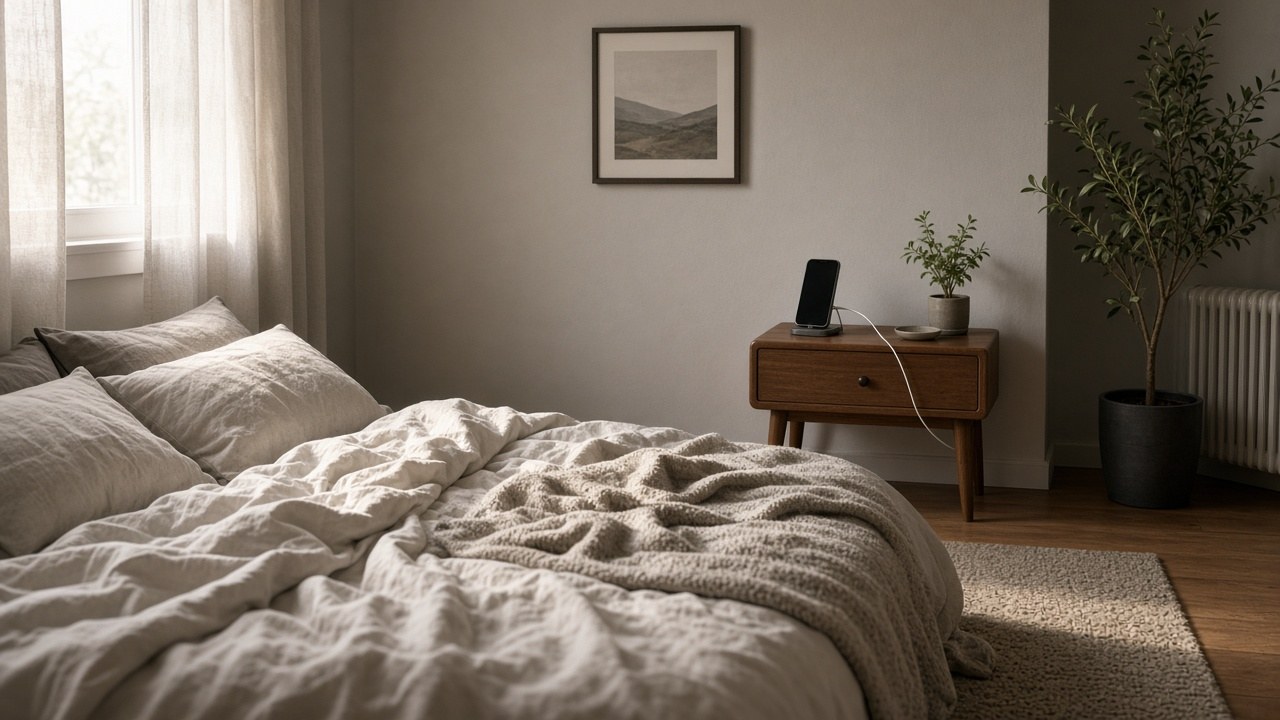
The adults who sleep better will not win by winning the wavelength. They will put the phone across the room, charge it outside the bed, and treat the last hour as offline on purpose. Night shift filters will stay on as a minor assist. They will not be the plan.
And the people who keep tinting the screen while they scroll to 1 a.m. will still wake up tired, then blame the light.
FAQ
Does phone screen light really ruin sleep? No, not mainly. Experimental work finds bright blue screen light delays sleep onset by about 2.7 minutes on average, with little effect on total sleep or quality. Bedtime displacement, stimulating content and night interruptions matter more.
Does blue light from phones suppress melatonin? It can, especially during longer evening sessions without a filter. A 2024 lab study found melatonin dropped after 90 minutes of smartphone reading, with adults still lower at bedtime about 50 minutes later, while whole night sleep and memory looked largely intact when the phone was put away about an hour before bed.
Do night mode or blue light filters help sleep? They may help melatonin a little. National Sleep Foundation consensus work found filters showed minimal benefit for sleep outcomes. They will not fix staying up late on stimulating content.
Is screen time before bed worse for kids than adults? Evidence is stronger for children and adolescents. An NSF expert panel reached consensus that screen use and pre sleep content impair sleep health in those age groups, and did not reach consensus that light alone does so for any age, including adults.
How long before bed should I stop using my phone? A practical target from lab work is about one hour before bedtime if you want to avoid the melatonin and early night sleep disturbances tied to evening LED screens. Ending the session beats relying on a filter.
Why do I sleep worse when I use my phone in bed every night? Large adult surveys link daily screen use in the hour before bed to later bedtimes, roughly 8 fewer minutes of sleep on workdays, and worse sleep quality. That pattern fits using the hour for the phone instead of for sleep.
This article is for general information and is not medical advice. Persistent insomnia, loud snoring, gasping or daytime impairment deserves a conversation with a qualified clinician.
Footnotes
¹ Chelsea Reynolds summarizing a multi country evidence synthesis, "How much does your phone's blue light really delay your sleep? Relax, it's just 2.7 minutes," The Conversation, 21 August 2024. Across 11 experimental studies, bright blue screen light delayed sleep onset by 2.7 minutes on average, with little effect on total sleep or quality; exciting content cost about 3.5 minutes across 7 studies; displacement and night disruption mattered more; typical screens about 80 to 100 lux versus roughly 1,000 to 2,000 lux for major melatonin impact. https://theconversation.com/how-much-does-your-phones-blue-light-really-delay-your-sleep-relax-its-just-2-7-minutes-236066
² Christopher Höhn and colleagues, "Effects of evening smartphone use on sleep and declarative memory consolidation in male adolescents and young adults," Brain Communications, 2024. 33 male adolescents and 35 male young adults; 90 minutes reading on smartphone with or without blue light filter vs printed book; melatonin suppressed after unfiltered phone use; adolescents recovered by bedtime (~50 minutes later), adults still reduced; whole night sleep and memory consolidation largely unaffected when phone put away about 1 hour before bed; authors advise avoiding LED screens in the final hour. https://doi.org/10.1093/braincomms/fcae173
³ Charlie Zhong, Matthew Masters, Sarah M. Donzella, W. Ryan Diver and Alpa V. Patel, "Electronic Screen Use and Sleep Duration and Timing in Adults," JAMA Network Open, 27 March 2025. Cross sectional analysis of 122,058 Cancer Prevention Study 3 adults; daily screen use in the hour before bed associated with 7.64 fewer minutes of workday sleep, about 19 minutes later bedtimes, 33% higher prevalence of poor sleep quality, and roughly 50 fewer minutes of sleep per week; stronger associations in evening chronotypes. https://jamanetwork.com/journals/jamanetworkopen/fullarticle/2831993
⁴ Lauren E. Hartstein, Gina Marie Mathew, David A. Reichenberger and colleagues, "The impact of screen use on sleep health across the lifespan: A National Sleep Foundation consensus statement," Sleep Health, 2024. 16 expert panelists; consensus that screen use and pre sleep content impair sleep health in children and adolescents, and that behavioral strategies help; no consensus that pre sleep screen light impairs sleep health for children, adolescents or adults; blue light filters showed minimal sleep benefit. https://www.sleephealthjournal.org/article/S2352-7218(24)00090-1/fulltext
Sources
- The Conversation, How much does your phone's blue light really delay your sleep?: https://theconversation.com/how-much-does-your-phones-blue-light-really-delay-your-sleep-relax-its-just-2-7-minutes-236066
- Höhn et al., Brain Communications (2024), evening smartphone use: https://doi.org/10.1093/braincomms/fcae173
- Zhong et al., JAMA Network Open (2025), adult screen use and sleep: https://jamanetwork.com/journals/jamanetworkopen/fullarticle/2831993
- Hartstein et al., National Sleep Foundation consensus on screens and sleep (Sleep Health, 2024): https://www.sleephealthjournal.org/article/S2352-7218(24)00090-1/fulltext
- Thinknarratives, Why You Still Feel Tired After 8 Hours of Sleep: https://thinknarratives.com/articles/why-you-still-feel-tired-after-8-hours-of-sleep
- Thinknarratives, Waking Up at 3 a.m. Is Not the Problem: https://thinknarratives.com/articles/waking-up-at-3-am-is-not-the-problem-the-clock-on-your-nightstand-is
- Thinknarratives, Stop Asking a Chatbot How You Slept: https://thinknarratives.com/articles/stop-asking-a-chatbot-how-you-slept