
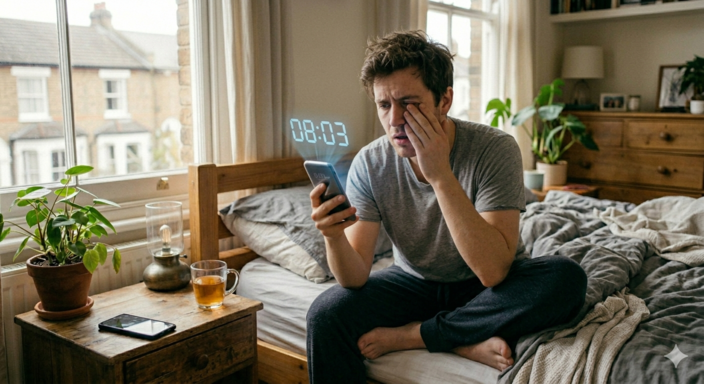
Key takeaway: Europe puts its clocks back on Sunday 25 October 2026 and the United States follows on Sunday 1 November 2026, and the "free" hour is better described as a partial refund for a body clock that never fully adjusted to summer time. In a Danish study covering 1995 to 2012, hospital contacts for depression rose 11% after the autumn change. The strongest harm evidence is against the spring change, but the autumn change still drags evenings earlier and darker, and the American Academy of Sleep Medicine backs permanent standard time, not permanent summer time.
I keep noticing how cheerful everyone gets about the hour in October.
You know the Sunday. Someone announces that we get an extra hour, as if a rebate had landed in the bank. The phone updates itself, the oven clock does not, and for a few weeks the car, the kitchen and your wrist disagree about what time it is. Then comes the first Monday evening, and the sky is finished before you are.
In Vilnius the sun sets at 5:59 p.m. on Saturday 24 October and at 4:57 p.m. the next day. Sunrise moves from 8:05 a.m. to 7:07 a.m.¹ The clock gives an hour to your bed and takes an hour from your evening.
I am not convinced the trade is as even as it feels.
Call it the borrowed hour
Start with the heart. In 2008, the Swedish researchers Imre Janszky and Rickard Ljung used the national heart attack registry, which has covered the country since 1987, to compare each day after a clock change with the same weekdays two weeks before and after. In the week after the spring change, heart attacks ran 5.1% higher (ratio 1.051, 95% confidence interval 1.032 to 1.071).²
After the autumn change the ratio for the whole week was 0.985. The interval, 0.969 to 1.002, could not rule out chance. Only the first weekday, the Monday, was reliably lower.²
That Monday is probably the hour doing its job, and I would not wave away a rested Monday.
The chronobiologist Till Roenneberg and his coauthors read the same result more harshly. A dip right after summer time ends, they argue, suggests the risk was elevated throughout summer time, and October pays part of it back.³
There is data behind that reading. In a 2007 Current Biology study, Roenneberg's group mined a survey of about 55,000 people in Central Europe. Free day sleep followed the progression of dawn under standard time but not under summer time.
In 50 volunteers tracked for four weeks before and after each change, sleep and activity readjusted within about a week when summer time ended. When it began, the timing of activity never fully adjusted, especially in late chronotypes, the owls.⁴
I think of it as the borrowed hour. Every March the schedule borrows an hour from the sun, the body never quite agrees to lend it, and every October we receive a partial repayment and call it a gift.
The repayment has a dark side too. A Danish team led by Bertel Hansen analyzed 185,419 psychiatric hospital contacts for unipolar depression between 1995 and 2012. The switch from summer time to standard time was followed by an 11% rise (95% confidence interval 7% to 15%) in the incidence of depressive episodes, fading over about 10 weeks. The switch in spring showed no matching rise.⁵
Even the sleep medicine position statements admit the autumn hour comes with strings. The American Academy of Sleep Medicine's 2023 statement says the change is commonly thought beneficial because of "an extra hour of sleep," yet it is still linked to sleep disruption, mood disturbance and shifts in cortisol, melatonin and other hormones.⁶
Call it the law clock gap
Think about the Monday after. The alarm goes off at what feels like the middle of the night, you work through a day that seems to have lost its afternoon, and by the time you head home the light is already gone.
Chronobiologists talk about three clocks. The sun clock puts noon where the sun is highest. The social clock is whatever the law prints on walls and phones. The body clock is the circadian one in your brain, set mostly by light.³
Call it the law clock gap: the distance between the clock your body keeps and the one the government prints. The everyday version is social jetlag, defined in 2006 as the difference in sleep timing between work days and free days.³ Summer time widens the gap by exactly an hour, because, as Roenneberg's group puts it, switching to summer time is nothing else but assigning your place to the time zone one further east.³
Vilnius makes this concrete. On 24 October the sun there is highest at 1:03 p.m. on the clock. On 25 October it is highest at 12:02 p.m. On the winter solstice, 21 December, solar noon falls at 12:16 p.m.¹
The sun did not move. The law did.
Light is the lever. Evening light pushes the body clock later and morning light pulls it earlier, so summer time, which adds evening light and morning dark, nudges people the wrong way if they need to wake on time.⁶ An economics study of US time zone borders, cited in that same statement, found that an extra hour of natural light in the evening cut sleep by an average of 19 minutes.⁶
Roenneberg's group also tried to measure how far the calendar slips. For Frankfurt, they calculated that summer time pushes back the seasonal relationship between dawn and the schedule by the equivalent of about four weeks in spring and six in autumn. If the body clock tracks dawn the same way in both seasons, they wrote, the late October change is scheduled a month too late.⁴
Where I have to argue with myself
I should be careful, because my headline is tidier than the data.
First, the autumn hour is real. The whole week dip in Sweden could be chance, but the Monday held, and the 2007 volunteers readjusted to the end of summer time within about a week.² ⁴ The strongest evidence of harm in this literature points at the spring change, not at October. The 2023 sleep medicine statement draws the same line and names reduced sleep as the major acute effect of the spring shift.⁶
Second, nearly all of this is observational. The Danish authors suggested the rise in depression may reflect distress at the sudden arrival of earlier sunsets and the long short days ahead.⁵ That is a story about dark evenings, not about the hour of sleep, and a registry cannot separate the two.
The long term picture is thinner still. The American Academy of Sleep Medicine's own 2020 statement conceded that the chronic effects of staying on summer time all year have not been well studied, and Roenneberg's group notes that chronic effects are hard to isolate because summer and winter differ in so many other ways.³
Third, people love the evening light, and I do not think they are deluded. One study of about 23,000 children across nine countries linked longer evening daylight to more physical activity, roughly 6%, although the effect showed up mostly in Europe.³ Also, the loudest voices for standard time are sleep societies, and sleep societies were always going to say go to bed.
None of that rescues the hour. It only stops me selling it as a catastrophe. The extra hour is real, it is not free, and it is not the main event.
Who gets to pick the clock
Europe has been stuck for eight years. The Commission proposed ending the clock changes on 12 September 2018. Parliament adopted its position in March 2019, voting to end them in 2021. The Council has still not agreed a position, and it needs a qualified majority of member states to do so. A Commission impact study launched in February 2026 is due by the end of this year.⁷
Lithuania wants out. On 6 October 2026, LRT reported that Transport Minister Juras Taminskas hopes to put the issue on the agenda when Lithuania takes over the rotating Council presidency in January. He says he has an initial agreement with the Baltic and Nordic countries on permanent summer time, and that Lithuanian surveys have consistently favored summer time all year. A Luminor bank economist told LRT that success looks unlikely.⁷
Here is what permanent summer time would mean in Vilnius. On 21 December the sun rises at 8:39 a.m. and sets at 3:53 p.m. on today's winter clock. Add an hour, which is my arithmetic and not a forecast from any agency, and sunrise would come at 9:39 a.m.¹
The United States has the same fight with the sides swapped. On 14 July 2026, the House passed the Sunshine Protection Act, H.R. 139, by 308 to 117. On 5 October, Senate Majority Leader John Thune told Politico there is "no clear path forward." The sleep academy condemned the House vote and wants permanent standard time instead.⁷ Congress adopted permanent summer time during the 1973 oil embargo and reversed it after a single winter.⁶
Notice the pattern. Nearly everyone agrees that switching twice a year is the worst option, and almost nobody agrees on what to freeze the clock on. If the goal is sleep, this essay points to standard time, with the caveat that the long term evidence is thinner than anyone admits.
The clock I would keep
If I could vote once, I would freeze the clock on the one that matches the sun, and I would still lose to the people who want the extra hour of light after work.
Here is my bet. The clocks will go back on 25 October in Europe and on 1 November in the United States, exactly as scheduled. The Council won't agree a position before the new year. The Commission's study will arrive at the end of 2026 and won't settle which time to keep, because the argument was never about data, it was about evenings.
The sleep societies will keep saying standard time, the evening light lovers will keep winning at the polls, and in March the same people who called October a gift will call spring a crime.
We will take the hour again. We won't ask who paid for it.
FAQ
Do we really get an extra hour of sleep when the clocks go back? Only on the night of the change, and only if you stay in bed. A Swedish registry study found that just the Monday after the autumn change had reliably fewer heart attacks, and some researchers argue the autumn hour is a partial repayment for a body clock that never fully adjusted to summer time.
When do the clocks change in 2026? In Lithuania and the rest of the EU, clocks go back on Sunday 25 October 2026, when 4:00 a.m. in Vilnius becomes 3:00 a.m. In the United States, daylight saving time ends at 2:00 a.m. on Sunday 1 November 2026.
Is the autumn clock change bad for your health? The evidence is stronger for the spring change than the autumn one. In Sweden, heart attacks were 5.1% higher after the spring change, but the autumn week was not clearly different, and in Denmark depression hospital contacts rose 11% after the autumn change. Both are observational findings and cannot prove cause and effect.
What is social jetlag? Social jetlag is the gap between the sleep your body clock wants and the sleep your schedule allows, usually measured as the difference in sleep timing between work days and free days. It was defined in a 2006 paper and is tied to the argument that summer time widens that gap by an hour.
Is permanent standard time or permanent summer time better for sleep? The American Academy of Sleep Medicine says permanent standard time, because it aligns best with the body clock. Evidence on year round summer time is thinner, and many people prefer lighter evenings. According to LRT, past Lithuanian surveys have consistently favored summer time all year.
Will the EU or the US stop changing the clocks? Not yet, as of 10 October 2026. The EU Council has no common position on the 2018 proposal, with a Commission study due by the end of 2026. In the United States, the House passed H.R. 139 on 14 July 2026, but the Senate has no clear path.
This essay is general information, not medical advice. If clock changes leave you exhausted, low in mood or worried about your heart, talk to a doctor.
Footnotes
¹ timeanddate.com, "Sunrise and sunset times in Vilnius, October 2026" and "December 2026." Source for sunset 5:59 p.m. (24 October) and 4:57 p.m. (25 October), sunrise 8:05 a.m. and 7:07 a.m., solar noon 1:03 p.m., 12:02 p.m. and 12:16 p.m. (21 December), and the 21 December sunrise 8:39 a.m. and sunset 3:53 p.m. The 9:39 a.m. figure is the essay's own arithmetic (8:39 plus one hour). Clocks in Vilnius go back at 4:00 a.m. on 25 October 2026.
² Janszky and Ljung, "Shifts to and from Daylight Saving Time and Incidence of Myocardial Infarction," New England Journal of Medicine 359(18), 1966 to 1968, 30 October 2008. Swedish registry of acute myocardial infarction since 1987. Spring week incidence ratio 1.051 (95% CI 1.032 to 1.071). Autumn week ratio 0.985 (95% CI 0.969 to 1.002), with only the first weekday reliably affected. Correspondence, not a full trial.
³ Roenneberg, Winnebeck and Klerman, "Daylight Saving Time and Artificial Time Zones, A Battle Between Biological and Social Times," Frontiers in Physiology, 2019. Source for the three clocks, social jetlag (Wittmann et al. 2006 definition), the argument that the autumn relief implies prior elevated risk, the time zone reassignment point, the difficulty of studying chronic effects, and the activity study of 23,000 children (about 6%, mostly in Europe). Written by researchers who advocate abolishing summer time.
⁴ Kantermann, Juda, Merrow and Roenneberg, "The Human Circadian Clock's Seasonal Adjustment Is Disrupted by Daylight Saving Time," Current Biology 17(22), 1996 to 2000, 20 November 2007. Survey of about 55,000 people from Central Europe, longitudinal study of 50 volunteers around the autumn 2006 and spring 2007 changes, and the Frankfurt calculation of 4 and 6 weeks and the one month too late remark.
⁵ Hansen, Sønderskov, Hageman, Dinesen and Østergaard, "Daylight Savings Time Transitions and the Incidence Rate of Unipolar Depressive Episodes," Epidemiology 28(3), 346 to 353, 1 May 2017. Danish Psychiatric Central Research Register, 1995 to 2012, 185,419 hospital contacts, 11% increase (95% CI 7% to 15%) after the switch to standard time, fading over about 10 weeks, no parallel rise after the spring switch. The sunset distress explanation is the authors' own suggestion.
⁶ Rishi et al., "Permanent standard time is the optimal choice for health and safety: an American Academy of Sleep Medicine position statement," Journal of Clinical Sleep Medicine 20(1), 121 to 125 (2024; endorsed by the American Thoracic Society on 25 October 2023), and Rishi et al., "Daylight saving time: an American Academy of Sleep Medicine position statement," Journal of Clinical Sleep Medicine 16(10), 1781 to 1784 (2020). Source for the "extra hour of sleep" passage, hormone shifts, the evening and morning light effect, the 19 minute finding from Giuntella and Mazzonna (2019), the 1974 reversal after one winter, and the 2020 statement that chronic effects of year round summer time are not well studied.
⁷ Council of the European Union, "Seasonal clock changes in the EU" (accessed 10 October 2026) and Council document ST 10045/26 (Commission information on the study, launched February 2026). LRT, "As clocks turn back, Lithuania renews its push to end Europe's time change debate," 6 October 2026. Clerk of the US House of Representatives, Roll Call 238, H.R. 139, 14 July 2026 (308 yea, 117 nay). USA Today, "John Thune: No 'clear path forward' for daylight saving time bill," 5 to 6 October 2026. AASM, "AASM condemns House passage of Sunshine Protection Act," July 2026. The European Parliament's March 2019 position is as described on the Council page.
Sources
¹ timeanddate.com (Vilnius, October 2026): https://www.timeanddate.com/sun/lithuania/vilnius?month=10&year=2026 and (December 2026): https://www.timeanddate.com/sun/lithuania/vilnius?month=12&year=2026
² New England Journal of Medicine (Janszky and Ljung 2008): https://www.nejm.org/doi/full/10.1056/NEJMc0807104 and Karolinska Institutet press release: https://news.ki.se/clock-shifts-affect-risk-of-heart-attack
³ Frontiers in Physiology (Roenneberg et al. 2019): https://pmc.ncbi.nlm.nih.gov/articles/PMC6692659/
⁴ Current Biology (Kantermann et al. 2007): https://pure.rug.nl/ws/files/6711968/2007CurrBiolKantermann.pdf
⁵ Epidemiology (Hansen et al. 2017): https://pure.au.dk/portal/en/publications/daylight-savings-time-transitions-and-the-incidence-rate-of-unipo/
⁶ Journal of Clinical Sleep Medicine (AASM 2023): https://pmc.ncbi.nlm.nih.gov/articles/PMC10758561/ and AASM 2020 statement: https://pmc.ncbi.nlm.nih.gov/articles/PMC7954020/
⁷ Council of the EU: https://www.consilium.europa.eu/en/policies/seasonal-time-changes/ and https://data.consilium.europa.eu/doc/document/ST-10045-2026-INIT/en/pdf ; LRT: https://www.lrt.lt/en/news-in-english/19/3073172/as-clocks-turn-back-lithuania-renews-its-push-to-end-europe-s-time-change-debate ; US House Clerk: https://clerk.house.gov/Votes/2026238 ; USA Today: https://www.usatoday.com/story/news/politics/2026/10/05/permanent-daylight-saving-time-bill-thune/92113315007/ ; AASM: https://aasm.org/aasm-opposes-sunshine-protection-act-2026/