
Key takeaway: AI researchers have spent a decade borrowing sleep from neuroscience, adding offline "replay" and consolidation phases to their models because those phases measurably improve learning. The same industry now celebrates 72 hour weeks for the humans. Sleep is not idle time; it is a second shift of work that produces insight waking effort cannot. If machines take over more of the daytime grind, the overnight shift becomes the most valuable thing a human worker does.
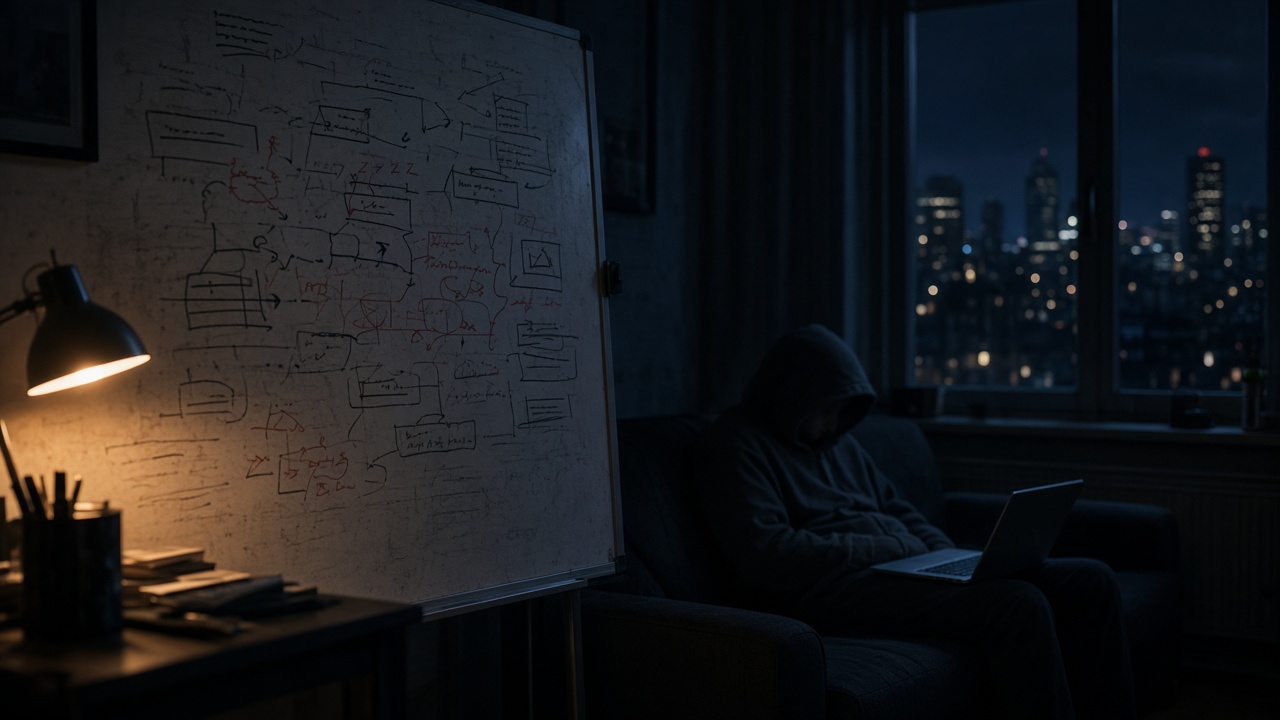
I keep thinking about a whiteboard in San Francisco at one in the morning.
It belongs, or belonged, to a hacker house in the Marina where the founder of an AI agent startup lives with his team. The Washington Post described days that can start at 7 a.m. and run until he goes to sleep at midnight or 1 a.m., in a house where the living arrangement lets the team gather around that whiteboard at 1 a.m. to work out new ideas.¹ I don't doubt the ideas felt good. Ideas at 1 a.m. always feel good. That is part of the problem.
There is a specific pride in that kind of night. Anyone who has worked near a launch knows it: the message timestamped 1:14 a.m. that is really a flag planted in the channel, the Saturday standup that says we are serious people. It feels like commitment. It photographs well.
And right now it is spreading. In 2025, Wired reported that a growing number of US startups, many of them in AI, were adopting China's "996" schedule: 9 a.m. to 9 p.m., six days a week, 72 hours in total.² One New York AI company told applicants not to bother unless they were excited about "working ~70 hrs/week in person with some of the most ambitious people in NYC."³ A schedule that China itself outlawed in 2021 became, in a few months, a screening question in Silicon Valley.³
If you don't work at a startup, you have not escaped. You have just been given a gentler version. Microsoft's telemetry from early 2025 showed meetings starting after 8 p.m. up 16% year over year, and 29% of active workers back in their inboxes by 10 p.m.⁴ The 996 founders are the loud edge of a quieter drift that reaches most of us.
Here is what makes this more than another burnout story.
The industry already knows the answer. It gave it to the machines.
The irony at the center of the AI boom is that its engineers keep reaching for sleep whenever their models fail to learn well.
In 2015, DeepMind published the system that taught itself to play 49 Atari games from raw pixels. The trick that made it work was something the team called experience replay: storing past experiences and training on them again later, offline. Google's own write up called it neurobiologically inspired, a mechanism the brain carries out in the hippocampus by rapidly reactivating recent experiences during rest periods such as sleep. Switching it off, the team reported, caused "a severe deterioration in performance."⁵ The paper itself drew the same comparison to offline reactivation in the hippocampus.⁶
The borrowing did not stop there. Neural networks have a famous weakness called catastrophic forgetting: teach them a new task and they tend to overwrite the old one. In 2022, a team at UC San Diego tried giving networks a sleep phase between lessons, a period of noisy, unsupervised activity loosely modeled on what neurons do at night. On one image benchmark, networks trained in sequence without sleep reached 19% overall accuracy. With the sleep phase, 44%.⁷ Old tasks that looked lost came back, because the information had never fully left; it needed an offline period to be reorganized.
Then, in 2025, researchers at Letta and UC Berkeley let language models "think" offline about a body of context before any user asked a question, and they named the technique after sleep. On their reasoning tests it cut the compute needed at question time by roughly five times for the same accuracy.⁸
So the pattern across a decade looks like this. The AI research community has repeatedly found that systems learn better when they get an offline period to replay and reorganize what they took in. They wrote it up in Nature. They shipped it. And then, across the same industry, a culture took hold that treats the human version of that offline period as a lack of ambition.
They engineered rest into the product and engineered it out of the payroll. Nobody, as far as I can tell, has asked for a 996 schedule for the GPUs.
Call it the overnight shift
I think of sleep as the overnight shift. Not recovery, not downtime, not the gap between two productive days. A second shift, staffed by the same brain, doing work that the day shift is structurally unable to do.
The clearest evidence I know comes from a 2004 study in Nature. Researchers at the University of Lübeck gave people a tedious number task. You could get better at it slowly, by getting faster, or all at once, by noticing a hidden shortcut built into every problem. After training, participants either slept for eight hours or stayed awake for the same period, at night or during the day. Then they came back to the task. Among those who slept, 59.1% discovered the hidden rule. Among those who stayed awake, 22.7% did, whether their waking hours fell at night or during the day.⁹
That distinction matters more than the headline number. The day shift makes you faster at what you already do; the overnight shift is where you notice the problem was shaped differently than you thought. Gradual improvement and sudden restructuring are different kinds of work, and the second one, at least in that study, mostly happened while people were unconscious.
Now look at the 1 a.m. whiteboard again. A day that runs from 7 a.m. to 1 a.m. is 18 hours awake. A classic study by Ann Williamson and Anne Marie Feyer found that after 17 to 19 hours without sleep, performance on some tests was equivalent to or worse than at a blood alcohol concentration of 0.05%.¹⁰ In plenty of countries that is at or over the legal limit for driving. The team gathered around the whiteboard is, by that measure, brainstorming at roughly the level of a group that has had a few drinks, except nobody would schedule an architecture review at the bar.
And here is the part that feels new to me, the part specific to this moment. For most of the history of office work, you could argue that the grind was where value got made. More hours meant more reports, more code, more calls. The AI tools these same companies sell are aimed squarely at that layer: the drafting, the boilerplate, the steady incremental speedup. If that layer gets cheaper every quarter, the scarce human contribution moves to the other kind of work. Seeing the hidden rule. Noticing that the problem is framed wrong. Restructuring.
In an economy where machines handle more of the waking grind, sleep protects the one human contribution that is getting scarcer: insight. Cutting it to compete with the machines is like firing your only architect so the bricklayers can work late.
Where I have to argue with myself
I want to be careful here, because the hustle crowd is not entirely wrong, and the evidence I am leaning on says so.
The same Lübeck study found that sleep did not enhance insight in people who had not trained on the task first.⁹ The overnight shift only processes what the day shift loaded. You cannot sleep your way into understanding a codebase you never opened. Founders who say the early years of a company demand unusual intensity are describing something real: if you have not wrestled hard with the problem, there is nothing for the night to rearrange.
The insight effect is also narrower than the pop science version suggests. A 2019 systematic review by Itamar Lerner and Mark Gluck found that sleep's boost to discovering hidden patterns showed up much more reliably for rules about sequences in time than for static ones.¹¹ Sleep is not a vending machine for breakthroughs. Some problems will not dissolve overnight no matter how well rested you are.
And the machine analogies are loose. Experience replay in a reinforcement learning system is not REM sleep. A network running noisy activity between training sessions is not dreaming. I am using these papers as evidence of what engineers believe works, not as proof that brains and models are the same thing.
So the honest version of the argument is about sequencing, not softness. Intensity during the day is the input. Sleep is the processing step. The 996 model treats the processing step as optional, and that is the error. Not the hard work. The refusal to let the hard work finish compiling.
The part that should worry everyone else
It would be comforting if this were only a quirk of twenty something founders in hacker houses. It isn't. The CDC's latest national survey data, published this April, found that 30.5% of US adults slept less than seven hours a night in 2024, and only 54.8% woke up feeling well rested most days.¹² Short sleep was most common among adults aged 35 to 64, which is to say, the managers. The people setting the 8 p.m. meetings.
Culture flows downhill from whoever is winning. If the AI companies are the ones everyone else imitates this decade, their sleep habits will be imitated too, long after anyone remembers which startup posted the job ad.
Where the overnight shift ends
The labs will keep giving their models more offline time, because the benchmarks reward it. The founders bragging about 1 a.m. whiteboards won't be the ones who find the next big idea. They will be the ones who wake up, eventually, and read it in a competitor's paper.
And within a few years, rest will come back as a recruiting pitch at the very companies now screening for 996. They will call it something technical. It will still be sleep.
FAQ
What is the "overnight shift"? It is my name for the idea that sleep is active work rather than downtime. During sleep the brain replays and reorganizes what it learned while awake, which is when people are most likely to notice hidden patterns. In a 2004 Nature study, 59.1% of people who slept discovered a hidden rule in a task, compared with 22.7% of those who stayed awake.
Do AI systems really use anything like sleep? Loosely, yes. DeepMind's 2015 Atari system relied on "experience replay," a mechanism its creators compared to how the hippocampus reactivates memories during rest. Later research added explicit sleep phases to neural networks to reduce forgetting, and a 2025 paper let language models process context offline before questions arrived. None of these are sleep in the biological sense, but all of them use an offline period to improve learning.
What is the 996 work schedule? 996 means working 9 a.m. to 9 p.m., six days a week, for 72 hours in total. It originated in China's tech sector, where it was outlawed in 2021, and in 2025 several US AI startups began openly recruiting for it.
Is working long hours bad for productivity? It depends on what kind of productivity you mean. Long hours can increase output on routine tasks, but after 17 to 19 hours awake, some measures of performance fall to levels equivalent to a 0.05% blood alcohol concentration. The bigger loss is insight, which sleep appears to support in ways waking effort does not.
Can sleep replace hard work? No. In the same study that showed sleep doubling insight, sleep did nothing for people who had not practiced the task first. Sleep processes what you put in during the day; it does not generate understanding from nothing.
How much sleep are American adults actually getting? According to CDC data for 2024, 30.5% of US adults sleep less than seven hours a night on average, and only 54.8% wake up feeling well rested most days or every day.
Footnotes
¹ Danielle Abril, "AI start-ups 'obsessed' with progress push hardcore work schedules," The Washington Post, 20 October 2025. Profile of Magnus Müller, cofounder and CEO of Browser Use.
² Wired, "Silicon Valley AI Startups Are Embracing China's Controversial '996' Work Schedule," 2025.
³ Rilla job listing as quoted in Fortune, "Some Silicon Valley AI startups are asking employees to adopt China's outlawed '996' work model," 1 August 2025.
⁴ Microsoft WorkLab, "Breaking down the infinite workday," Work Trend Index Special Report, June 2025. Based on aggregated Microsoft 365 signals through 15 February 2025 plus a survey of 31,000 workers in 31 markets.
⁵ Google Research blog, "From Pixels to Actions: Human-level control through Deep Reinforcement Learning," February 2015.
⁶ Mnih et al., "Human-level control through deep reinforcement learning," Nature 518 (2015).
⁷ Tadros, Krishnan, Ramyaa and Bazhenov, "Sleep-like unsupervised replay reduces catastrophic forgetting in artificial neural networks," Nature Communications 13, 7742 (2022). CIFAR10 class incremental results: 44% with the sleep phase vs 19% for sequential training without it.
⁸ Lin, Snell, Wang, Packer, Wooders, Stoica and Gonzalez, "Sleep-time Compute: Beyond Inference Scaling at Test-time," arXiv:2504.13171 (2025). The roughly 5x reduction applies to the authors' Stateful GSM-Symbolic and Stateful AIME benchmarks.
⁹ Wagner, Gais, Haider, Verleger and Born, "Sleep inspires insight," Nature 427, 352 to 355 (2004). 13 of 22 participants in the sleep group vs 5 of 22 in each wake group.
¹⁰ Williamson and Feyer, "Moderate sleep deprivation produces impairments in cognitive and motor performance equivalent to legally prescribed levels of alcohol intoxication," Occupational and Environmental Medicine 57 (2000).
¹¹ Lerner and Gluck, "Sleep and the Extraction of Hidden Regularities: A Systematic Review and the Importance of Temporal Rules," Sleep Medicine Reviews (2019).
¹² Ng, Black and Adjaye-Gbewonyo, "Short Sleep Duration and Sleep Difficulties Among Adults: United States, 2024," NCHS Data Brief No. 559, April 2026.
Sources
¹ The Washington Post: https://www.washingtonpost.com/business/2025/10/20/ai-996-startups/
² Wired: https://www.wired.com/story/silicon-valley-china-996-work-schedule/
³ Fortune: https://fortune.com/2025/08/01/ai-startups-996-china-working-model-silicon-valley/
⁴ Microsoft WorkLab: https://www.microsoft.com/en-us/worklab/work-trend-index/breaking-down-infinite-workday
⁵ Google Research blog: https://research.google/blog/from-pixels-to-actions-human-level-control-through-deep-reinforcement-learning/
⁶ Nature (Mnih et al. 2015): https://www.nature.com/articles/nature14236
⁷ Nature Communications (Tadros et al. 2022): https://www.nature.com/articles/s41467-022-34938-7
⁸ arXiv (Lin et al. 2025): https://arxiv.org/abs/2504.13171
⁹ Nature (Wagner et al. 2004): https://www.nature.com/articles/nature02223
¹⁰ Occupational and Environmental Medicine (Williamson and Feyer 2000): https://pmc.ncbi.nlm.nih.gov/articles/PMC1739867/
¹¹ Sleep Medicine Reviews (Lerner and Gluck 2019): https://pmc.ncbi.nlm.nih.gov/articles/PMC6779511/
¹² CDC NCHS Data Brief No. 559: https://www.cdc.gov/nchs/products/databriefs/db559.htm