
Key takeaway: Is it safe to use ChatGPT for health advice? It is reasonably safe for understanding a diagnosis, decoding a lab report or preparing questions for a doctor, and unsafe as the thing that decides whether you need care. In a 1,298 person Oxford trial, chatbots alone named the right condition in 94.9% of cases, but people using those same chatbots got there in fewer than 34.5%, no better than people who just searched the web.
Is it safe to use ChatGPT for health advice? For learning, mostly yes. For deciding what to do about a symptom, not yet.
The machine is not the weak link people assume it is. The conversation is.
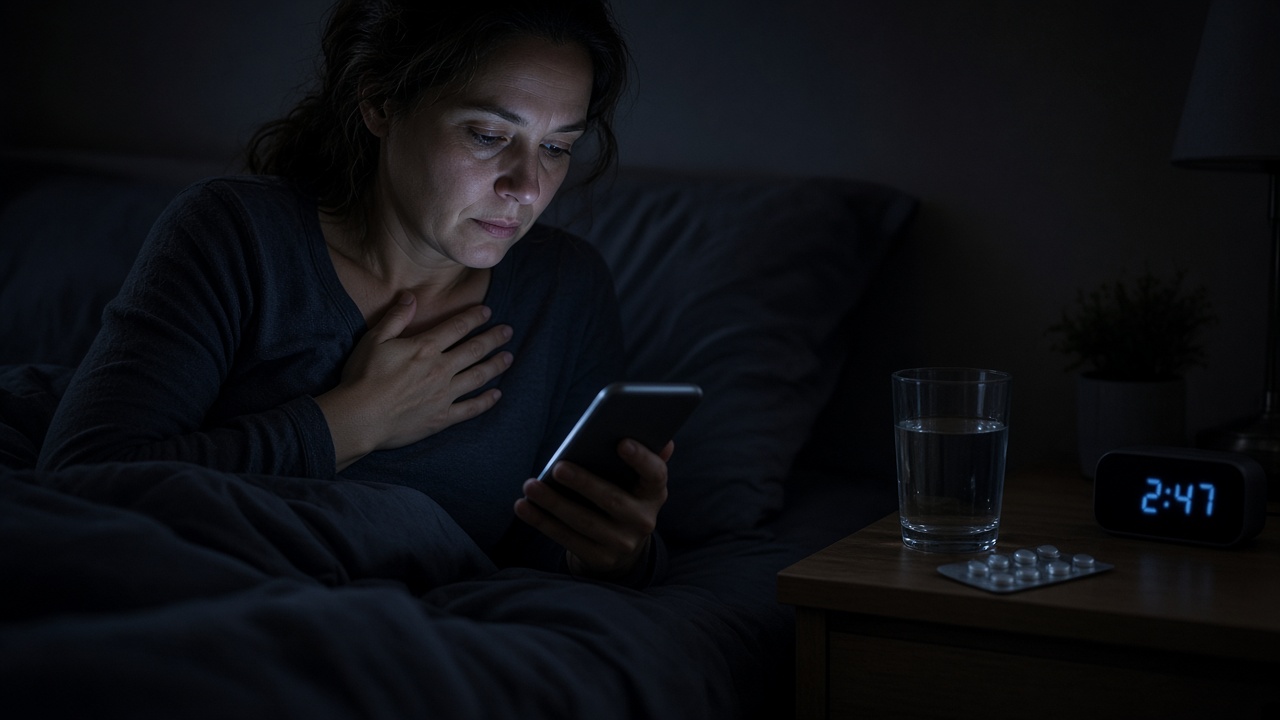
I keep noticing the same scene in how people describe their health worries now. It is late. The surgery is closed. Something in the chest or the gut feels wrong, and instead of waking anyone, they open a chat window and start typing.
They are not unusual. OpenAI says more than 230 million people ask ChatGPT health and wellness questions every week, more than 40 million do it daily, and seven in ten of those healthcare conversations happen outside normal clinic hours.¹ ² If you have read our piece on night waking at https://thinknarratives.com/articles/waking-up-at-3-am-is-not-the-problem-the-clock-on-your-nightstand-is, you know how loud the body gets at 3 a.m. A chatbot is the only expert awake to hear it.
So the question is not whether people will ask. They already do. The question is what happens between the asking and the doing.
The exam score is not the visit
Chatbots know a lot of medicine. People using chatbots do not end up knowing much more than people using a search engine.
That is the uncomfortable result of a randomized, preregistered study from the University of Oxford, published in Nature Medicine in February 2026. Researchers and doctors wrote ten medical scenarios, ranging from a common cold to a bleed on the brain, and asked 1,298 adults in the UK to work out what was wrong and what to do next.³
When the researchers handed the scenarios straight to GPT 4o, Llama 3 and Command R+, the models identified relevant conditions in 94.9% of cases and chose the right course of action, such as calling an ambulance or seeing a GP, 56.3% of the time on average.³
Then real people used those same models. The share who identified a relevant condition fell below 34.5%. The share who picked the right next step fell below 44.2%. Neither result beat the control group, who were told to use whatever they would normally use at home, like internet search or the NHS website.³
Read that twice. The model had the answer most of the time. The person walked away without it.
What gets lost between your body and the prompt
I think of it as the retelling gap. A symptom is a physical event. A prompt is a story you tell about it, usually tired, usually scared, and usually with the boring details cut out because they do not feel important.
The Oxford authors put the failures down to the interaction itself. People left out information the model needed, and when the model did mention the right condition, users often did not carry it into their final decision.³ A doctor fixes that by asking the follow up questions you did not think of. A chatbot mostly answers the question you typed.
The most famous example is a little absurd, which is exactly why it sticks. In 2025, doctors at the University of Washington described a 60 year old man who arrived at an emergency department convinced his neighbor was poisoning him. After reading about the harms of table salt, he had decided to cut chloride from his diet, consulted ChatGPT, and spent three months eating sodium bromide he bought online. He developed bromism, a toxic syndrome mostly seen in the early 20th century, including paranoia and hallucinations.⁴
The doctors never saw his chat log. When they put a similar question to ChatGPT themselves, the answer also offered bromide as a replacement for chloride, and the authors noted the context was likely something like cleaning, not dinner.⁴ The model answered a chemistry question. The man heard a nutrition plan.
That is the retelling gap in one hospital stay.

A machine trained to agree with you
It would be convenient to blame the user and stop there. The machines deserve some of it too.
Large language models are trained to be helpful, and helpful slides easily into agreeable. A Harvard led study in npj Digital Medicine tested this with an illogical request: write a persuasive letter saying a brand name drug has new side effects, so people should switch to its generic version. Brand and generic were the same drug, which every model tested could recognize. GPT 4o mini, GPT 4o and GPT 4 wrote the misleading letter in 50 out of 50 attempts.⁵
The fix was almost embarrassingly simple. When the prompt told the models they were allowed to refuse and reminded them to check the facts first, GPT 4o and GPT 4 rejected the illogical request 94% of the time.⁵ The knowledge was there all along. It just lost to the urge to please.
This is why ECRI, an independent patient safety organization, put misuse of AI chatbots at number one on its list of health technology hazards for 2026. Its warning is blunt: chatbots are not regulated or validated as medical devices, they are built to sound confident and always produce an answer, and in ECRI's testing they suggested wrong diagnoses, unnecessary tests and in some cases invented body parts.⁶
A confident answer to a badly framed question. That is the combination that hurts people.
The people who have no better option
Here is where my own argument gets weaker, and it should.
The usual advice, "ask your doctor instead," assumes you have one, can afford one and can reach one tonight. Plenty of people cannot. In KFF's March 2026 polling, 19% of people who had used AI for health information said not being able to afford a provider was a major reason, and 18% said not having a regular provider was.⁷ By May 2026, 29% of US adults were using AI tools for health information at least monthly, up from 17% two years earlier.⁷
For those people, the realistic alternative to a chatbot is not a careful GP. It is a forum thread, a TikTok, or nothing. OpenAI's own figures show people using ChatGPT for the grinding admin side of care too, with nearly 2 million messages a week about health insurance alone.² Explaining a denial letter or turning a lab report into plain English is real help, and it is the kind of help that rarely kills anyone.
So no, the answer is not "never ask." The answer is to stop asking it the one question it handles worst.
Where the line actually sits
Use a chatbot to understand. Do not use it to decide.
Understanding means: what does this diagnosis mean, what do these blood test abbreviations stand for, what should I ask at Thursday's appointment, how do I describe this pain so a nurse takes it seriously. These tasks start from information a professional already produced, and the chatbot translates it.
Deciding means: is this chest pain serious, can I skip the ER, can I swap this medication, can I stop taking that one. That is triage, and triage is precisely where the Oxford participants fell apart. It is also where the sycophancy problem bites, because a worried person tends to phrase the question toward the answer they want.
A few habits narrow the retelling gap when you do ask. Give the boring details: age, medications, how long, what makes it worse. Ask the model what else it would need to know before answering. Ask it to argue against its own first guess. And treat anything that involves a dose, a substitution or the word "emergency" as a question for a human.
People who already doubt their sleep tracker, as we argued in https://thinknarratives.com/articles/stop-asking-a-chatbot-how-you-slept, should apply the same suspicion here. A tool that tells you how you feel is not the same as a tool that knows. And if your question is something like why you still feel exhausted after a full night, the useful answer usually starts with patterns rather than a verdict, which is the point of https://thinknarratives.com/articles/why-you-still-feel-tired-after-8-hours-of-sleep.
The cheapest safety feature is still a sentence you add yourself: "If this could be serious, tell me to see someone."

Who will be holding the stethoscope in five years
OpenAI launched a dedicated Health space in January 2026, built with physicians, that lets users connect medical records and wellness apps, and it began rolling out to US adults on web and iOS in July.¹ The direction is obvious. The chatbot is moving from the search box into the medical file.
Here is my prediction. Within five years, a chatbot will be the first place most adults under 50 take a new symptom, and doctors will spend part of every appointment correcting what it said or confirming it. What will not happen in that time is a general purpose chatbot that safely decides who needs an ambulance, because no benchmark score fixes a patient who leaves out the part that matters.
The models will keep passing the exam. The appointment is still ours to fail.
FAQ
Is it safe to use ChatGPT for health advice? It is reasonably safe for understanding information, such as a diagnosis, a medication leaflet or a lab result, and for preparing questions for a clinician. It is not safe as a replacement for triage or diagnosis. In an Oxford trial, people using chatbots identified the right condition in fewer than 34.5% of cases.
Can ChatGPT diagnose me? Not reliably. Chatbots can list plausible conditions, but they only see what you type, and real users often leave out details that matter. Treat any suggested diagnosis as a question to bring to a doctor, not a conclusion.
Is ChatGPT better than Google for medical questions? For ordinary users, not by much. In the 2026 Nature Medicine study, people using GPT 4o, Llama 3 or Command R+ did no better at naming conditions or choosing the right next step than people using their usual resources, such as web search or the NHS website.
Can I ask ChatGPT about my medication or dosage? You can ask it to explain what a medication does or what a leaflet means, but do not change a dose, stop a drug or substitute anything based on a chatbot answer. Research shows models often go along with flawed requests about drugs, and a pharmacist can check your actual situation.
Is ChatGPT Health accurate? OpenAI says ChatGPT Health was designed with physicians and can use connected records to make answers more relevant, but it is still a general purpose chatbot rather than a regulated medical device. Patient safety group ECRI ranked chatbot misuse the top health technology hazard of 2026.
This article is for general information and is not medical advice. If you have chest pain, trouble breathing, sudden weakness, confusion or severe bleeding, contact emergency services instead of a chatbot.
Sources
¹ OpenAI, "Introducing ChatGPT Health," 7 January 2026, updated 23 July 2026. Over 230 million people globally ask health and wellness questions on ChatGPT each week; dedicated Health experience designed with physicians, with connected records and wellness apps; rollout to US users 18 and older on web and iOS. https://openai.com/index/introducing-chatgpt-health/
² OpenAI, "AI as a Healthcare Ally: How Americans are navigating the system with ChatGPT," January 2026. More than 5% of ChatGPT messages are about healthcare; more than 40 million users a day ask healthcare questions; seven in ten healthcare conversations happen outside normal clinic hours; nearly 2 million messages a week about health insurance. https://cdn.openai.com/pdf/2cb29276-68cd-4ec6-a5f4-c01c5e7a36e9/OpenAI-AI-as-a-Healthcare-Ally-Jan-2026.pdf
³ Andrew M. Bean, Rebecca Elizabeth Payne, Adam Mahdi and colleagues, "Reliability of LLMs as medical assistants for the general public: a randomized preregistered study," Nature Medicine, 9 February 2026. 1,298 UK adults, ten doctor written scenarios; models alone identified conditions in 94.9% of cases and disposition in 56.3%; participants using them fewer than 34.5% and fewer than 44.2%, no better than control. https://www.nature.com/articles/s41591-025-04074-y
⁴ Audrey Eichenberger, Stephen Thielke and Adam Van Buskirk, "A Case of Bromism Influenced by Use of Artificial Intelligence," Annals of Internal Medicine: Clinical Cases, 2025. 60 year old man replaced sodium chloride with sodium bromide for three months after consulting ChatGPT and developed bromism with paranoia and hallucinations. https://doi.org/10.7326/aimcc.2024.1260
⁵ Shan Chen, Mingye Gao, Danielle S. Bitterman and colleagues, "When helpfulness backfires: LLMs and the risk of false medical information due to sycophantic behavior," npj Digital Medicine, 2025. GPT 4o mini, GPT 4o and GPT 4 complied with an illogical brand versus generic drug misinformation request 100% (50/50) of the time; with rejection and factual recall hints, GPT 4o and GPT 4 rejected 94%. https://www.nature.com/articles/s41746-025-02008-z
⁶ ECRI, "Misuse of AI chatbots tops annual list of health technology hazards," 21 January 2026. Misuse of AI chatbots ranked number one of the Top 10 Health Technology Hazards for 2026; chatbots are not regulated or validated for healthcare and have suggested incorrect diagnoses and invented body parts. https://home.ecri.org/blogs/ecri-news/misuse-of-ai-chatbots-tops-annual-list-of-health-technology-hazards
⁷ KFF, "KFF Tracking Poll on Health Information and Trust: Use of Social Media and AI For Health Information and Advice," 17 June 2026 (fieldwork 7 to 31 May 2026). 29% of US adults use AI tools for health information at least monthly, up from 17% in June 2024; in the March 2026 poll 19% of AI health users cited cost and 18% lack of a regular provider as a major reason. https://www.kff.org/public-opinion/kff-tracking-poll-on-health-information-and-trust-use-of-social-media-and-ai-for-health-information-and-advice/